


The Barblairian – Thanks for Asking! – by Liam Sweeny.
RRX: Cover art is cool. It shows listeners what the artist thinks the album is all about. Because music can be felt visually. If you had to give the public a visual image that you think they would see and just “get” your groove right away, what would it be?
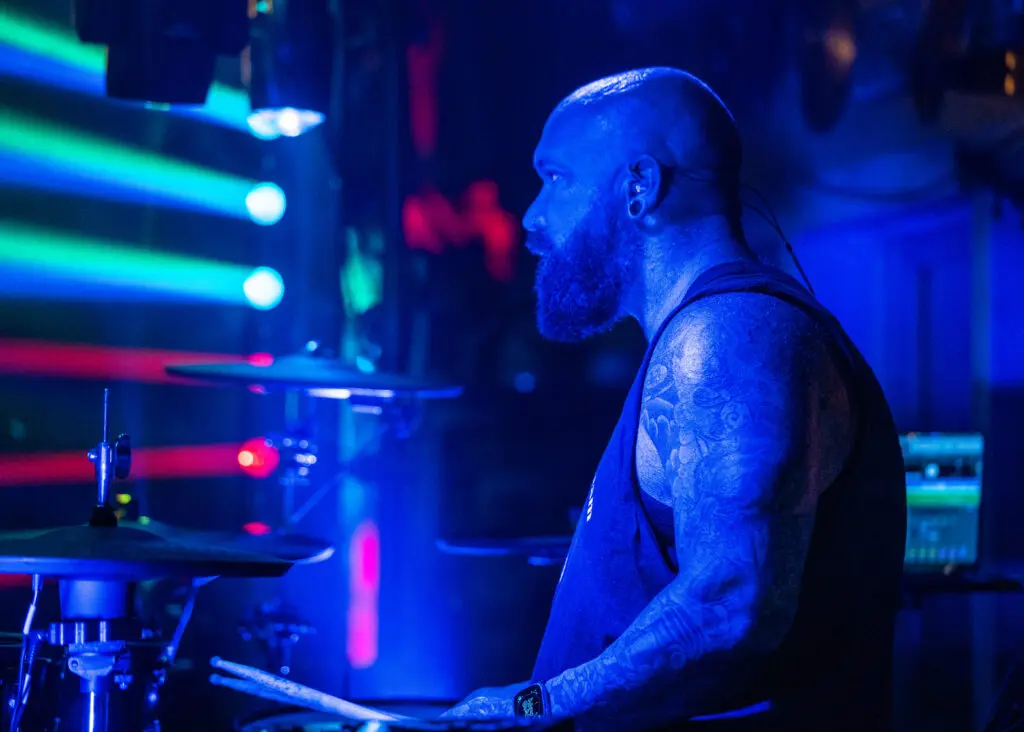
JB: If I had to give the public a single visual that would make them instantly get my groove, it would be a drummer standing at the center of a constantly shifting world.
Picture a dark stage where the lights, screens, and characters are all moving and changing around the kit Colors flipping, visuals glitching, stories unfolding, but the drums are the anchor. The music drives everything, and the environment reacts to it in real time. That image represents what I do: every show is different, every set has its own lights and storyline, and each performance becomes its own piece of art instead of a repeatable product.
That visual says it all. It tells you this isn’t just a concert, it’s a living, evolving experience where sound becomes motion, rhythm becomes imagery, and you don’t just hear the groove… you see it.
RRX: We have to play somewhere, and sometimes those places have more going for them than a stage and a power outlet. What is a memorable place you played, and bonus points if it’s not a well-known place.
JB: One of the most memorable places I’ve ever played was this open room right on a lake Not a well-known venue at all, just a space with a stage, a power outlet, and the elements completely in control.
It was about 95 degrees, no real airflow, and because of the heat only about 20 people showed up. I played four hours straight, which is hard enough under normal conditions, but that night I literally had a CamelBak water tube mounted on my drums filled with Liquid I.V. just to make it through the set.
Then, out of nowhere, thousands of mayflies swarmed the room. They were everywhere, on my drums, in my face — I almost choked at one point. It was chaotic in the most unexpected way, and absolutely unforgettable.
But what made it truly special was the small crowd. Because there were so few people, I was able to take the mic off of my head, step down, and actually have real, close conversations with people while I played. It stopped feeling like a performance and started feeling like a shared experience. I genuinely connected with everyone in that room.
It wasn’t glamorous. It wasn’t famous. But it was raw, human, and memorable and that’s the kind of show that sticks with you.
RRX: Part of learning to be a musician is to fall in love with a song, an album, and hammer away at your instrument until you can play that whole thing. What was that song for you? Was there a hardest part?
JB: Travis Barker has been a huge influence on me. Growing up, there were so many songs at different stages of my playing where I remember thinking, how is a drummer even doing that? Those moments pushed me to lock myself in and hammer away until it finally clicked. That process shaped the way I play today.
More recently, one song that really stands out is “Anthem Part 3” by Blink-182. I had a ton of requests for it during an emo night show. On paper, it is not an incredibly complicated song, but once you actually sit down and try to play it the right way, it is a serious workout. The stamina, the consistency, and getting every part to feel right took real effort.
It took me about a month to get that song down note for note. The hardest part was locking in the energy and endurance without letting anything rush or fall apart. Once it finally clicked, it stopped feeling like a challenge and just became part of my show. Those are my favorite moments as a musician, when something that once felt impossible turns into muscle memory and pure expression.
RRX: Stereotypes are a bitch. I mean, aside from the really bad ones, you have cultural stereotypes about everything, including music. Would do you think is the stereotype for the music you play, and how far are you away from it?
JB: There is definitely a stereotype around backing tracks, especially in cover bands, and my entire show is built on backing tracks because I am a solo drummer. I get why that can raise eyebrows at first. Once people actually see the show and realize how much is happening beyond just hitting play, that stereotype disappears pretty quickly.
The biggest stereotype I run into from other musicians is around my use of AI. When people hear AI mentioned in the same sentence as my show, they assume the music itself is being created or altered by it. That is not the case at all. The music is still human, physical, and performed live. AI is strictly a production tool for me.
I use AI to create visuals, bring my characters to life on screen, and handle narration in a way that feels cinematic and real. It also allows me to design and program an entire light show before I ever step on stage, without needing to hire a lighting engineer. As a solo artist, that is huge. It lets me deliver a full-scale production that would normally require a team.
So if the stereotype is that backing tracks or AI make a show less authentic, I am pretty far from that. In my case, they are what allow me to do more as a single performer, not less.
RRX: Our style comes from the extension of our influences. It’s like an evolution. We’re influenced, and it inspires us to influence. What can you say about your influences, and what you feel you’ve done with their influence as a musician or band? Have you extended their work?
JB: My style is very much the result of studying drummers who pushed the role of drums beyond just keeping time. Travis Barker was one of the first influences that showed me how a drummer could be the frontman, how energy, feel, and attitude could carry an entire show. Watching him made me realize that drums could drive a crowd the same way a vocalist or guitarist does.
As I got deeper into playing, drummers like Luke Holland showed me what discipline and precision at a high level looks like. His control, consistency, and ability to make technically demanding parts feel musical raised my bar for what live performance should sound and feel like. More recently, II from Sleep Token influenced the way I think about space, atmosphere, and emotional weight. His playing proves that restraint and intention can be just as powerful as speed or complexity.
Where I feel I have extended those influences is in how I present the drums as part of a larger experience. I am not trying to outplay anyone or recreate what they already do. I took the idea of the drummer as a focal point, combined it with precision and atmosphere, and then built an entire visual and narrative world around it. The drums remain fully human and fully live, but the show around them becomes cinematic, almost like a moving piece of art.
I see my work as an evolution of those influences rather than an imitation. They taught me what was possible behind the kit. I took that foundation and expanded it into something that blends performance, storytelling, and production in a way that feels uniquely mine.
RRX: What would you like fans to know before they come to see you play? (No basic stuff; get specific.)
JB: Before you come see me play, I want you to know you’re not walking into a standard “band night” or a drummer doing a few covers behind a kit. You’re walking into a living episode of the Barblairian universe, and you’re part of it the second the lights go down.
The Barblairian is a character, but he’s also a mission. He’s the version of me that decided the world doesn’t get to win with dullness. He’s a reminder that people still deserve to feel something loud, real, and electric. In a world where everything is heavy, where everyone’s carrying stress, bills, bad news, and burnout, the Barblairian exists for one reason: to light up the room and leave it brighter than it was when you walked in.
That’s why I do what I do.
Every show is designed like a piece of art. Not in a “look at me” way, but in a “you’re about to experience something” way. The music is the backbone, the drums are the engine, and the visuals and lighting are the language that turns it into a story. The set list is multi-genre on purpose. I want the night to feel like a ride, not a playlist. You might go from rock to hip-hop to an emo anthem to something that makes you laugh and go, “Wait, what is happening right now?” That surprise is intentional. It keeps you present. It keeps you alive.
And here’s the important part: I’m a solo drummer. That means I’m doing the job of the band, the hype, and the production team all at once. So yes, there are backing tracks. But the point of the show is not to pretend there’s a band behind a curtain. The point is to take one human being and build a full-scale experience around them. It’s athletic. It’s performance. It’s stamina. It’s timing. It’s control. And because it’s live, anything can happen. I’m not hiding behind anything. I’m driving the whole thing with my hands and feet.
Now the storyline.
The Barblairian world is populated with characters that aren’t just “cool visuals.” They’re part of the atmosphere. They’re part of the message. They represent the voices we all have in our heads, the chaos of modern life, and the weirdness of trying to stay inspired in a world that wants you numb.
Channel Zero is the glitchy narrator of the universe. He’s the one hijacking the screen, changing channels, flipping moods, and telling the story like a late-night broadcast from the end of the world. He’s comedy, he’s chaos, he’s commentary. Sometimes he’s the voice in your head. Sometimes he’s the voice trying to keep you moving.
Lux Cortex is the brainpower. The calculated, high-tech pressure. He’s intensity. He’s focus. He’s that part of you that wants to build something bigger than you are, but also wants control over everything. When Lux shows up, the vibe changes. It gets sharper. More cinematic. More “this is bigger than a bar show.”
Cloud Chaser is the escape. The part of you that wants to lift off for a minute. To float above the stress. To breathe. When that energy hits, the show opens up. It becomes lighter, expansive, sometimes even emotional, like you’re looking out over the lake at midnight and you remember you’re still a human being.
The Grizzly is the raw power. The protector. The unfiltered energy. When the Grizzly shows up, it’s primal. It’s big. It’s “turn it up” and don’t overthink it. He’s the reminder that sometimes you don’t need an explanation, you just need to feel the floor shake and let it out.
And the Barblairian sits at the center of all of it. He’s the conductor. He’s the fighter. He’s the one who takes all those voices, all that chaos, all that pressure, and turns it into motion and sound. He doesn’t run from the world, he flips it into something that fuels the crowd.
So what do I want you to know before you come?
Come ready to participate, not just watch.
If you come to judge it like a typical band setup, you’ll miss the point in the first five minutes. But if you come open-minded, you’re going to realize it’s not about what instruments are on stage. It’s about what the room feels like. It’s about the moment when a song hits, the lights snap, the screen speaks, and you look around and see strangers smiling like they’ve known each other for years.
Come ready for it to be loud and physical. This isn’t background music while you sip a drink and scroll your phone. You’re going to feel the kick drum. You’re going to feel the build-ups. You’re going to feel the drops. It’s meant to wake people up.
Come ready for the show to be different than the last time you saw me. The visuals shift. The lighting changes. The characters evolve. The story grows. Sometimes I’ll test something new. Sometimes I’ll bring a moment back because it hit so hard it deserves another chapter. Either way, you’re not getting a carbon copy. You’re getting that night’s version of the art.
And if you’re the kind of person who’s been through it lately, if you’ve been tired, stressed, stuck, or just bored with the routine, this is for you. I built this whole thing as a reminder that fun still matters. Energy still matters. Community still matters. It’s not just drums. It’s a signal flare.
So when you show up, don’t just come to see me play. Come to get pulled into the story. Come to leave feeling lighter. Come to be part of a room that’s brighter for a couple hours than the outside world.
That’s the Barblairian. That’s the mission.
And if you’re there, you’re in it with me.
Photo by Snap Shot Photography.