


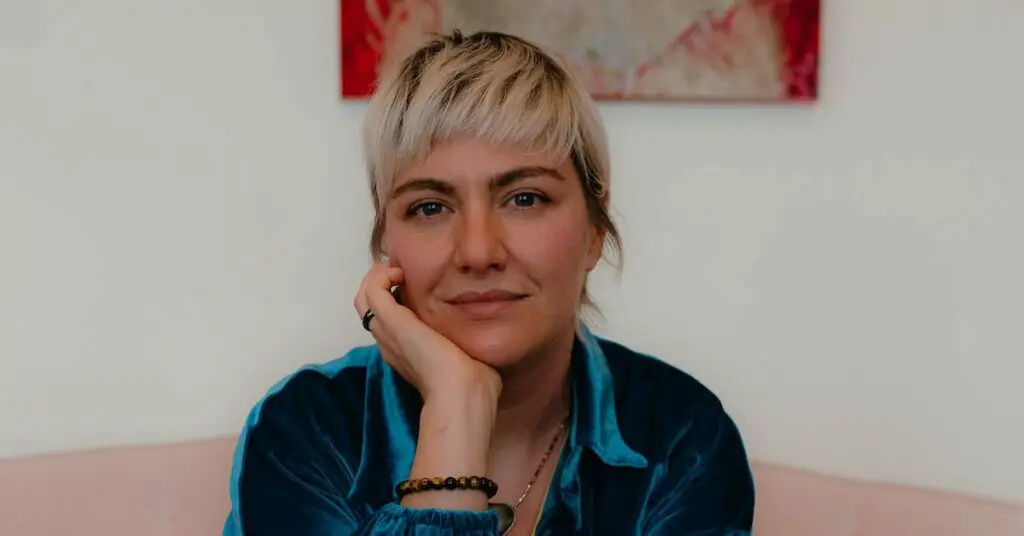
The depletion of cohesion beneath collapse’s looming mass leaves an absence of faith, where ruptive passion takes shape. Immersed in the saturation of unceasing sighs, divinity dangles hope where fleeing life can’t arise, until the relentless will to survive unearths the craft of what it means to be alive.
This verity unveiled itself through the soft-lit lumen of local painter Julie Brown, whose zeal drew my fascination into her hushed interior vastness. Having shared the turbulence of her twenties with me prior to our encounter, I knew I’d be welcomed into an unruffled refuge where abstraction could be explored to the liminal edge.
An embodiment of implosive magnetism highlights the material intelligence of a remarkable sequence of works that breathe beyond anatomy. The structural traces unravel a luminous compression accumulated through a seriousness void of pretension. Evoking responses that are experiential rather than explanatory, the tone remains controlled without muddying interpretation.
Her hunger for clarity, worn through disembodiment, depicts a metaphysical narrative encased in the airiness of dream logic. Imagine a rapture without climax, stretching sensation fine enough to linger. Unfastened, you’re plunged into absorption as breath slows, memories awaken, harmony thickens, and time blanks on advancement.
A ripple that doesn’t grant exhilaration, but permission into a sub-atomic dimension where hues press closer, and the body thrums like guitar strings stroked by the fingers of ancestors. It carries a faint ache braided through wisdom real enough to touch. Though present and slightly untethered, you wade through a state that can’t be held, only tasted. Nearing culmination, you’re comfortably exposed, bare to the marrow of the bone. Calm and glistening, you’re cradled by an unsullied world that only gives and never takes.
Her work gets you high on a drug you can’t buy, but can only experience through an unflinching dive into the jungle of life that turns the weak into monsters and the strong into sovereigns, not to rule over others, but to master oneself in a way that euthanizes the ego.
I suppose this all makes sense, given her venture into holistic health modalities such as acupuncture, sensory deprivation, salt caves, meditation, and sound healing back in 2019, which shifted the game for her from that of arena football to the national league. This, combined with picking back up the paintbrush, granted Julie a second coming, eventually landing her in tuning fork sound therapy in 2021, where she fused with her inner compass and, at last, found her life’s vocation that had been obscured by familiarity for so damn long.
Now a certified sound healer, she’s able to see her inner world in terms of frequency and vibration, transferring that ethereal surfacing through your chest, jaw, and stomach, resulting in a lightly disorienting containment rather than stimulation. It’s the kind of wavy sh** that a nonreceptive person would equate to hocus pocus or voodoo, but I’m here to double down on the truth. She is the real f***ing deal. No games, no gimmicks. My brain left her naturally lit somatic sphere, serenaded by divine tranquility. And I’m saying this after a gracious sample tuning.
Julie is a being who thoroughly understands the power of art to transform and connect us all into a unified consciousness. An integral part of a shared collective of creatives within the Troy, NY area, she strides forth in the waking reality of imagining a new world.
Sitting down to speak with her, the oneiric trance became anchored in a discussion that unleashed the raw humanity of a pillar within the art community.

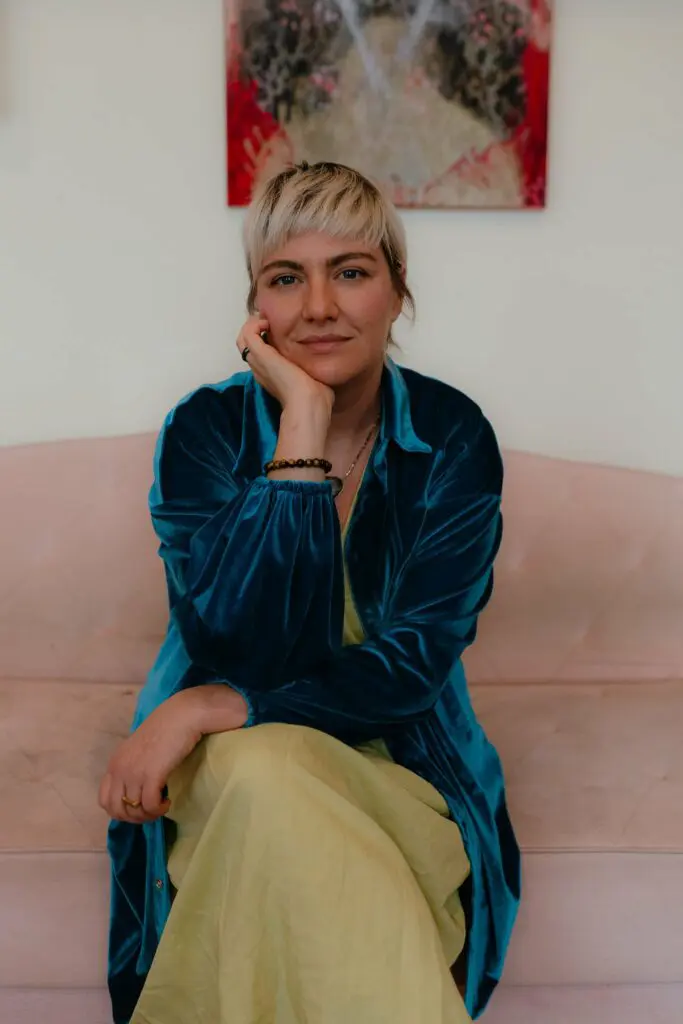
Julie Brown
RRX: When you look at your body of work as a whole, what part of yourself do you recognize that existed before diagnosis, language, or explanation?
Julie Brown: This sense of open playfulness. This open heart that always wanted to give everyone everything. That was always there. I feel like that energy is in my work. It’s like an opening, like a portal. The intention behind every piece, without me even thinking about it, is how can I imbue this work with as much positive energy as possible so that anyone looking at it feels something. It’s giving, but giving from a place of abundance, not lack. I understand that I’m abundant. I don’t feel a sense of scarcity. That energy exchange feels sacred to me. Anyone experiencing my work feels like a gift to me, regardless of how they label it.
RRX: During the years when anxiety and panic dominated your inner life, how did your body communicate truths that your mind couldn’t yet hear?
JB: I believe every form of sickness is your body trying to tell you something. I used to see myself as a victim, like why are these things happening to me? Why do I have anxiety? Why do I have depression? I used to say “I am depressed” as if it was my identity. Now I honor those signals. When my body stops me, whether it’s anxiety or depression, I see it as information telling me something needs to shift. For me, frustration usually lives in my stomach. That’s how I know something isn’t flowing. When things are aligned, I feel satisfied. I ground myself, do acupressure, come back to truth with a capital T.
RRX: In these paintings, the forms feel gathered inward rather than released outward. What inner force is responsible for that gathering?
JB: Compassion. I don’t think you can have anything without compassion for yourself. A lot of this work came from real self-love, not performative self-love, but truly accepting myself for who I am and loving myself unconditionally. That’s been the only way forward.
RRX: When you returned to painting after years away, what aspect of yourself did the act of making restore that nothing else could?
JB: Hope. Excitement about life. Purpose. When I wasn’t painting, I was in the darkest place of my life. I didn’t believe happiness was possible. I remember saying to my therapist that I couldn’t even imagine being happy for a minute, let alone a day. When I returned to painting in 2020 and made dozens and dozens of works, something shifted. Suddenly, happiness existed in my body again. Contentment existed. I had to build tolerance for joy because it felt unfamiliar. Painting gave me permission to believe in what was possible again.
RRX: Many of these surfaces feel layered with residue rather than gesture. What are these layers holding that couldn’t be released all at once?
JB: I call it the veil. It’s like peeling an onion. You don’t know how many layers there are when you start. We all have blind spots, things we don’t see clearly because we’re inside them. Once I felt empowered enough to stand on my own two feet, I wanted to peel those layers back. Trauma lives there. Ego lives there. Childhood conditioning lives there. Healing isn’t comfortable. It doesn’t end. You reprioritize everything when you strip things away. You can’t hide or distract yourself anymore. You have to be with it. That’s the work.
RRX: Light appears here as pressure rather than illumination. What does that kind of light reveal to you about healing?
JB: Light is infinitely more powerful than darkness. Darkness exists, but calling in light eradicates it completely. I work with 100% pure light. I call in guides, source energy. I don’t see myself as the creator of the work. I’m a conduit. A channel. That’s where the ego separates. I allow the light to move through me. We forget who we are as humans. We forget that we’re light beings, connected to everything. Healing is remembering. We forget, then we remember. That’s the test of being human.
RRX: When working with sound, frequency, or paint, how do you recognize the moment when an emotional release becomes a shift in consciousness?
JB: I feel it in my body. Tingling, waves, chills. I often feel the same emotion that’s releasing from the other person because we’re sharing the same frequency. After sound sessions, it’s always a 180. People come in anxious or closed off and leave lighter. The frequencies integrate over days. With painting, it’s similar. When you’re creating, you’re present. Something reorders itself internally. The process itself does the work. It’s not about the final product or whether it sells. It’s about what happens while you’re there.
RRX: The repeated patterns in your work feel more like memory than ornament. What role does repetition play in your spiritual integration?
JB: Repetition is everything. Meditation is repetition. Journaling is repetition. Returning to the work again and again is how we integrate. These paintings are living meditative spaces. Repetition is how we reprogram ourselves. It’s how we come home to ourselves.
RRX: As your practice has moved toward collective healing, how has your understanding of individuality changed?
JB: You lose individuality in the best way. You realize you’re connected to everyone. Collective healing amplifies everything. We need each other. We’re hardwired for connection. Purpose comes from service. When you step into that, individuality becomes something porous, something shared.
RRX: If these paintings were encountered long after your story was forgotten, what essence of your inner world do you believe would still be felt?
JB: Love. Wonder. Interconnectedness. Energy. Those things live in the work beyond me.
With nothing left to extract, no thesis to underline nor doctrine to convert, Julie Brown’s work doesn’t exist to be understood so much as it demands to be taken in, momentarily and sincerely, barefaced.
It resists flair and certitude, offering instead an expanse where focus unclenches, breath settles, and the ego dissipates. You don’t leave altered in a way that demands explanation, but in a way the body carries forward.
What she leaves topples both inspiration and conclusion, replacing them with a heightened awareness that arrives unannounced. Rooted in the creative ecosystem of Troy, her practice unfolds in humble conversation with others equally invested in imagining what comes next. Nothing boisterous, but more profound. Within that shared labor, art shifts from self-revelation to connected sustenance, paving the way for something enduring to take shape.