


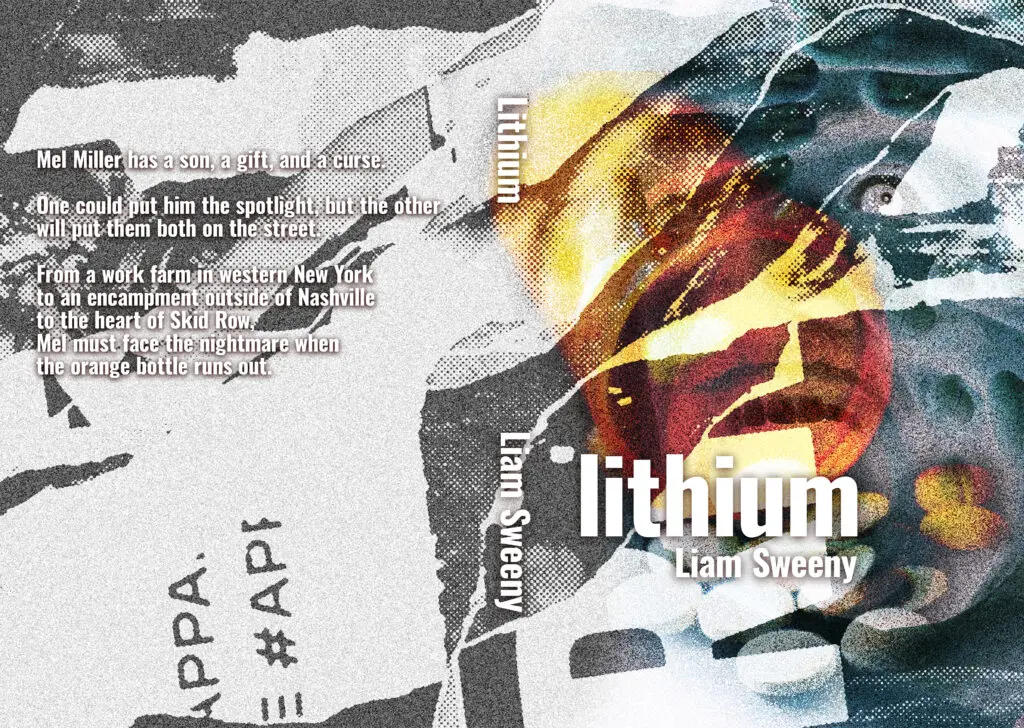
Lithium, Chptr 24 – Xperience Fiction – by Liam Sweeny.
Mel rubbed his wrists the next morning beyond their actual pain. Something about being restrained, the panic of not being able to move and the vulnerability of being exposed to any manner of harm, not to mention the inability to take his mind off it while he was in the four points, made him humble and guarded.
Everyone who walked by him averted their gaze. He got it. One thing people fear about going into a psych ward is being thrown in the mix of a psychotic outburst, and it was he that now validated that fear in so many eyes. He did feel shame, as much as he could.
His mind was fogging on him. He had decided, after Amanda had gone, that he was in four-point restraints because he was the sacrifice of a dying God, and when he was released, he took over as God. He made it a point not to tell anyone, content merely to walk amongst his creations. In his gut he felt a desperation, a knowing that he wouldn’t be God for much longer, and he would run out of cosmic beings to inhabit before he would have to go out to the desert to burn. He was tired and hungry, and the pancakes he requested were tasteless even with the packet of imitation maple syrup.
Critter, Ramon and Magda walked over and set their breakfast trays down.
“How was the bondage sesh?” Critter said.
“It was okay,” Mel said. “You don’t get the ball gag unless you want the shocks.” Mel surprised himself by being able to make a joke. Maybe God has a sense of humor.
“What happened?” Magda said. “You went at those paintings like I don’t know what.”
“My son was taken by D- something. I gotta’ find out and write that down.”
“DFCS,” Critter said. ‘Da Fuckin’ Child Stealers’ if that helps.”
“It might,” Mel said.
Ramon took some powdered eggs in his spoon. “They took my kids too,” Ramon said. “I mean I got it, but they don’t take kids when other people are sick. And if they do, they give ‘em back. It’s tough, man. I feel for you.”
“You’re lucky you’re not a woman,” Magda said. “They got a creepy orderly here. He jokes about dating women in here, like we’re a captive audience. I couldn’t imagine having that guy watch me tied up and shit.”
“Speaking of shit, did you have to?” Critter set his fork down. “Or piss? How does that work?”
“We’re trying to eat, Crit, man, c’mon,” Ramon said.
“Didn’t have to,” Mel said. “Shit. I was lucky.”
Mel attended two groups after breakfast. One was about cognitive distortions. It was part of something called Cognitive Behavioral Therapy, something that wasn’t big the last time Mel was in the wards but had gained popularity since. He heard more about it from Sarah, who swore by it, and Orrin, who saw it as High Society’s way of convincing the little guy to change their state of mind rather than change what’s wrong with the world. Mel just found it to be something to occupy his mind until he had his next appointment, a twelve-thirty with a social worker.
They met in one of the group rooms that wasn’t being used at the time. It was common practice, since there was a shortage of offices, and the doctor’s office was occupied twenty-four seven.
Maggie Carlyle was a round woman, pear shaped, with hairdo Mel would place in the beehive family. She had jewelry, pearls, and pendants. He imagined the pearls were fake; after all, who would bring valuables somewhere they could so easily get destroyed?
“So, Mr. Miller, if we’re going to get you any help, we’re going to have to fill out some paperwork. So I’m going to need to ask you some questions. I need you to pay attention; are you able to do that?”
Mel nodded. “I can,” he said. “But I need a favor.”
“One favor at a time,” she said. “I’m doing you a favor filling this out.”
“I just need to get out of here,” Mel said. “I don’t need all kinds of paperwork.”
“Mr. Miller, if you leave here without us creating a case for you, you’ll be guaranteed to go right back out on the street. I’m trying to help you.”
“Okay,” Mel said. “Let’s do it.”
Maggie asked him his vitals, social security number. birthdate, race, gender he identified as – and he answered them in the trance that prisoners of war get when they give their name, rank, and serial number.
“Are you a smoker?” She asked.
Mel shook his head. “No,” he said.
“Do you drink?” Mel didn’t know whether to be completely honest about the question, not knowing who was going to get it.
“On rare occasion?” He said.
“How often?” She asked, bringing her pen to a halt.
“I don’t know, about a drink a month? Not spaced out like that, but about that much?”
“Okay, in the past year, how much have you had in one sitting?”
“Is there a reason you’re so laser-focused on my drinking?” Mel asked.
Maggie took a breath. “Can you please answer the question?”
“Most I can remember drinking at once was three beers,” Mel said. “I am… was on meds. It would’ve hurt me to drink more.”
Maggie jotted his words down, at least the part she needed.
“Okay, drug use?”
“I used to smoke pot a long time ago,” Mel said.
The pen stopped. “How long ago?” She asked. Mel was getting a little crispy from the grilling.
“I don’t know, maybe thirteen years?”
“You don’t know exactly?” Maggie said.
Mel thought about it, referencing elections to peg dates.
“Fourteen years,” he said.
“If you’re using now, I should tell you that we do urinalysis in order to sign you up for help.”
“Why do you mistrust me?” Mel said. “You just met me, and you’ve got me pegged as an alcoholic drug addict.”
“I’m just trying to help you, Mr. Miller.”
“Why would you help someone you don’t trust?”
“It’s my job.”
“They say if you get a job doing what you love, you never work a day,” Mel said. “I’d say you seem very overworked.”
***
It started in group. Mel had, over the past few days, discovered that most things started in group. They started out boring until they became raw, and wounds opened, and words led to shouts and, if lucky, that was all it end up being. As far as Mel was aware, his outburst was still the only bit of violence to happen on the ward since he’d been there. And Mel really didn’t want to be a part of any additional strife while he had to be there. He had ascended to God, hopped down to Satan, and was burning in the desert. Soon he knew he would become just a man again.
The group leader, a soft-spoken man in a powder blue polo shirt named Tom, passed around a box of colored pencils for art therapy. Mel was ecstatic at the chance to ply his trade. Colored pencils were just brushes with harder tips.
Mel didn’t listen to the instructions. He didn’t have to. It was art, it was subjective, and no matter what the assignment, unless it was ‘draw an apple,’ he could squeeze an interpretation to fit it.
Mel drew a house. Not the kind of house you would list with a realtor and advertise the number of bedrooms and bathrooms and give open houses. It was essence of house, which brought it to the essence of home. He angled the pencils to shade without cross-strokes and blended adjacent colors on the color wheel he had memorized. He blanked out the background noise and drew with wild imagining and yearning. He almost didn’t hear Tom ask everyone put down their pencils. But he caught it and sketched as much as he could before Tom mentioned him by name.
“Okay, everybody, hold up your artwork,” Tom said. Most everybody did.
“I don’t want to,” Magda said. “It sucks. I’m embarrassed.”
“The point of this exercise it to not be afraid to show people who you are. Your artwork is an extension of who you are. You don’t have to, Magda, but you’ll find you’re no better or worse than anyone else here.”
“Yo, nobody’s as good as Mel,” Critter said. “Look at that shit.”
Everyone checked out Mel’s drawing and whispered among themselves. Mel glanced at everyone else’s work and realized that the instructions might have just been ‘draw an apple.’ There were a couple of good ones, some half as good, and some that could’ve been done in preschool.
“Okay,” Ted said. “Mel, a little off topic, but phenomenal. Now, if your drawing doesn’t look like Mel’s don’t worry.” He looked at Mel. “You must be an artist, right?”
“You could say that,” Mel said. He could say more than that.
“Good job, Mel.” Mel felt like a five-year-old who scored a spot on the refrigerator and a pat on the head.
He walked out of group when it was over and went to the day room. The nurses were busy with shift change, and unfortunately, Amanda was going off shift. Favors were better granted when she was on.
He tried to watch television, but he couldn’t get into soap operas. It was the white noise of television, beaten only by static. Static, then soap operas.
“Rembrandt,” Critter said as he walked over. “Where did you learn to draw?”
“Been drawing since I was a kid,” Mel said. “Painting more than drawing.”
“They might have paints somewhere.” Critter slapped a deck of playing cards down. “You should check that out. Maybe you can replace the paintings you ripped up.”
“Those weren’t paintings. Those were prints.”
“Painting, prints; what’s the difference?”
“The difference between me ripping up fifty bucks and me ripping up fifty million.”
“Oh, like, the originals.”
“Yup,” Mel said.
“So if you painted some stuff to replace those other ones, they’d actually be more valuable.”
“Technically.” Mel said. “If my name meant anything. It doesn’t.”
“It should,” Critter said.
“I’m gonna ask the nurses if they can get some paints and a canvas so I can do actual work here. I’m hoping they can do it.”
“If they have them here, yeah,” Critter said. “If they have to get them, probably not. But try. Show them that. Tell them you want to make good on what you did with the other… prints, right?” Mel nodded.
Mel waited until after the first rounds of the new staff before going up and making his pitch. He had his drawing, and if he had to lay it all on the line, he would. Painting would give him redemption.
Laura was the head nurse. She was polite but no nonsense. She wasn’t happy with him after his outburst, but no nurse was, not even Amanda. It had been a couple of days with no incident. Now or never.
“Hi Laura,” Mel said.
“Hi, Mel, what do you need?”
Me unfolded the drawing and handed it to her. Lead with strength.
“Wow, that’s really nice,” she said. “Did you do this?”
“I did. In group. Took me about an hour.” Laura slid him the paper.
“Well, that’s really good, Mel. You’re talented,” she said.
“Can I ask a favor?”
“Sure,” she said. “Can’t promise anything, though.”
“I want to make good on what I did, ripping up the paintings. If I can get some paints and a canvas, I can paint you all something that will more than make up for it.”
“Mel, I don’t know if we have any,” she said. “I don’t think we do. And I know we don’t have canvases. It’s not something in the program, so that stuff would have to come out of somebody’s pocket.”
Mel’s heart dropped at the fact that the first clear idea that had hit his head in weeks was going down in the wastebasket.
“It could be a part of my program,” Mel said. “It’s the only thing I have going for me, and if the hospital can get me a canvas and a small thing of paints, I could get back on track. I mean, they would give a man crutches if he was having trouble walking. I’m having trouble getting my thoughts together. Painting would help.”
“I’m sorry, Mel, we can’t.”
“I have one of my paintings in the Getty Center. It was in the Guggenheim; just look for Roy Miller. You can find out. My paintings pay for more than themselves.”
“We really can’t,” Laura said. “I wish we could.”
Mel wanted to argue, but he glanced down the hall at the bare section of wall, at the fact that maybe one or two people may have drawn comfort from a print he trashed, and now they didn’t have it anymore. He walked back to his room, collapsed on his bed and held the blanket to his face to absorb the coming tears.
***
Sleep was Mel’s refuge. It was the comfort and the solace that washed over him like a gentle, soaking rain. He slept after he wept and wept after he slept. He wasn’t depressed; he knew that because he could feel the pain of his situation to his core, and his depressions robbed him of feeling. And his thoughts raced still while his depressed thought stalled. But his racing thoughts attacked him until he could scarcely bear it and he cowered in narcoleptic bliss.
He dreamt of Andy almost exclusively. He dreamt of a grand adventure, free of worry, absent the struggle to survive and the uncertainty of desolation. They drove to lakes and beaches, climbed mountains and hiked forests. They stopped in little shops on colorful streets in lands that didn’t speak their language, and they laughed and made up words to say that sounded right.
In between the flights of fancy, Hope fell down a well and he couldn’t catch her. She drove away from him and though he raced, he couldn’t catch her. She dropped Andy from a cliff and it drug Mel over by gravity. But in one dream that repeated over the past few days was of he and Hope by the pond, naked, in each other’s arms, and she reaches into her chest and pulls out a radiant glow.
The staff woke him up for meals and meds, and he didn’t say much to Critter, Ramon and Magda when they shared a table. They said that they understood that it was the med-hole, and everybody went through it. New meds kicking him in the dirt and so on, and so on.
By the weekend, he was picking up energy. He wasn’t God, or Satan, and he had stopped crying and burying himself in criticism and self-deprecation. He was able to talk, really talk, and for once, he could see a light coming.
“You’re looking better,” Amanda told him. “You even took a shower this morning. I’m impressed.”
“Thanks, it felt good. Refreshing.”
“You have a meeting with your social worker today,” she said. “Why I came in. Listen, I know you didn’t really gel with Maggie the last time she came. That’s right?”
“Yeah,” Mel said. “She just harped on my bare amount of drinking and the pot I haven’t done in fifteen years.”
“I know, and I know how frustrating that can be, but she sees people that are full-on addicts that tell her they haven’t touched a needle in their lives.”
“But that really isn’t me,” Mel said.
“I know. I mean, I believe you. But there really is help out there, and Maggie has to make sure that, of the people in here, the ones who the help can actually do something for are the ones who get it.”
“I don’t know if she’ll be open to giving me help,” Mel said. “I don’t see how I deserve it.”
“When you go in, just be honest. Be yourself. Her second visit, she’ll give you a chance to tell your story. Tell it. Even if it hurts, tell her stuff like you told me when I was watching over you.”
Mel waited in the day room until Maggie walked in the entranceway and called out to him. He followed her into an empty group room with small talk.
“Ms. Carlyle,” Mel said when he sat down. “I just want to apologize for the way I was acting last time. It wasn’t right. I wish I could blame the illness, but I really can’t.”
Maggie set her pack of papers to the side. “Just so you know, I do love my work,” she said. “For every hundred people I encounter in places like this, maybe ten, maybe, take the help and make something of it. The other ninety are a revolving door. But I go home feeling good about that ten. And I will always want you to be in that ten.
“And it’s not a judgment, me asking you about the drinking and drugs,” she said. “If you told me you shot heroin ten minutes ago, I could still find a program for you. Probably a detox.”
“I was being honest about the drinking and drugs,” Mel said. “I get it, but just for your knowledge. I’m pretty clean.”
“It’s good to know,” Maggie said. “So you’re homeless. We don’t have an address for you, and you did tell me you were between places last time. I can assume you’re homeless, right?”
“I am.”
“How long have you been homeless?” Maggie asked.
“Not that long,” Mel said. “I got evicted a little over a month ago.”
“In Albany?”
“Thereabouts.” Mel said. “A city called Watervliet. North of Albany.” Maggie asked him to spell it and jotted it down.
“And you said you have a son, is that right?”
“Yeah, his name is Andy, and DFCS took him when I came in here. I haven’t talked to him, and if they send him back to his mother, he will definitely be abused. That’s why I had custody.”
“Okay, I’ll look into that for you. But be aware that since you’re here, and you’re homeless, they aren’t exactly just going to hand him to you. There’s a process.”
“I figured as much.” Mel couldn’t begin to gauge his chances with a process that grinds through bureaucracy.
“We can help you, but you have to help us help you,” Maggie said. “Now, when was the last time you worked?”
“About six, seven months ago. On the books,” he said, “Off the books, about a week ago. But he barely paid me, so I guess that doesn’t count.”
Mel had tucked the drawing he had done in his pocket before the meeting, and he pulled it out and unfolded it.
“I have a skill,” he said. “I’m an artist.” He showed her the drawing. “Mostly a painter. I have a photographic memory.” Mel told her about his painting in the Guggenheim. He also told her of his swan song in the Getty Center.
“I am really lost without that painting,” Mel said. “I don’t know if it’s even possible, but can you see if they still have it? They won’t let me call the Getty Center. I know you have a lot of stuff on your plate, but you’d never see someone smile wider. It could be a game-changer for me.”
“It’s an unusual request,” she said. “There is no way I could promise anything, and that’s assuming I have the time to do it,” she said. “But you got me curious.”