


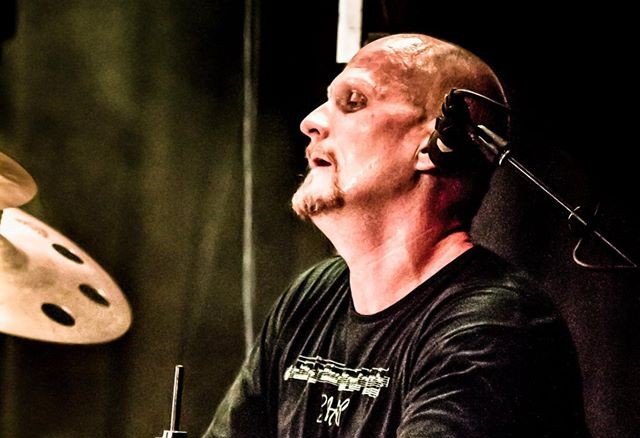
Bill Ketzer – An Xperience Interview – by OP Callaghan,
This month, we’re focusing on a veteran of the local music scene, Mr. Bill Ketzer! He’s a drummer, singer, guitar player, historian, and has the absolute best “You didn’t get the gig” story that I have ever heard. So let’s give it up for Bill Ketzer!
RRX: How did you get started as a drummer?
BK: My first real “WOW” moment came when my father bought me Kiss’ “Alive!” at the old Record Town in Colonie. I was in 3rd grade, and my mother was appalled. Peter Criss’ drum solo on “100,000 Years,” those flanged triplets, and his jazz-inspired feel for dynamics, those highs and lows, just hypnotized me. Years later, I interviewed Slayer’s Dave Lombardo for Metroland Magazine, and he said the exact same thing! From there, my other early favorites were Bill Ward, John Bonham, Andy Parker, Neal Smith, and metal guys like early Priest drummer Les Binks, Maiden’s Clive Burr, Saxon’s Nigel Glockler, and Accept’s Stefan Kaufmann.
I didn’t get an actual drum kit until I was 12 years old. A schoolmate from our neighborhood sold me his brother’s old Ludwig knock-offs for 10 bucks – while he was away at college! When he came home that summer, it must have been a bad scene because one day the phone rang and he was like, “Man, you gotta give me that kit back!” But by then I was like, “No way, a deal’s a deal!” I was hooked. In that era, you still had to learn songs in headphones with a quarter-inch jack, and keep dropping the needle on the record to the lick you were trying to learn!
RRX: Do you play any other instruments? Did you take lessons?
BK: I can get by on guitar and bass, but I’m really an imposter. Same thing with golf, ha! If you give me a specific set of tunes to learn, I’ll nail them down through repetition, but I can’t improvise at all. I don’t know scales or any theory. I “sang” in cover bands for a long time, too.
I’m basically self-taught. When I was at Colonie High in the ‘80s, I was too cool for lessons, which I regret to this day. I showed up once, maybe twice. The band guy was Gene Falcone, and the first thing he wanted was to teach me traditional grip, which was hard and weird, so I never went back. Huge mistake. 20 years later, when I was looking for regular work and needed to know basic Latin and Jazz concepts – as well as the ability to sight read – I had to pay a ton of money for someone to teach me all of that, when I could have gotten it for free, and built on that foundation with every gig. I mean, there are benefits to teaching yourself in terms of style, how you interact with a piece and other musicians, but in the end, I didn’t do myself any favors. Lots of missed opportunities there.
RRX: Do you come from a musical family?
BK: Not in the sense that they played instruments or were performers. Both of my parents liked music and encouraged me to play, so it was always in the house. My mom was just sort of the church choir sort, but had a great ear for harmony. One of her favorites was the Andrews Sisters, but she exposed me to Harry Belafonte, Johnny Horton, John Denver, and, of course, Al Hirt’s “Whipped Cream & Other Delights” (is there any garage sale where it can’t be found to this day?) My father died young, but I have very vivid memories of his big tenor voice and performances at the Masonic Temple in Latham. Mostly hymns. Stuff like “In the Garden,” or “How Great Thou Art.” He was the one who’d sing me to sleep, a tradition I carried on in my own family for a long time.
RRX: Tell me about your first kit.
BK: My first really gig-worthy drum set was a blue, 5-piece LaSalle, which was just one of the 100 Japanese budget brands made by Pearl. The shells were composite, but you could actually tune them! My mom bought them for my 14th birthday at the old Hermie’s Music in Schenectady. A few years later, I got a set of ludicrously oversized Tama Imperial Stars – massive oversized cannons. Like, far more obnoxious than anything Herman Rarebell ever owned. It was like a rack full of floor toms. Much later, I found out that when I traded them in at Drome Sound, Jay Bittner grabbed them for a brief second. Apparently, he had the same realization I did: they were completely unwieldy, untunable, and better off for storing corn silage. But they did the job.
I didn’t really have a steady job in that era, but I just couldn’t bear to play the Camber “kitchen grade” cymbals. I scraped together enough rubles to get a few Paiste 404 and 505 crashes. Best. Budget. Cymbals. Ever. Collectors actually seek them out now.
RRX: Tell me about your first gig.
BK: I think I was 14, in my first real band. Me and Joe Pallone were sort of the freshmen in the group, and we did a few backyard parties, graduations, and stuff like that. But I think my first legit gig in front of total strangers was a St. Clare’s Church bazaar in Colonie, and then a short time later, we did some sort of block party at the Colonie Village Fire Department. We set up on a huge flatbed trailer with wooden slats for flooring, and the kit bounced all over the damn place; the mics were smacking us in the teeth. But it felt like metal to me, Biff Byford spandex and all.
RRX: You’ve had quite a history! I’ve seen you play with at least four bands. For those who don’t know, talk about your playing history.
BK: Wow, hard to list them all, but the first gigging/recording band I joined was Vigilance in the late 1980s. I still see Jeff Nusbaum from that outfit here and there. It was the first band that really gave me chops, because we rehearsed for like four hours and had a million songs.
Then I hooked up with Duane Beer when he was forming Plaid, and we took off for a while. It was the dawn of alternative music, and punk was a resurgent part of that. Still a guy I look up to. So prolific, never boring, and one of the only people I know who never really has a bad word to say about anyone. All energy. It was incredible to play with him again in Blasé Debris – 25 years later!
I did Can’t Say for about five years behind the kit, which started out as a fill-in gig, but you know how that goes. They were a signed band, so they toured a lot. That gave me a real education in what works and what doesn’t, and how management, promoters, studio, A & R departments, and the industry generally functioned at the time.
In that era, we also had Thee Heinous Brothers, which boasted a combined total weight of like 1,800 lbs. Big Al was in the mix there, and we made a pretty hilarious LP called “Thugs and Kisses,” which Chrome Peeler Records still has available for free on their website. It was a full costume, full mayonnaise affair. It was a bad idea to get too close to the stage. If you leap on stage in NYC, with a crowd full of jaded Manhattanites, with overwhelming volume, dressed up like Cookie Monster, and the whole place takes five giant steps backward … that’s real power.
After that, I went back to school and got a four-year degree, started working full-time. That became the era of the weekend warrior cover bands, which made way more money than any of the bands I just mentioned combined! Second Hand Smoke, the Lab Rats, tons of fill-ins with wedding bands … I even got to do stints in North Again and Howe Glassman’s Coal Palace Kings, which also included Mike Eck at the time. It was awesome, but I couldn’t travel. I regret not sticking that gig out.
I played in Ten Year Vamp, an absolutely killer heavy pop band, for about three years. I did fill-ins when their full-time drummer (Greg Nash) was unavailable, but they kept me on as a utility guy. Keys, percussion, backing vocals, that sort of thing. I learned so much from them, including how to play to a live click track for the first time in my life. Best sideman gig ever. They treated me so well, and they were amazing songwriters. I wish they were still around!
Then it was Blasé Debris until I just couldn’t make it work anymore. Today, I do the SOCOL Coalition with a bunch of my old high school buds, mainly for fun and a positive way, I think, to remember all of the bandmates we’ve lost over the past decade.
RRX: What is your proudest moment behind the kit?
BK: I think it will always be playing for 17,000 people at the New York State Fair in Syracuse, at the old grandstand. I was lucky enough to do that with Ten Year Vamp in 2010, opening for Aerosmith. That was just a sort of a knock-off summer for them, no new album that year. We were lucky because they weren’t touring as part of a package. They were just booking headline dates at festivals and big outdoor venues (like state fairs) across the country. I think they called it the Cocked, Locked and Ready to Rock Tour, ha! That type of arrangement can allow venues to showcase local acts, but the band had veto power over openers. Not management, the band. They approved us, and we just killed it that night. We were a heavy pop act, and the band looked and sounded great, the songs were very strong, the crowd felt it, and the weather was amazing.
Plus, it was the whole experience of meeting Aerosmith. They gave us full access to their catering, the stage, everything but the buses. We ate with them. Brad Whitford gave us a personal tour of his Les Paul collection. Steven Tyler comes out during our soundcheck, in flip-flops and socks, to check the side fills and monitors. After 40 years in the business (at the time), he still cares enough about the sound to give the front-of-house guy crap for improper positioning of the line arrays! And the setlist. Unreal. They played straight-up chestnuts too, stuff like “No More, No More.” I’ll never forget it.
RRX: What are you playing now? Tell us about your drum collection!
BK: I mostly play other people’s kits now! LOL. But I still have a pretty decent vintage snare collection. Like Jay Bittner, I have a thing for Slingerland Artist snares – to me, they sound way better than Radio Kings – but I try to grab timeless classics from other companies too. I have a few Ludwig Supraphonics, a Leedy Broadway Duall, a Gretsch 4157, and a Rogers Dynasonic. For most rock gigs, I still use my first real touring kit, a Pearl DLX from the late 1980s with punishing 24” kicks. They are pre-Masters Series drums and have a real flexible tuning range. They sound amazing live or in the studio. You can hear them on Blasé Debris’ “The Gauze” album. Playing again with Duane Beer after all that time was such a great experience. For funk or jazz, I still bust out the Slingerlands, and my son really likes those too.
RRX: Tell us a gig horror story.
BK: It’s 1994, and I’m in rough shape. Living a real destructive and pretty much transient lifestyle. By that time, I’ve been in Can’t Say for a few years, we’re signed to Moon Ska, and they’re sending us on little guerrilla-style tours throughout New England that summer. I get out of work that day, and my roommates, who were night shifters, are passing around an old bottle of White Horse scotch. Suddenly, it’s two hours later, the U-Haul pulls up, and I load my gear, feeling like Alexander the Great about to conquer Asia Minor. We drive two hours to the first gig on the tour in Hartford, and to my horror, I discover that my entire hardware case is still at home, drinking with my roommates. So for the entire stretch I had to beg other drummers for their hardware – all of it – to mount hi-hats, cymbals, my snare … I didn’t even have a throne. As you can guess, results varied. Some nights I sat on a folding chair, or a few anvil cases. It was a truly miserable summer.
RRX: We’ve lost quite a few local musicians, many of whom you’ve shared the stage with, or nearly shared, lol. Tell us the Henry McFerran story! And a Big Al story!
BK: Well, my favorite McFerran story has to be my ill-fated audition for China White sometime in 1984. In my mind, I was the obvious choice for the drum throne because all the other obvious choices were already working, and I handled the audition pretty well, even though I missed a few downbeats here and there. But I couldn’t really tell you whether that was the truth, or whether I was actually on a slow train to Siberia and was just having a pleasant, if awkward, fever dream.
What I DO remember, however, was Henry telling me that I didn’t get the gig. I went down to Adirondack Strings at the agreed-upon time, and he just smiled at me warmly, almost sympathetically, put his hand on my shoulder, and said, “Listen man, we can’t have you as our drummer. You’re a good drummer, but you don’t really live anywhere, you don’t have a phone number, you don’t have a job, and you don’t have a car! I mean, how the hell is THAT going to work?” And then, as if he didn’t expect it to be as funny as it sounded when he put it out there, his eyes got wide as if pleasantly surprised, and he laughed: “HAHAHAHAHAHAAAA!” And sure, he was totally laughing straight at me – looked me right in the eyes and howled – but the way he did it … it made me laugh too. I recognized it as empathy, as compassion. And it was a wakeup call. I learned how to make and keep commitments (sometimes). I got a job and a car. I even got a phone number!
When it comes to Albie … man. Just in general, he forced me so far outside my comfort zone musically that I sometimes wanted to jump out of my skin. We manly-men don’t like to talk about making music in these terms, but you do it with certain people for 35 years, and it is a very intimate thing. It’s telepathy, it’s symbiotic, but it’s also physical. You know them at a level that transcends thinking, beyond friendship. You don’t have to look at them even once on stage, and it’s tight as a tick, even if you haven’t seen each other in a few years. You’re the same tributary carrying that creation to the open water.
Honestly, my favorite experiences with Al came after Can’t Say, when I somehow found myself “singing” in the Lab Rats, a metal cover band with Greg Nash on drums and my lifelong friend Joe Pallone on bass. We were like the four chambers of Frankenstein’s heart. We never rehearsed, just relied on our collective musical canon. One night, we’d decide to play sides 1 and 2 of “Kiss Alive!” all the way through, because we could. We believed we could, and we did. I could play that entire LP in my sleep by the time I was 14, and couldn’t do it wrong if I was in a coma. Same for them. And everyone just got it. It packed the clubs for a long time.
Then, in the blink of an eye, all three of them were gone. In the course of a little more than one year. I still haven’t figured out what I’m supposed to do with all this silence now.
RRX: Every one of them is missed. What do you do for fun when you’re not drumming?
BK: I’m a big history nerd, so I spend a lot of time researching and writing about local history topics. I’m on the board of trustees at Bethlehem Historical Association, and I am lucky to also serve as Bethlehem’s official town historian. We launched an oral history program in 2024, and it’s been such an honor to preserve the memories and experiences of our oldest generations, to see the world through their eyes. Being a parent to teenagers also takes up a lot of my time, but I love it even though it’s the hardest job I’ve ever had!
Thanks to Bill Ketzter, a wonderful guy and tremendous player.