

By Larry Felton.
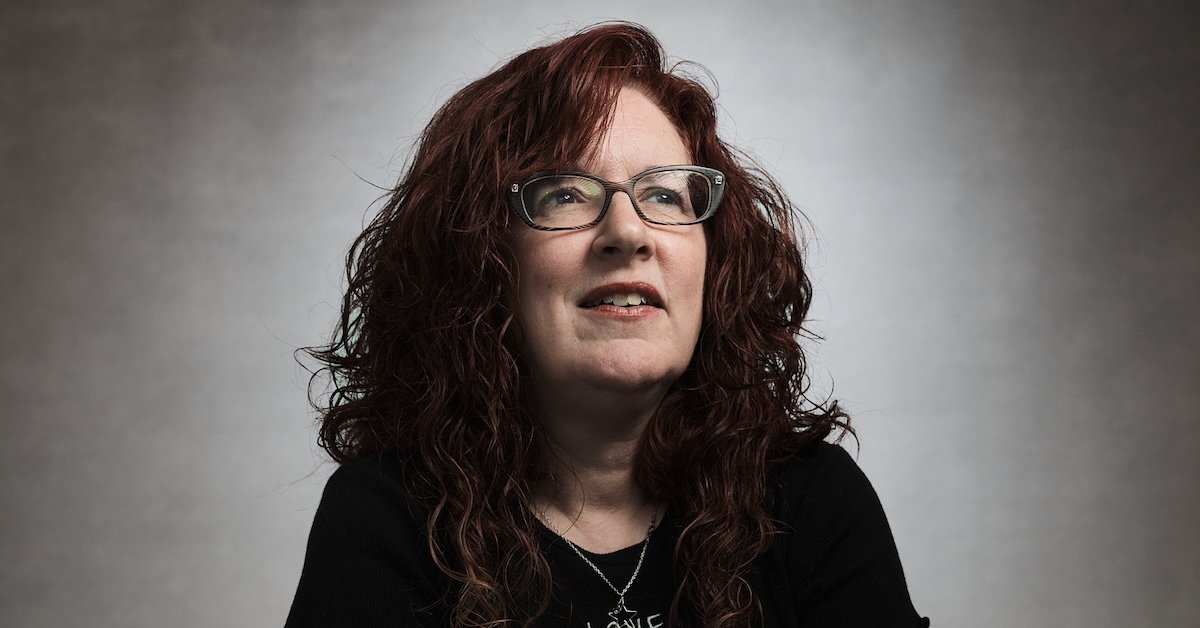
Heather Schwartz performs as Quiet Girl Comedy. I sat down with Heather to talk about where that name came from and how she learned to perform on her own terms.
RRX: Before we talked, I watched some videos of your performances, which left me wondering how you ended up calling yourself Quiet Girl Comedy. You were a lot of things in those videos, but quiet wasn’t one of them.
HS: In sixth grade, my friend and I were given the responsibility of counting the votes for the superlatives for our yearbook. I desperately wanted to win Most Musical Girl. We counted them up, and I was super close, but not there. Instead, I won Quietest Girl.
I was horrified! Why would anyone even make that a category? That wasn’t how I saw myself. What I wanted to be recognized for was my musical ability and my desire to be onstage.
I remember auditioning for our sixth-grade musical. I practiced the song in my room and thought, “I sound exactly like Olivia Newton-John. I’m sure of it.” Then I got to the audition and couldn’t really sing out. I was really quiet, like a wallflower. Needless to say, I did not land my dream lead role.
That kind of thing kept happening throughout my life. I would perform, but it took so much out of me. There was more anxiety than enjoyment.
RRX: So even though performing made you anxious, you kept coming back. How did that work?
HS: I would give it up sometimes. I’d say, “This just isn’t my thing. I’ll stop doing this.” Then I would see people performing and think, “Oh, I would love to be like that. I want to do that. I know I have it in me.”
Years later, I took an improv class and had so much fun. We were playing games, playing pretend, blurting things out.
Pretty quickly, I started performing. I still had extreme anxiety about it, but I loved improv so much that I thought, “Well, I guess if performing is the price I have to pay for doing improv, I’ll do it.”
I had that mindset for a long time.
RRX: What was it like performing with all that anxiety?
HS: In the past, if I had a show scheduled in a month, as soon as it was scheduled, I couldn’t eat. I’d spend each day worrying about it. My appetite would be way down, so I’d feel weak because I wasn’t eating enough.
I could always power through once I got there. I could get onstage and do the thing I needed to do. But it took so much energy. It didn’t feel joyful. I would think, “This is supposed to be fun. I’m supposed to be having fun, and I’m not.”
RRX: I got the feeling from watching you perform that you’re having fun. What changed?
HS: For a long time, I kind of felt like I needed to become this other person—the person who was comfortable performing. Then I realized I didn’t need to become comfortable with it exactly. I needed to support myself as a person who is uncomfortable.
And over time I started embracing the idea that I can still be considered a quiet person throughout all of this. I can own that label. I’m not the ham. I’m not the person everybody always said was going to be onstage someday. I’m not the class clown.
I’m never going to be that person. But I can still do the things I want to do.
RRX: One of the pieces you’re best known for is “Heather’s Junk Drawer.” Where did that come from?
HS: I felt like I wasn’t doing my own work as a performer. I felt like this voice was there and had grown and developed, but I didn’t know how to let it out because I couldn’t see an avenue that I fit into.
I’m not a stand-up, but what I naturally wanted to do wasn’t fully improv either. I was obsessed with people who did solo shows, so I gave myself permission to rehearse solo. I would go onstage with nobody else in the room and just do things.
I kept exploring what my own voice sounded like and what felt natural to me. I thought, “How can I get myself onstage solo and actually feel comfortable doing it?” I realized I could get onstage if I had all my stuff with me—my million security blankets.
That became “Heather’s Junk Drawer.” It’s a 20-minute comedy piece where I bring my own junk drawer onstage and get the audience to help me try to clean it out. But it never happens. I unpack things, tell stories, sing songs, and invite people to play along. Really, I’m more interested in the objects than I am in getting rid of them.
RRX: How do audiences respond to “Heather’s Junk Drawer?”
HS: That surprised me. People always come up afterward and say, “Oh, I have that thing,” or “I don’t know why I keep this either.”
We’re all kind of hoarding these objects that are nostalgic or useful or useless or possibly needed for taxes or something. It’s almost a universal human experience that we don’t always talk about.
RRX: Your newest project, “Love Yourself More,” takes some of these ideas in another direction. Where did that come from?
HS: The world was just seeming so hard and difficult, and I was feeling frustrated that there was nothing I could do that would really make a difference.
I started thinking about kids and thought, “What could I teach them? What would I say if I could say something?” And I thought that if everybody could just love themselves more, that would make a difference. No matter what is going on, if kids love themselves, that is a support that can help them get through it.
So I decided it had to be a show. It uses songs, interactive elements, and a lot of improvisation. I’m always watching the kids and noticing what they might need.
Through a Saratoga Arts grant, we’re bringing the show to three local libraries in November and early December, and I especially want disabled children, families, and young adults to feel welcome.
It’s a big deal for some families to come out into the world. I want it to feel worth the effort. Maybe it isn’t going to go perfectly, because things don’t go perfectly. But if they can say, “There were five minutes there that worked, and that kid got a message that helped,” cool.
I want to be part of that.
See Heather E. Schwartz perform Love Yourself More Nov. 14 at 3 p.m. at Saratoga Springs Public Library; Nov. 21 at 11 a.m. at Schuylerville Public Library; and Dec. 5 at 11 a.m. at Ballston Community Public Library. Heather’s Junk Drawer comes to Bard & Baker in Troy Nov. 15 at 5 p.m.

