
Theater Review: Youth Is a Country You Can’t Go Back To—But You Can Hear It Here
By: Joanna Palladino
Static, swing, and Southern ghosts in a one-man mixtape about becoming Tennessee Williams
Harbinger Theatre’s production, A Distant Country Called Youth doesn’t just trace the early life of Tennessee Williams—it tunes it. Adapted by Steve Lawson and directed by Linda Shirey, this one-man show transforms 82 letters from Tennessee Williams into a living, breathing soundscape of longing, humor, and artistic awakening. The play’s title (one of the working titles of Williams’ masterpiece The Glass Menagerie), captures the story of the play itself. Adapted from his personal letters, the production focuses on the “distant” or formative years when Tennessee Williams struggled with family issues, professional rejection, and personal identity to find his voice, concluding with his triumph of The Glass Menagerie.
Patrick White Is the Engine—and the Ensemble
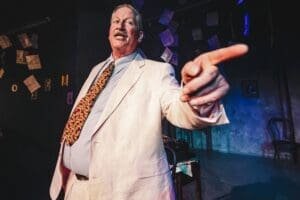
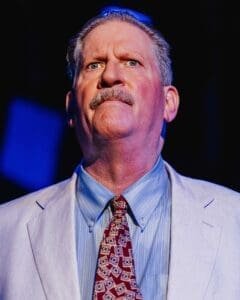
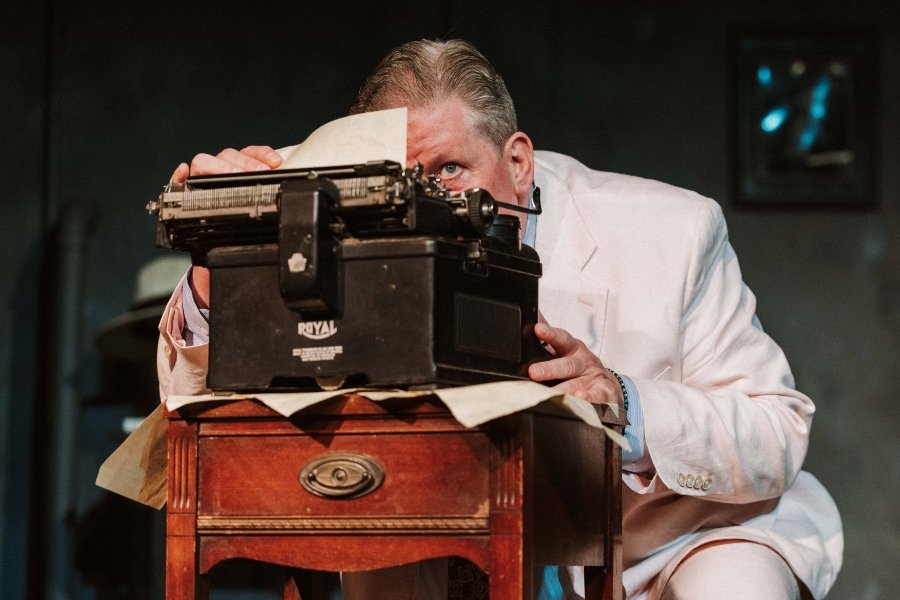
Patrick White takes on the role of Tennessee Williams—and delivers a true tour de force.
This isn’t just a strong performance. It’s a sustained, controlled, and remarkably detailed work that never lets go of the thread for a second. In a one-man show with nowhere to hide, White commands the stage with total authority—shifting through time, tone, and emotional states with precision.
White moves through each letter like a series of radio frequencies—awkward, searching, defiant, seductive—sometimes overlapping, sometimes cutting out mid-signal. You don’t watch him switch aspects of Tennessee’s personality – you feel him tuning the dial, finding the signal, and chasing it again.
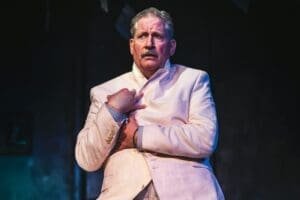
What makes White’s performance extraordinary is the layering. He’s not just playing Tennessee Williams—he’s revealing the formation of a mind. The humor lands but his vulnerability lands harder. And the undercurrent—desire, fear, ambition, isolation—is always present, even in stillness.
There’s also a physical intelligence to the performance that keeps it alive moment to moment. A shift in posture becomes adolescence. A tightening in the voice signals control slipping. A pause—perfectly timed—carries as much weight as a full monologue.
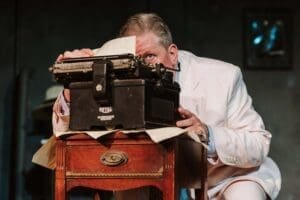
And then there’s White’s use of the set pieces and props—deceptively simple, but incredibly effective. Objects become extensions of character, of memory, of relationship. In his hands, they’re not just tools—they’re transformations. A small adjustment, a different grip, a shift in how something is held or handled, and suddenly you’re seeing someone else in the room. It’s subtle, specific, and essential to how he builds a full world on an otherwise minimally decorated stage.
White’s stamina is impressive. But more than that—it’s the consistency. There isn’t a moment where the focus drops, where the character slips, where the energy fades. He holds the audience completely, without forcing it.
Most importantly, he understands rhythm. Lines don’t just land—they phrase. Silence breathes. Emotion builds through timing, and sometimes volume. It’s the kind of performance that feels musical even before the sound design enters.
It’s commanding without being showy. Intimate without ever losing scale.
A One-Man Show That Feels Like a Full Cast
White’s performance reminds us that even a one-man show takes a community. The entire crew should also be commended. In this production, every element is working in sync. Even unseen hands are felt. It’s a reminder that he most intimate theater is still deeply collaborative.
The Direction by Linda Shirey is superb. Shirey trusts the material, her actor, and the audience completely – letting the work and White tell this magical story of how Tennessee Williams came to be one of the world’s most revered playwrights.
Kathryn Capalbo (Stage Manager) and Stephen Henel (Assistant Stage Manager) provide the essential safety net for White’s performance.
Stephen Wilson (Lighting Designer) deploys his lighting design to let time pass instead of announcing it.
Maghen Ryan-Adair (Set Design) provides the necessary structure that allows White to convey time, place, and mood.
Colleen Lovett (Costume) dresses White in a simple linen suit allowing him the vehicle to transform into Tennessee Wiliams.
Debby Bercier (Line Coach) was essential in assisting White to memorize the words of 82 letters and her role can’t be understated.
The Sound Design Locks It All Together
The sound design by Shaya Reyes doesn’t decorate the play—it structures it. Reyes’ sound design aligns performance, memory, and emotion into a single frequency. It’s subtle, precise, and just out of reach—like the past itself. Reyes’ musical selections rely heavily on the Ink Spots. The Ink Spots aren’t just setting the mood—they’re tuning you to the same emotional frequency Tennessee Williams was writing from. (On the stage is an album of the Ink Spots as well!) The Ink Spots were an American vocal pop group who gained international fame in the 1930s and 1940s.
Their songs feel like an interior monologue—like someone speaking into space and hearing only fragments return. Which is exactly where this play lives.
Reyes’ selection of “If I Didn’t Care” was a happy surprise! The song is one of the most acclaimed recordings by the Ink Spots, selling 19 million copies and used in the opening scene of The Shawshank Redemption. The song matches the feel of this play – a story told as recollection.
Here is Reyes’ complete playlist:
Pre-Show
- Address Unknown– The Ink Spots
- We Three (My Echo, My Shadow, And Me)– The Ink Spots
- Memories of You – The Ink Spots
- Maybe– The Ink Spots
- I Don’t Want to Set the World on Fire– The Ink Spots
- I’m Making Believe– The Ink Spots & Ella Fitzgerald
- We’ll Meet Again– The Ink Spots
- I’ll Get By (As Long As I Have You)– The Ink Spots
- If I Didn’t Care– The Ink Spots
- Do I Worry? – The Ink Spots
- Don’t Get Around Much Anymore – The Ink Spots
- I Get the Blues When It Rains – The Ink Spots
- It’s Funny to Everyone But Me – The Ink Spots
- To Each His Own – The Ink Spots
- My Prayer – The Ink Spots
During the Show
- Happy Day in Paris- Duke Ellington & Jimmie Blanton
- Body and Soul (Take 3) – Duke Ellington & Jimmie Blanton
- East St. Louis Toodle-Oo – Ellington & His Washingtonians
- Rhapsody in Blue – George Gershwin
- Way Down Yonder in New Orleans– Bix Beiderbecke
- Cocktails for Two– Coleman Hawkins
- Black and Tan Fantasy”– Duke Ellington
- Guajira Sicodélica– Los Destellos
- La Mazamorrita– Los Sanders de Nana
- Stompin’ at the Savoy– Benny Goodman
- There Will Never Be Another You – Lester Young & Oscar Peterson Trio
- Somebody Stole My Gal– Ted Weems
- I’m Beginning to See the Light– The Ink Spots
The draw of Tennessee Williams influences our modern soundtrack decades later. You can still hear artists circling the same emotional terrain: desire under glass, fragile identity, longing that feels both intimate and unreachable. Songs like these still channel the same ache:
- “Streetcar” – Lola Young
- “Chelsea Hotel #2” – Leonard Cohen
- “Hope There’s Someone” – Antony and the Johnsons
- “Video Games” – Lana Del Rey
- “Suddenly Last Summer” – The Motels
And more obvious musical tributes to the playwright include:
- Blue Mountain Ballads – Paul Bowles
- Quelque chose de Tennessee- Michel Berger
- Tennessee Williams– The Residents
- Fair Weather – Little Lore
- Evil Eye” – Little Lore
- Tennessee – Alicia Blue, Lucinda Williams, John Paul White
- “Tennessee Williams: Words and Music – Alison Fraser
At the center of A Distant Country Called Youth is Patrick White—and what he’s doing isn’t just impressive, it’s rare.
This is the kind of performance that doesn’t announce itself. It accumulates. It draws you in slowly, until you realize you’ve been holding your breath through entire stretches of it. He builds a human being from fragments—voice, posture, timing—and lets you watch that person become something larger than himself.
And what helps make that possible—is the sound design that is a living structure that supports him at every turn. The sound design by Shaya Reyes gives White something to play against and within. It shapes the rhythm of the evening. It creates space where silence matters. You may not always consciously notice it. But you feel it—every second. That’s what great sound design does. It doesn’t pull focus.
If you care about performance—really care about it—go see this.
If you love the way music shapes emotion, timing, and memory—go see this.
If you want to watch an actor do something precise, intelligent, and deeply human—go see this.
Because this isn’t just a play about Tennessee Williams. It’s a chance to watch memory take shape in real time—because, as Williams wrote, “in memory, everything seems to happen to music.”
And for once, you can hear exactly what he meant.
Show Info
Location:
Harbinger Theatre at The Mopco Improv Theatre
10 N Jay Street, Schenectady, NY
Performance Dates:
April 24, 25, 26 & May 1, 2, 3
Fri & Sat: 7:30 PM
Sun: 2:00 PM
Tickets: https://harbingertheatre.ludus.com/index.php
Images by Andrew Elder Best Frame Forward