

By Larry Felton.
Four Musicians, No Leader, and the Jazz Suite Born in a Basement
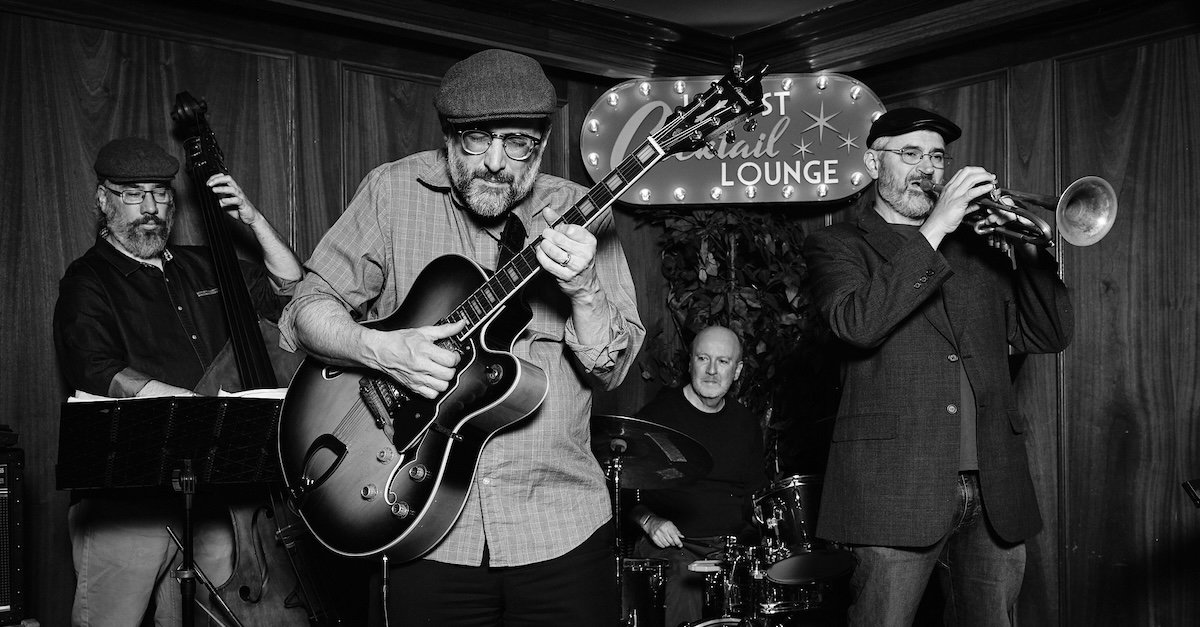
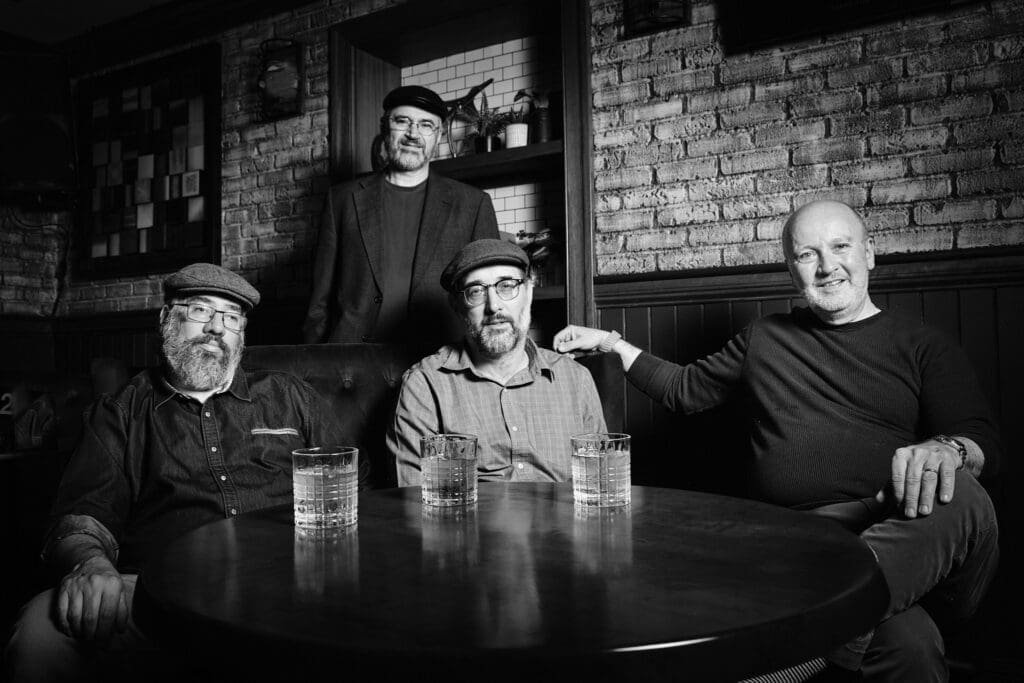
There is no Arch Stanton in the Arch Stanton Quartet. The band is Terry Gordon on horns, Jim Ketterer on drums, Chris Macchia on bass, and Roger Noyes on guitar — four musicians who deliberately chose a fictional name because they wanted the group to function as a democracy rather than revolve around a single leader.
Since last fall, the quartet has been performing “Exploring the Sheltering Sky,” a program of jazz adaptations and spoken word drawn from the Paul Bowles novel “The Sheltering Sky” and his lesser-known classical compositions. Bowles is remembered as a writer, but he was also a protégé of Aaron Copland and Virgil Thomson. He composed chamber music, piano pieces, and orchestral works before leaving New York for Tangier after World War II. His novel follows three Americans drifting through North Africa, and the band’s reworkings of his piano pieces provide the musical spine of the hour-long performance.
The Albany County Arts and Culture Program supported the creation of “Exploring the Sheltering Sky” and performances of it at public libraries across the county. I caught the program at the Bach Branch of the Albany Public Library in late April and sat down with all four members at the Lark Tavern before a gig.
RRX: For readers unfamiliar with the reference, where does the name Arch Stanton come from?
Jim Ketterer: From the beginning, the idea was that this should really be a band — not a pickup gig situation — and that it should be a democracy. Nobody’s name is out front. But when you’re booking jazz gigs, if your name is too creative, places think you’re not really a jazz group.
Roger Noyes: So we brought some creativity in through the back door. On the surface, Arch Stanton sounds like a standard jazz name. But it’s a reference to “The Good, the Bad and the Ugly.”
(For the uninitiated, in the film’s climax, the characters race to a cemetery searching for Arch Stanton’s grave, believing the gold is buried there. It isn’t — it’s in an unmarked grave right next to it.)
RN: He’s an absent character in the movie and an absent character in our band.
RRX: Jim, you’ve lived in Morocco, Tunisia, and Egypt. What did Bowles’ work unlock for you?
JK: I grew up outside of Saratoga, on a two-mile road with two houses on it. I used to see planes high up on their transatlantic flight. I was always thinking, who’s on that flight? Where are they going? What are they doing? I want to do that too.
While in college, I started studying Arabic. And I think it was in college when I first encountered some Paul Bowles. I dug more into it, and then just really got into the book a lot. And as I was figuring out a way to finally go live in North Africa, it was definitely in my imagination.
But what I didn’t know at the time was that Paul Bowles had been a composer before he left New York and moved to Tangier right after World War II. I listened to a ton of the music that he composed, and also did a lot of reading about that part of his life. And I think if he can, I can.
RRX: How did you adapt his classical piano music for a jazz group?
Terry Gordon: It was a five-hour rehearsal in Jim’s basement. Jim had picked the tunes for us to take apart. I call it “putting it through the Arch prism.” We’d pick out the main melodic theme, then go to a slightly different spot in the piece, grab another melodic snippet for a bridge, and turn it into something we could use.
Chris Macchia: What was fun is that Bowles had very sparse left-hand bass parts — maybe two notes — and we’d voice those together in a way that became our stamp on it. The fidelity to the melody is still very true. But the impression of the harmony is what we were able to really adapt.
JK: If you went back and listened to the originals, which are two piano four-hand pieces, you’d recognize the melodies. But the selection and ordering of the tunes is meant to fit the trajectory of the whole performance — from the forward momentum of “Cross Country,” to “April Fool Baby,” a fractured love song with lyrics by Gertrude Stein, to “Nocturne,” which captures the stillness of the desert and the sky.
RRX: Jim assigned each of you a solo to develop on your own. What did that process look like?
JK: I selected texts from the novel and sent one to each of these guys — compose something to go with my recitation. I gave each a musical idea and said, run with it. A lot of the work was done on their own, but then the way the text and their playing interact has evolved. It makes more programmatic sense now.
RRX: You booked the first gig before the material existed?
JK: About two weeks after that session in the basement. That’s one of the reasons that session was so intense — we knew we had a first performance coming. We booked the gig before we had the material.
RRX: How has the program been received?
JK: Every time, I worry no one will show up, and every time we’re surprised. A woman at one performance told us her father had lived in Morocco. When I read the passage about how if you’ve been to the Sahara, you will go back — she said it finally made sense why her father, even after a terminal diagnosis, returned. People have opened up to us after these shows in ways none of us expected.
CM: There’s an emotional impulse to this music that brings people in, and we try to seize that by not being distant. We do sophisticated things musically, but there’s always a desire to connect with the audience.
The final performance of “Exploring the Sheltering Sky” will be on June 19 at the Albany Institute of History and Art. The performance runs from 12:30 to 2:00 p.m. and is free. For more information, visit archstantonjazz.com.

