


By Joanna Palladino.
Albany Civic Theater’s production of David Lindsay-Abaire’s “Fuddy Meers” is a theatrical funhouse, a world where memory fractures, language twists itself into knots, and truth arrives in unreliable bursts. The production embraces the play’s absurdity with discipline, heart, and a surprising amount of emotional insight. The result is a smart, tightly performed production that balances chaos with clarity—and large doses of comedy.
At the center is Claire, a woman who wakes each morning with complete amnesia. Her routine of rediscovering her life is upended when a limping, lisping stranger wearing a ski mask hauls her into what appears to be a frantic rescue mission. Surrounding her are a cast of characters who range from the sweetly bizarre to the dangerously unhinged: a puppet-wielding accomplice, a stroke survivor whose dialogue resembles linguistic origami, a teenage son drowning in dysfunction and despair, and a husband whose smile hides more than it reveals.

Despite the script’s surreal whiplash, ACT’s production remains on track and is cohesive, thanks in part to strong direction and a great production team.
Amanda Conlon is simply perfect as Claire. She brings sincerity and complexity to a role that could easily become a gimmick. Her portrayal is tender, humorous, and heartbreaking.
Gregor Wynnyczuk plays Richard, her husband, with earnestness, revealing Richard’s complex layers at just the right pace- and with the right amount of humor.
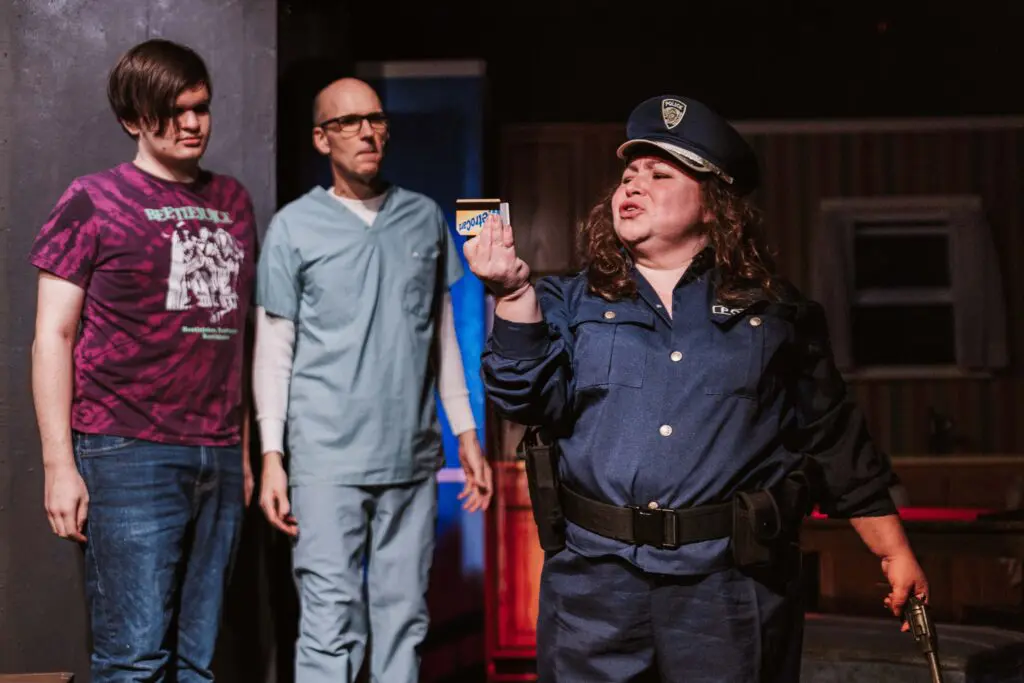
Kenny, the teenage son, is performed realistically by Dominic Tillou, who grounds the production with wry humor and emotional authenticity. He is sharp-tongued and unsettling but also loving and empathetic when the scene allows.
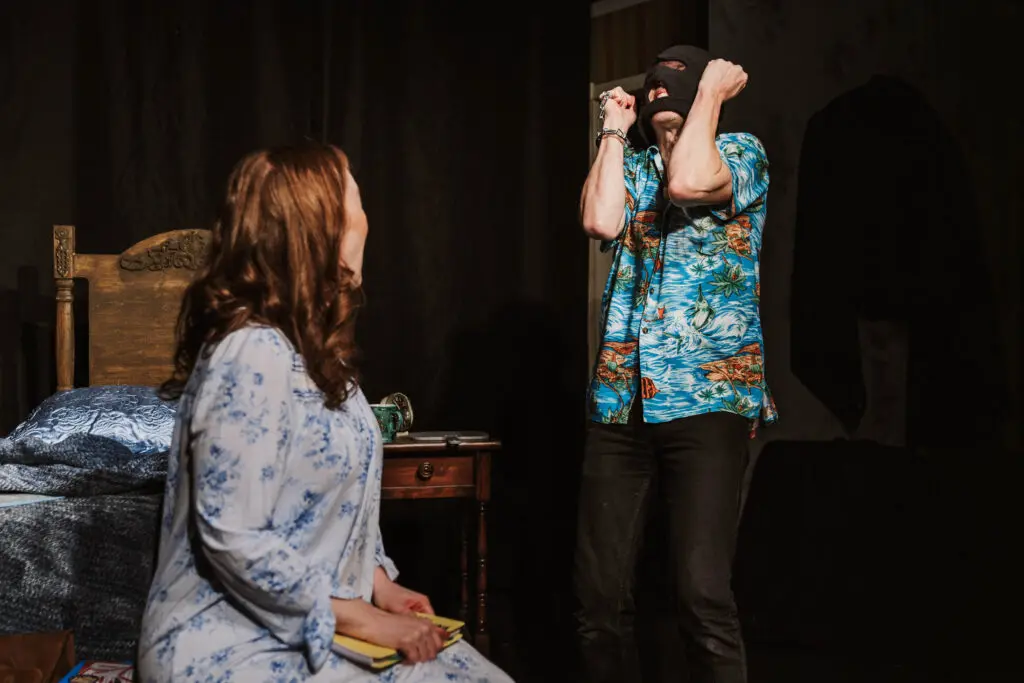
Eric-jon Tasker is spectacular as the Limping Man. Eric-jon balances menace and vulnerability with carefully controlled physicality. He masterfully wins the audience over with his dark humor and the perfect mix of charm and danger. His scenes with Claire, Gertie, and Millet are electric and have the audience questioning his motives at every twist and turn.
Gertie, the stroke survivor, played masterfully by Jackie DeGiorgis, steals scenes with her fractured language, turning muddled phrases into comedic gems. She embodies the realness of someone who has suffered a stroke, allowing the audience to see the impact of the stroke while maintaining her humanness and her strength.
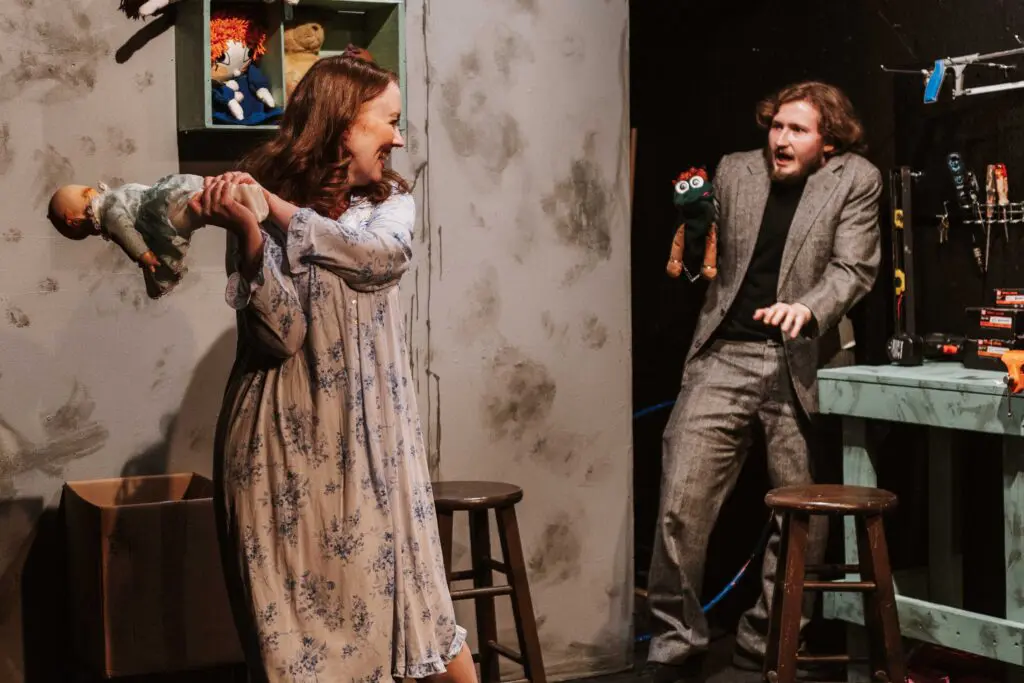
Alex Headley is phenomenal as Millet and his puppet (yes, a puppet) and creates some of the show’s funniest—and strangest—moments. Alex’s Millet is undeniably human, fractured, childlike, and tender.
Isabelle McKeon is hilarious as Heidi and injects a blend of softness, edge, realness, and energy into every scene she is in.
The director, Teresa Storti, and stage manager Oona Newman maintain a tight grip on pacing, with staging that keeps the action crystal clear without sacrificing momentum. The minimalist set design by Jacob Bell and Peter Kantor allows characters—and their psychological distortions—to take center stage. The set construction and decoration team (Peter Kantor, Kat Fronheiser, Kevin McNamara, Isabelle McKeon, and Dominic Tillou) should be applauded for their work and also for adding childlike touches (like a sock monkey) that reflect the play’s major themes. Oona Newman’s lighting design helps the audience to travel from location to location and draws the eye to the action on stage. Dianne E. O’Neil’s costume design is spot on, and Libby Brennesholtz deserves kudos for the perfect puppet construction of Millet’s alter ego. Kimberly Martin’s fight scene coordination, coupled with Brian McBride Land’s special effects makeup, adds realism to the surrealism occurring on stage.
Of note is the sound design by Barry Streifert, done in coordination with Teresa Storti. At first listen, the show’s curated soundtrack felt like a jukebox chock full of quarters from an odd mix of barflies, but together, the selections chart Claire’s emotional orbit: the memories she longs for, the confusion she lives in, and the future unknown. The playlist ranges from mid-century bubble gum pop, 1970s introspection, and contemporary experimental sound. Streifert’s playlist included:
Pre-Show
- Crazy – Gnarls Barkley
- The Windmills of Your Mind – Mel Torme
- Dream Weaver – Gary Wright
- I Forgot to Remember to Forget
- Memory – Sugarcult
- Sentimental Journey – Doris Day
- Yesterday Once More – The Carpenters
- Pack Up Your Sorrows – Mimi and Richard Fariña
- Every Breath You Take – Police
- Always Something There to Remind Me – Peggy Lee
- Buttons and Bows – Dinah Shore
Act 1
- Everybody Loves a Lover – Doris Day
- Everybody’s Talkin’ – Harry Nilsson
Intermission
- If You Take Me Back – Kansas Joe McCoy
- Don’t You Forget About Me – Simple Minds
- Reminiscing – Little River Band
- One More Ride on the Merri-Go-Round – Peggy Lee
- Time After Time -Cyndi Lauper
- I’m Forever Blowing Bubbles – Doris Day with Jack Smith
- Photograph – Nickelback
- Remember Me I’m the One Who Loves You – Dean Martin
- Back in Your Own Back Yard – Peggy Lee
- One More Memory – Wayne Newton
- Yesterday’s Gone – Chad and Jeremy
- Comin’ Home Baby – Mel Torme
- Always Something There to Remind Me – Peggy Lee
Act 2
- Mooseburger Stomp – David Schwartz from the soundtrack of Northern Exposure
Finale
- Que Sera-Sera – Doris Day
- Unwritten – Natasha Bedingfield
The irony and naïveté of employing Doris Day’s “Everybody Loves a Lover” early serve as an ironic commentary on Claire’s fragile, uncertain morning optimism. The sugary tone underscores the artificial stability she clings to as she greets a life she can’t remember.
The preshow music had some gems that are also worth mentioning. The Carpenters’ “Yesterday Once More”, lush and nostalgic, highlights the tragedy of a woman unable to access her own past. The song’s yearning for memory contrasts sharply with Claire’s inability to hold onto hers, creating a moment that is both ironic and quietly devastating.
Seifert’s inclusion of “Pack Up Your Sorrows” by Mimi and Richard Fariña was unexpected. Where other songs emphasize disorientation or longing, this folk anthem introduces something different: compassion. Its gentle refrain—offering to help carry the burdens of another—echoes the play’s buried theme of mutual care amid dysfunction. Even in a world as chaotic as Claire’s, moments of kindness and connection shine through. The Fariñas’ warm, empathetic tone becomes a subtle reminder that healing is possible, even when memory is not.
The song provides an emotional counterbalance to the show’s darker reveals, suggesting that Claire’s fractured life still contains the potential for rebuilding. Its inclusion is understated but powerful—a whisper of hope in the middle of a psychological storm.
Harry Nilsson’s “Everybody’s Talkin” in Act 1 becomes a sonic reflection of the characters’ self-absorption and emotional isolation. The lyric “I don’t hear a word they’re sayin’” takes on new resonance and is perfectly placed in the scene.
In stark contrast to the nostalgic selections, during a scene change, the play employed the song “Chronoparalysis” on the album “Kitbashing” by ABADIR, which offered an auditory exploration of Claire’s internal fragmentation. Its glitchy textures, warped pulses, and looping structures feel like the sonic equivalent of a memory short-circuiting. For those of you unaware, ABADIR is an Egyptian artist based in Berlin who blends a large spectrum of musical styles, combining the cinematic with ambient and club music. The album “Kitbashing” is a collaboration alongside media artist Nicoló Cervello, where the two explore the impact of social media and data-extracting algorithms, and offers an escape. It’s amazing that Streifert stumbled upon this selection, especially since ABDIR was quoted in an interview with Shape+ in 2022 saying: “Broadly speaking there are very negative aspects of nostalgia, but we can’t totally avoid it, we are humans with memories and emotions, and the question is how to use nostalgia or engage with the past in a subversive way and without mourning.”
If the nostalgic songs represent the past Claire cannot grasp, and “Pack Up Your Sorrows” represents the emotional support she desperately needs, ABADIR’s track represents the present tense of her mind: unsteady, dislocated, and suspended between moments. It is a bold, modern inclusion that deepens the psychological dimension of the production.
Ending with Doris Day’s “Que Sera, Sera” feels like a lullaby of resignation. Its iconic refrain— “the future’s not ours to see”—echoes Claire’s central dilemma. The song lands with a bittersweet ache, reminding the audience that she moves blindly through a life everyone but her can recognize.
Albany Civic Theater’s “Fuddy Meers” is a vibrant, thoughtful, and emotionally layered production of a delightfully difficult play. Its ensemble work is strong, its pacing crisp, and its sound design rich—balancing nostalgia, confusion, and hope. This is a production that recognizes memory as a collage: bright pieces, broken pieces, and pieces we carry for one another.
Albany Civic Theater’s production of Fuddy Meers is a compelling and memorable night at the theater.
Tickets can be purchased by clicking here
Location:
Albany Civic Theater
235 Second Ave, Albany, NY 12209
Performance Dates:
December 5, 6, 7, 12, 13, 14, 19, 20, 21 2025.
Fri & Sat 7:30, Sun 3:00
A talkback with the director and cast to follow the Sunday, December 14th performance
Images from Best Frame Forward.

