

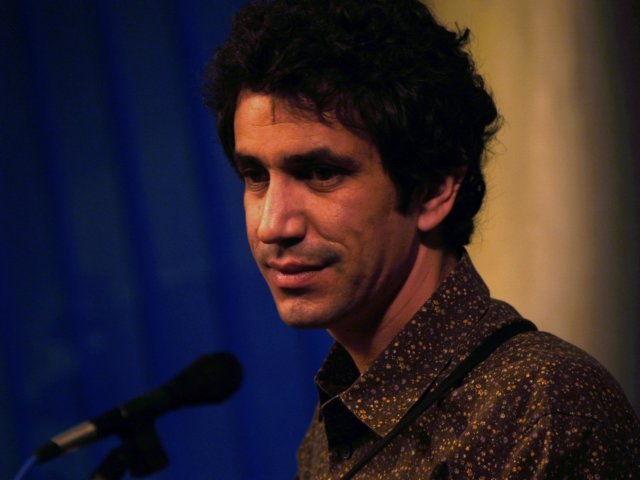
A. J. Croce – Music and Life – in D.R.
In 1973, two-year-old A.J. Croce lost his dad, singer/songwriter Jim Croce, in a plane crash. And then things got worse for him.
But we’re not here to dwell on the past. You can look up his bio elsewhere, if you really want to know. Today we are celebrating his career as an accomplished musician and intrepid human being.
A.J. first mastered the piano, and then later, became an exceptional guitarist. Somewhere in there, he also learned to sing. He has played with virtually every notable modern musician, a spectrum including Elvis’s guitarist, James Burton, to John Oates, of Hall and Oates. In one session, he replaced Jerry Lee Lewis on keyboards. He has more than held his own in their midst many, many times.
He has also become an excellent songwriter.
In his thirties, he decided to revisit his father’s repertoire, playing those great Jim Croce songs: “Operator,” “Leroy Brown,” “Time in a Bottle,” and others. All those songs were recorded by Jim in a very narrow window of just 18 months. In retrospect, that’s astounding.
You can experience A.J. Croce during his “Croce Plays Croce 2026” tour, at Universal Preservation Hall in Saratoga on Thursday, April 9th. Doors at 7:30 (maybe a smidge earlier). Come and celebrate the music, the performer and, mostly, the man.
(Many thanks to Jim Merlis for facilitating this interview)
RRX: Thank you for consenting to this interview. To get right to it, you’re probably best known as a virtuoso pianist. Was piano your first instrument?
AJC: I was drawn to the piano before I could walk; it just spoke to me. I got my first lesson when I was about eight, though I was already running to the piano with my little transistor radio to play along with whatever I was tuned into at the time. Being that I was legally blind from 4 to 10, my early lessons were more about learning my scales and chords. I was encouraged to improvise, and that freedom changed my life. Piano was my solace.
RRX: Who were some of your earliest musical influences?
AJC: I was fortunate to have a father (and grandfather) who loved records and music of all eras and genres. So as a kid who couldn’t see, I was turned on to Ray Charles and Stevie Wonder. With Ray Charles I went down the rabbit hole on where his influences came from, the jazz, blues, gospel… and I was fortunate to have my dad’s record collection, which wasn’t vast but amazing and diverse. So I listened to Fats Waller, Bessie Smith, and Delta blues like Mississippi John Hurt, and Skip James as well as Sonny Terry and Brownie McGee,Otis Redding, Sam Cooke, Solomon Burke, Little Richard, Chuck Berry, Jimmy Reed. Allen Toussaint and the records he wrote and produced for Lee Dorsey, and Irma Thomas made a big impact. Then there was great country like Lefty Frizzell, Hank Williams, Jimmy Rodgers. Folk music like Woody Guthrie and Leadbelly. Gospel, and lots of 50’s and 60’s Rock & Roll.
RRX: When did you take up the guitar? Was playing your father’s music emotionally difficult at first? Has it become cathartic?
AJC: When I turned 30 my mother gave me my father’s 1933 Gibson L-00. I’d learned a few chords over the years, partially because I had recorded and toured with so many great guitarists. When someone would play a cool-sounding chord or riff I’d ask how to play it. Because I had limited knowledge of the fretboard and only maybe 6 or 7 chords under my fingers at first, it simplified my songwriting in a profound way. I had success with the first song I recorded on guitar and for a few years avoided applying the music theory that I know as a pianist in order to keep things simple. But as I fell in love with the instrument I started to feel the limitations were a bit too stifling and my desire to compose more sophisticated music on guitar won out. I’ve never forgotten the power of simplicity, though now it’s a choice and not a necessity.
After a few years of owning the old Gibson I felt obligated to learn a few of the songs that my dad wrote on the instrument. Being a piano player, finger style came naturally. While I it would be another 15 years before I’d perform any of my fathers music in concert, it was emotional and cathartic.
RRX: There’s a recurring joke about guitar players saying, “You can never own enough guitars.” How many guitars do you own? Do you have any favorites?
AJC: Too many! Instruments are tools. My rule for acquiring guitars is that each one needs to do something unique that none of the others can do. I need to be inspired to write a song when I pick up a guitar, or I don’t need it. I’m currently in the process of culling my collection. With a couple exceptions, my criteria for getting rid of guitars is that if I don’t want to tour with it, because it’s rare or in mint condition, or it’s too heavy, then I don’t need it. There are still a few guitars that I’m on the lookout for that I could really put to good use, but not until I get rid of a few. My favorites and ones I’ll never part with are my 1967 Gibson 330 (my first electric), 1955 Gibson SJ, a 1966 Martin D18, my 1951 Martin 0018, a ‘57 Les Paul Gold Top (Murphy Lab), a custom Jazzmaster and of course the ‘33 L-00. I have other great guitars but these are the most special to me.
RRX: You’ve released eleven albums, the latest being “Heart of the Eternal” (BMG, 2025). There’s some pretty tasty music on there. I particularly liked “Hey Margarita” and “On A Roll.” How is that you are not more widely known? I think you just got yourself a new fan…
AJC: Thank you! I don’t know if I have an answer to your question. One thing I can tell you is that for most of my life I avoided celebrity. Growing up in the periphery of renown made me cautious and a little suspicious at times. While I always wanted my music to be heard, I never felt like I needed to be adored by strangers. At a certain point maybe ten year ago, I realized that a certain amount of recognition is a necessity if I wanted to share my music with a larger audience (which is a little crazy, since I’d been touring and recording for about 25 years at that point). Who knows if it will make a difference since so much of this business is about good luck, great timing, and perseverance. At least I have the perseverance in spades. Curiously, there’s an ideal for musicians not to sell out, and yet the whole point of performing live is to sell out. Once I finally embraced the idea that I deserved to have my work recognized (as everyone does), my perspective changed and I became open to whatever may come, for better or worse.
RRX; Jazz pianist Bill Evans is reported to have told a colleague, just before his death: “Focus on truth and beauty, and forget all the rest.” It seems like this is precisely what you have done. True? Has music kept you going through good times and bad?
AJC: Truth and beauty are critical to the music I try to create. There’s a lot of music that I’ve composed which require dynamics. Lately I feel that outside of jazz or classical music fans, there aren’t many people that have the patience to listen to a song develop these days. I want my music to be universal, so I try to be very aware when I’m writing a song if the verse is simple and clear. I do my best to tell a good story and get to the point. So, the time it takes to get to the chorus and whether a song needs a bridge, (because fewer and fewer people have the patience to listen to an entire three minute song) are important factors to consider.
As for music keeping me going, it’s been profoundly rewarding in a holistic way. It’s my life and I wear many hats: artist, publisher, record label head. This business is like a roller coaster with it’s ups and downs, so I’m very grateful to make a living entertaining people, whether the crowds are big or small.
RRX: It seems that you have a broader family, made up of all the incredible musicians you have encountered over your career. Is it a comfort knowing you have been accepted into this amazing family?
AJC: It’s an enormous comfort and honor to have worked and played with so many talented folks. As you mentioned, not everybody is aware of my music, or my history as an artist and some folks assume that I just started my career by playing my fathers music five years ago. But for the first 30 years of my career I didn’t talk about my father in interviews or play his music. People can get nasty on social media sometimes, but you know B.B. King, Ray Charles, Willie Nelson, Leon Russell, Allen Toussaint and the dozens of other amazing artists I’ve performed, written, or recorded with didn’t need me or my last name to sell tickets or records. I guess knowing it was due to my own merits as an artist feels rewarding. When I was younger I never even brought up all the iconic folks I worked with — I just thought people would think I was bragging — though because many people are just discovering me now and I’m paying tribute to my father’s legacy more than my own, I think it’s important that they know a little about my past.
RRX: Any thoughts you want to leave your fans with?

