

From Blues To Greens
An Interview with Mark Richardson by Sara Busone
DJ – “Not Another Blues Show”
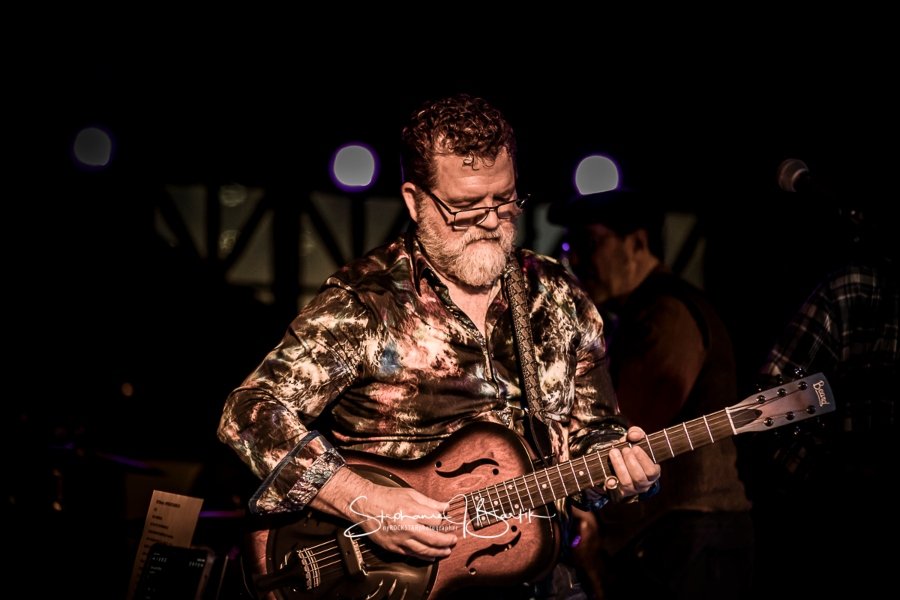
Photo By: Stephanie J. Bartik
RRX: Have you DJ’d before?
Mark Richardson: I’ve done interviews. I’ve been on the radio. But I’ve never been in DJ work or anything like that.
RRX: What do you think of it so far?
MR: I love it. It’s absolutely one of the coolest things I’ve ever gotten to do. It’s so cool. I didn’t know what to expect. It kind of was – I was really surprised when Seth (Casale) reached out to me. I was like, you know, I’m honored that you would ask me, but I don’t know anything about it. So I talked to Sonny (Speed), whom I’ve happened to know for a long, long time. I said, Sonny, if I say yes to this, what am I signing up for? He said, you know, it’s a commitment. But it’s a few hours of my time a week, and it’s something that’s good to do. It’s good to continue to make sure that this genre of music stays relevant, because blues is always in danger of stepping off a cliff into just … irrelevance.
RRX: Really?
MR: I mean, I think it’s true. It’s viewed as this really, really simplistic art form … a musical form, you know? “1-4-5.” Yeah, everybody thinks they can play the blues. But the truth is, it’s really a complicated thing. And you have to leave a lot of space. There are nuances, and I think that the general public typically doesn’t appreciate some of those nuances. So, what I really appreciate about this opportunity is that there are a lot of new, modern, young blues artists that are really kind of pushing the genre forward in a way that I think is really solid. It reminds me a lot of the whole Stevie Ray Vaughan revolution that happened. He changed the way people thought about blues. So did the Rolling Stones in the late sixties. So periodically it kind of goes through these resurgences, and I think we’re in one now, except it’s not one single artist, right? It’s kind of a community of blues people who take it very seriously and don’t want to see it go away.
RRX: Now, you were a player yourself, right?
MR: Yeah
RRX: Please refresh my memory … what did you play? Do you sing?
MR: I’m still playing! Yeah, I play guitar and sing … and right now I’m doing a project called “Not A Band.” So I have this theme going … it’s “not a” theme. (Laughs)
RRX: Not a theme. Not a band. I like that.
MR: It’s not a blues show… (laughs)
RRX: That’s so great. I love the name of your show.
MR: It’s kind of a play on words. When I first moved to New York, I met some guys, and they were in this band. Really avant-garde, kind of out-there stuff. And the name of their band was “un.” And you can use that as a precursor or … I don’t remember the right term. Grammatical term? Yeah, but you know they were unpopular; they were whatever it was. And that always kind of stuck with me because I’ve always fancied myself to be … anti-establishment might be too strong a word … anti-authoritarian for sure. And this idea of a “not” this and “not” that, or the show or the band or whatever, isn’t what you might expect. I have to tell this story…
RRX: Sure!
MR: I had just sold my last business. I sold my business in July last year, and I was trying to figure out what I was going to do. The sale happened very quickly, which was great. So, then I’m kind of left like, after a decade of 24/7 running my own business and having employees and investors and all that, I’m now sitting there going, “I don’t have to get up today.” You know?
RRX: Sure. It’s liberating. But an adjustment, I’m sure.
MR: Yeah. So, I said, you know, I really want to start playing again, and I just put together – I wanted a place to jam and get some people together and just have a jam. Not do a show or worry about any of that. So, Tom O’Connor at Jive Hive was kind enough to say, “Well, you can come do that here if you want to rent a rehearsal space.” Because I don’t have rehearsal space in my house. So I’m calling a bunch of people … and I ended up putting together a really fun and talented group of people. I always like being the least talented person in the band. (Laughs)
RRX: Okay … interesting.
MR: (Laughs) I was calling Mike Kelley from Hammerhead Horns, and many other bands I’ve known. I called him up; he said, “Yeah, I’ll come do that! It’s just one night. I’ll come like a Tuesday or Wednesday night” … something like that. And then a couple days or maybe a week later, I said, “Here, Mike … here’s a song … here’s a set.” He’s like, “Man, it sounds like you’re putting a band together. I just don’t have time.” You know, because he’s super busy. Not only was he doing Hammerhead … he was doing sessions in the city and all over the place. He’s such a talented, in-demand guy. I totally got it. But I said, “Mike, man, I swear I am not putting a band together. It’s not a band! And that stuck. So now that’s what I call it. (Laughs)
RRX: It’s Not A Band, and this is Not A Show. Hilarious! I love it. Now you have a background in cannabis, as well?
MR: Well, I wouldn’t say I have a background in it. But I do have a card, license. I have a dispensary that is open and operating in Whitehall.
RRX: Oh, tell me a little bit about that.
MR: I partnered with Joe Kelley, who has Northern Lights in Menands. So, Joe already had an operating facility – one of the first ones in the capital region to get open … third or something. But that’s his hometown. He’s got a pizza place up there and a couple other small businesses. He was really looking to open a store in his location. So we created a partnership. I’ve been doing a little bit of marketing. We just launched a website … a redesigned website. We’re working on a digital loyalty program. People can sign up and get rewards. So I’m helping with some of that kind of … I would call back-office stuff more. Communication … strategy-type things.
RRX: That’s cool.
MR: They’re both Northern Lights. This is Northern Lights NY Menands, and that’s Northern Lights NY Whitehall. The idea is to potentially build a brand out of that. And we’re interested in other opportunities. Simultaneously, I was running a very successful solar development company.
RRX: Which is fascinating.
MR: It was a successful company, but it took all of my time. So … the idea of trying to go out on a limb and go to some place that I had really no idea how it was going to go … just wasn’t practical. And then, after the license was granted to me, we took on some investors in the other business, and of course, part of that process was background checks and disclosures. I said, “Hey, I got a cannabis license,” and they were like, “That’s great, you can’t use it .” So that put the final nail in the coffin for starting the dispensary.
RRX: Yeah, I bet.
MR: Fast forward a year and a half, or two more years, and the clock’s ticking on my CURAD license because there was only so much time you could keep the application open. And we sold the solar business, and I happened to meet Joe through a mutual acquaintance. We hit it off immediately. Joe’s such a good, solid guy. Just one of the nice guys. Super hard worker. He’s a really good dude, and he’s got a great place in Menands. I was really impressed with that. And so, we decided to give it a shot.
RRX: You have a lot of things going on. You have a lot of vision.
MR: I like to keep my eyes open. I think I’m also cursed with this aversion to boredom. (Laughs)
RRX: Aversion to boredom! I like that.
MR: Unfortunately, it’s really hard to make any money in the music business. But it’s not about the money for me. It’s really about the enjoyment. Being able to … It’s a way to communicate. I don’t think any non-musicians really understand that, but musicians totally get it. It’s nonverbal communication with other people, and there’s really nothing quite like it. So far, on the radio show, I haven’t scripted anything.
RRX: I was going to ask you about that.
MR: I’ve been trying to keep it super limited for me and my voice and just let the music do the talking. So it’s just me introducing songs and telling people who it was, and maybe a tiny little factoid. I certainly don’t want it to turn into a pedantic … you know, a history lesson or anything like that. I just can’t stand that. There’s enough of those out there. And there are a few really great documentaries. If you want to go check it out, they’re out there. I don’t need to do that part, but I do think that highlighting some of the connections – and I learn new stuff all the time. I mean, that happens all the time if you are really into music, right? You just see those connections. The roots and branches in all the different places. Who influenced who, who ripped off some lick or phrase or whatever, and it’s prevalent. It’s everywhere, but it’s really prevalent in the blues because you’ve got a relatively limited vocabulary. And this goes back to my previous comment about people kind of misunderstanding that limited vocabulary for simple and not very interesting. Right?
RRX: Yeah…
MR: Those things are not true, and they’re not mutually exclusive. To have a limited vocabulary – that’s what makes it so great. Frankly, it’s people’s ability to express that relatively limited vocabulary in a way that either nobody’s heard before or it’s got new energy in some way, but you’re always calling back to the licks and phrases, and the structure and arrangement of songs. It’s a really cool thing … to help people kind of connect those dots.
“Not Another Blues Show’ with Mark Richardson is Wednesdays at 6-8pm Eastern Time.

