

by Joanna Palladino.
How well do we really know the people we see every day?
The person who makes our coffee. The neighbor we wave to. The coworker we talk to every morning. We can know someone’s routine, their stories and even their jokes and still know almost nothing about what is actually happening in their life.
Harbinger Theatre’s production of Meghan Kennedy’s The Counter, directed by Patrick White, and staged at Albany Barn, takes that deceptively simple idea and turns it into a tender and increasingly complicated exploration of friendship, grief, loneliness and human connection.
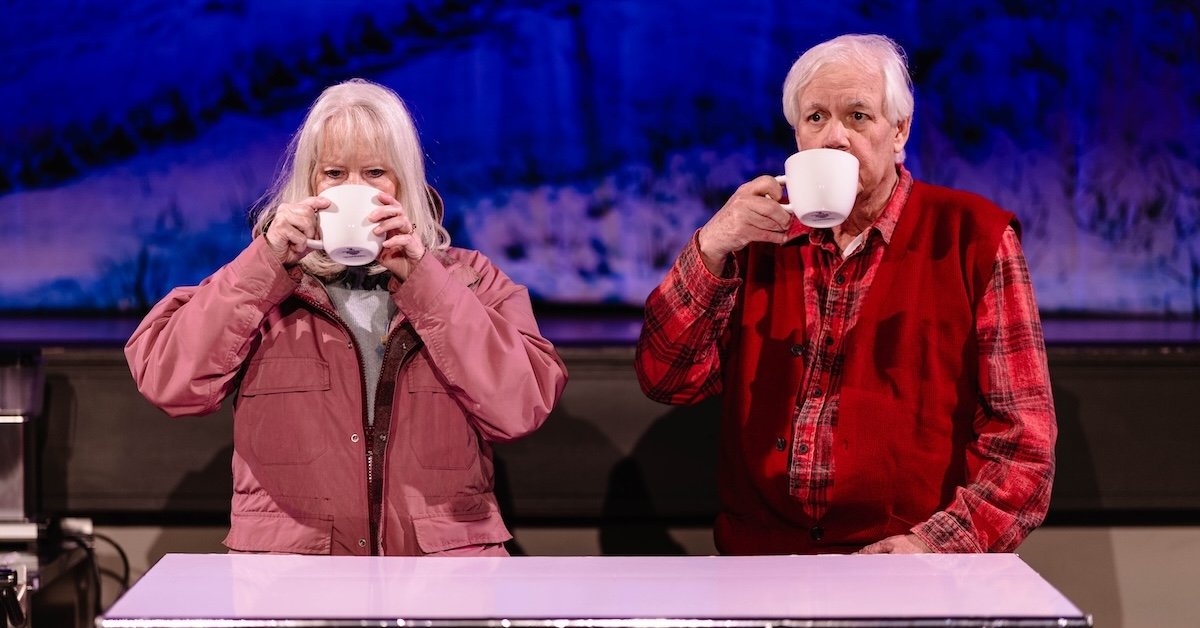
Paul (George Filieau), a retired firefighter, regularly visits a small upstate New York diner where Katie (Lisa Bryk) works behind the counter. They have the comfortable familiarity that develops between people who see each other day after day. Then Paul suggests they become real friends—and that real friendship requires exchanging secrets.
At roughly 75 minutes without an intermission, Harbinger’s production of The Counter is an absolute gem! It’s an intimate play—three actors, one primary location and conversations that gradually reveal much more than either Paul or Katie initially intended. There is nowhere for the actors to hide, and fortunately, this cast doesn’t need to.
George Filieau as Paul gives us a man who feels immediately familiar. Filieau has a wonderful ability to make Paul’s humor and routines feel natural rather than performed. He can be funny, stubborn and endearing, but as the play progresses, Filieau gradually lets us see the vulnerability underneath.
Lisa Bryk as Katie has the equally difficult job of showing us the difference between being friendly to someone and actually letting that person know you. Bryk handles that transition beautifully. Katie listens as much as she speaks, which is particularly important in a play where listening eventually becomes an action in itself.
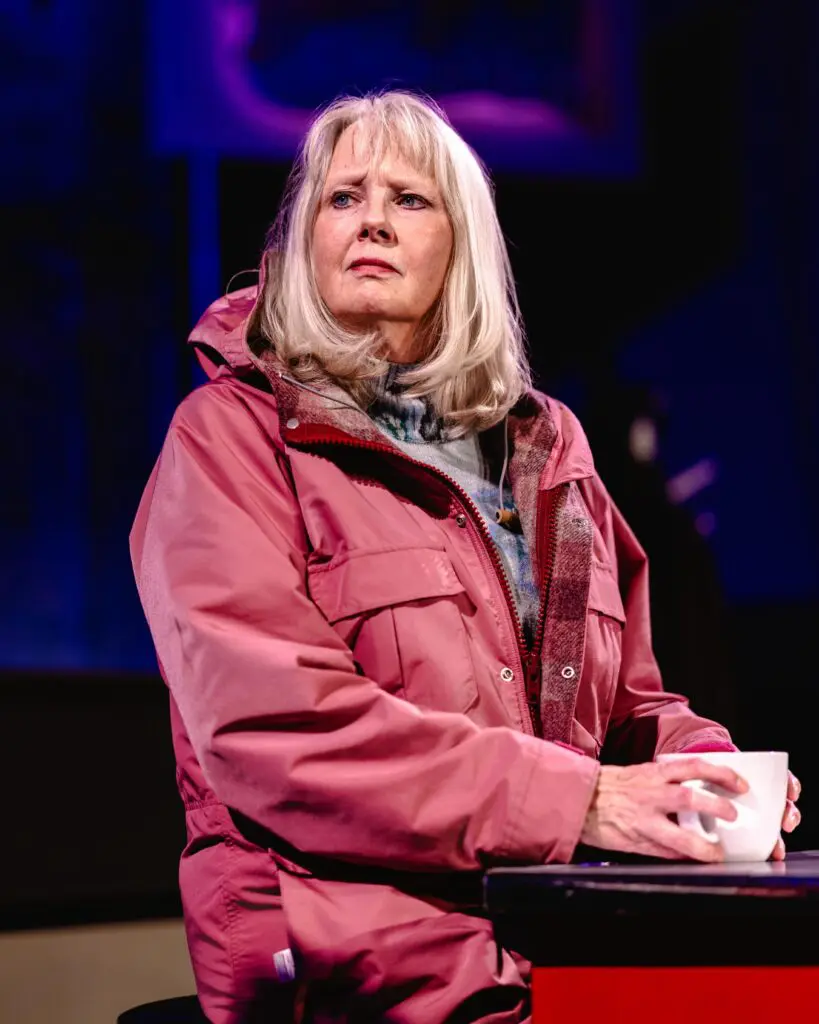
Joyce Reynolds as Peg, the town doctor, enters later in the play and immediately changes the energy in the room. Reynolds makes the most of her time onstage, bringing warmth, humor and another dimension to this small-town world. Like so much in The Counter, there is more beneath the surface than we initially understand, and Reynolds lets that emerge naturally without telegraphing where the play is headed.
Director Patrick White wisely doesn’t over-direct this quiet play. He allows conversations to breathe and trusts his actors. That restraint is important because The Counter isn’t driven by action in the traditional theatrical sense.
The action is someone deciding whether to say something.
Someone hearing it. Someone figuring out what to do with the information they now know.
White was also responsible for the set design and created the ordinary diner environment necessary for the story while tackling the challenges of a production staged at the Albany Barn. Kudos to the rest of the production and creative team:
Regina Baker as stage manager; Jennie Sinnott and Meghan Ryan-Adair for set construction and decoration; Michael O’Keeffe as board operator; Stephen Wilson as lighting designer; Marjorie Geiger as house manager; and Kayla DeMicco as PR coordinator.
One of my favorite elements of this production was Shaya Rayes’ sound design.
Rayes makes the smart decision not to overwhelm this intimate play with unnecessary sound. Instead, one of the simplest noises associated with a diner becomes one of the production’s most effective devices—the bell over the door.
The bell is used to mark the scene changes.
It’s a wonderfully economical choice. We recognize the sound and understand exactly where it belongs, but Rayes repurposes it as theatrical punctuation. A scene ends. The bell rings. Time moves forward. We return to the counter.
As the pattern repeats, that tiny sound becomes part of the rhythm of the play. There is something especially appropriate about using the sound of a door in a story about the difficulty of letting people into our lives.
Rayes also creates a terrific musical introduction with a preshow playlist rooted heavily in blues, early rock and instrumentals. Her entire playlist is:
- Sleep Walk— Santo & Johnny
- Blues We Like — B.B. King
- Deep Freeze — Joe Houston
- Slow Blues — Mick Taylor
- Big Baby Blues — Ritchie Valens
- Remembering You — Roy Rogers (Blues)
- Blues on a Borrowed Guitar — Snowy White
- The Return of Duke’s Mood — Duke Robillard
- Movin’ and Groovin — Duane Eddy
- Red River Rock — Johnny & The Hurricanes
- Albert’s Shuffle — Mike Bloomfield & Al Kooper
It’s an interesting musical landscape for this particular play. The blues is particularly well suited to these characters—music capable of expressing loneliness, loss and longing without surrendering entirely to any of these emotions.

Even some of the titles seem to have been written for this play: Remembering You. Slow Blues. Sleep Walk. Blues on a Borrowed Guitar.
There is repetition in blues music—a familiar structure revisited again and again, with small changes carrying the emotion. There is repetition in The Counter, too.
Paul comes to the diner. Katie serves him. They talk. Another day comes. They do it again.
But each conversation is slightly different because now they know something they didn’t know before.
What makes Rayes’ design particularly effective is that once the play begins, all that preshow music disappears. There isn’t a soundtrack continually telling the audience what to feel. There are voices. Pauses. The bell marking the scene changes.
And silence.
Until there isn’t.
The only music heard during the play is Henry Mancini’s Love Theme from Romeo and Juliet, which accompanies a wonderful moment in which Paul dances with Peg.
It’s a fascinating selection with a history that adds another layer to the production. The melody was composed by Nino Rota for Franco Zeffirelli’s 1968 film Romeo and Juliet. Henry Mancini created his own instrumental arrangement, which became a huge crossover hit in 1969, spending two weeks at No. 1 on the Billboard Hot 100 and knocking the Beatles’ “Get Back” from the top spot.
The melody took on another life when lyrics were added and it became widely known as “A Time for Us.”
And A Time for Us is an unexpectedly perfect phrase for The Counter.
This is, after all, a play about time. Time spent sitting across from another person. Time lost to grief. Time spent keeping things to ourselves. And the finite amount of time we have to really know one another.
Because Rayes has withheld music throughout the rest of the play, Mancini’s sweeping romanticism immediately changes the atmosphere. Paul and Peg dance, and for a brief moment a play built almost entirely upon conversation allows music and movement to do the talking.
That restraint is what makes Rayes’ sound design work so well. The preshow playlist establishes the emotional world. The bell gives the play its rhythm. Mancini allows one fleeting human connection to become almost cinematic. And the silence gives everything else room to breathe.
The Counter asks what happens when the everyday relationships in our lives stop being superficial. What responsibility comes with truly knowing someone?
Harbinger Theatre doesn’t try to answer those questions for us.
Instead, it gives us three people, a diner counter, some coffee, a collection of secrets—and the occasional sound of a bell.
Someone speaks.
Someone listens.
The bell rings.
And time moves forward.
Perhaps that is what A Time for Us means here. We get only so much time with one another.
The Counter reminds us to use some of it to listen.
Performance Info:
Albany Barn
56 2nd Street
Albany, NY 12210
9/17-9/26
$15
Tickets may be purchased by clicking here
Photos from Andrew Elder of Best Frame Forward

