



Johnny Temple: Pages For The People -By: Liam Sweeny
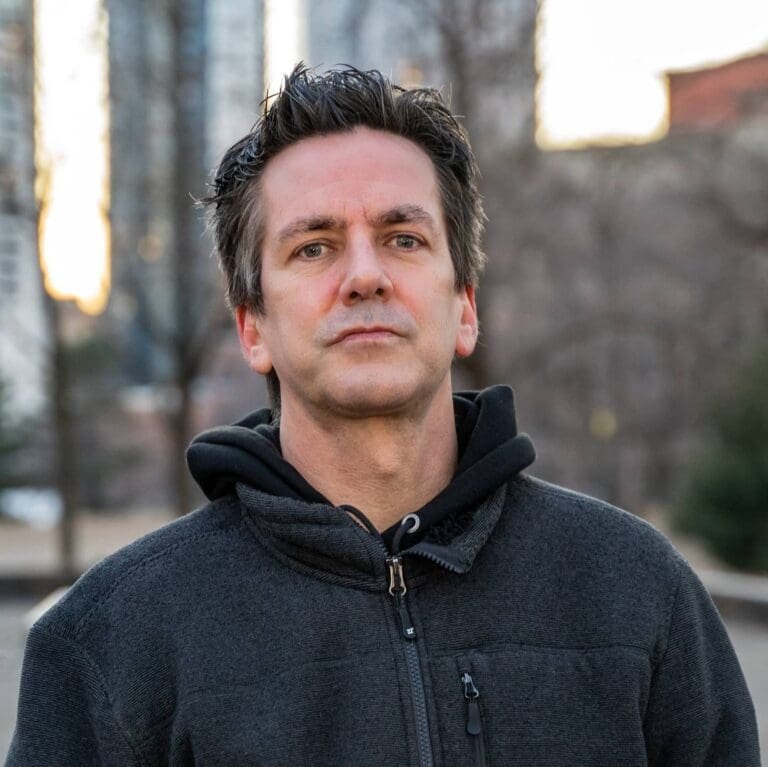
It seems like with everything, there’s an establishment, and there’s an anti-establishment. In music, there are huge conglomerate record labels, and there are Indie labels. In the book world, it’s no different. Behind the scenes, you have about five major publishers that dominate your local bookstores, and a wild west of indie publishers. And one of the handful of sheriffs in this vast Dodge is Akashic Books.
Akashic was founded by Johnny Temple in 1996 to gather and preserve the world’s cool literature from the prophesied global destruction of Y2K. Nah, I’m making that up. Welcome to literature. Johnny was also a bassist in the DC music scene.
I sit down with Johnny to talk about the Oxford comma and the rising cost of ink.
RRX: You’re not just a bassist. You’re also the publisher of Akashic Books, a Brooklyn-based independent publisher that has been pretty much an oasis in the indie scene. As a writer who has books chugging along in indie, it gives me a warm fuzzy to know that you’ve been around since 1999. That’s practical immortality for indies. How?
Akashic started as a record label in 1996, and then we published our first book in 1997. I never thought it was going to be easy to start a book publishing company, but I had the great fortune of starting the company as a hobby when I was a full-time musician in Girls Against Boys, and we had a few years where we made a lot of money, so when we signed to Geffen Records in 1996, I had disposable income for the first time. So I started the company with two friends, Bobby Sullivan and Mark Sullivan, basically as a hobby, and Mark and Bobby walked out of the company early on, but I kept it going. I had this really great grace period of like four or five years where the company didn’t need to make any money. I don’t think I could’ve gotten it off the ground without that grace period.
Also, I think, anyone who runs a record label, or a publishing company – you do it because you think you have good taste. And I think I have good taste. That’s what the success of my company ultimately comes down to, being able to identify great books. We publish a lot of African American authors, writers from the African diaspora, Jamaican writers, Trinidadian writers, and we’ve helped to launch some really important literary careers.
I’ve always thought that if you can somehow manage to keep the doors of your business open, you’ll allow for the possibility of success to come along at some point. And in 2011 we had a mega smash hit, our fake children’s book for parents called “Go the Fuck to Sleep.” And that book has sold several million copies, and just continues to sell large amounts of books year after year. Singlehandedly, that book stabilizes the company and allows us to keep going.
RRX: Akashic’s tagline, from the Google machine, is “reverse-gentrification of the literary world.” And it taps into something that writers know that many people, including readers, don’t. There’s a social strata, an elitism. Is reversing that a founding principle of Akashic, or was it something you ran across in the business, and picked up the cause?
That’s a great question that I don’t think I’ve ever been asked. That was a founding principle, It wasn’t something we came up with – that tagline was devised by fellow DC punk rocker Chris Thomson came up with that, a number of years into our company’s existence. He came up with it based on the work we were doing. I don’t like the elitism in the book publishing business. Sometimes it feel like the book business is largely based in Manhattan, a bunch of very well educated, mostly white people, gazing adoringly at themselves and their classmates from Ivy league schools and publishing, sort of, one another. And then complaining that no one reads anymore. Whereas, when you say no one reads anymore; have you tried to sell your books to everybody, across the social strata? It seems to me that huge swaths of the population are not marketed to with books – basically ignored by the book business. And that’s slowly changing, but we want to be part of that change. We need to get more books to more people, and more relevant books to more people, and that’s one of the more exciting challenges of publishing books.
RRX: One of your authors is Les Claypool, bassist from Primus. He’s such an amazing player, and he’s constantly collaborating with people. I can say he’s stellar, but you’ve worked with him. I’m guessing you knew him before he publishing with Akashic, but what the hell do I know? What’s his story, with his book, or with any random hijinks?
Before publishing Les, I had met him. Girls Against Boys had played in a festival in Belgium. We shared a stage with Primus, and I think I met him in passing, but we didn’t know each other. The book actually came to Akashic through a literary agent, the book publisher’s equivalent of a rock ‘n’ roll manager. When the book was submitted to us, I was very excited. This is Les Claypool’s novel, “South of the Pumphouse” I read the book, and I loved it. We decided to publish it. We’ve been very successful with it. We’re in the tenth or eleventh printing. And then, along the way, Les and his team talked to us about publishing an oral history of Primus. So we did the Primus book, which was also just such a great process. Les and Primus; they have so much integrity. Talk about process, you know, it’s like they do everything right, and they’re wonderful to work with. I don’t have too many hijinks, other than… this isn’t hijinks, but Les will play every once in a while in New York City, and whether it’s Primus, or part of another band, I’ll go to the show, and I’ll get to go backstage, and it’s very interesting to be backstage at a rock concert as a book publisher. Whereas I’ve been backstage at thousands of rock concerts as a musician.
I hope to do more books with Les Claypool. He’s got a lot of stories, obviously, inside of him, and I’m a bass player, and he’s a huge inspiration. What he can do with a bass is just sort of jaw-droppingly. There’s so much that he does that I would never be able to do.
RRX: Before Akashic, or actually during, you were the bass player in a band called Girls Against Boys, that’s been signed to a number of record labels, including Geffen. Can you tell us about the band?
All of us in Girls Against Boys are originally from Washington DC. So we all came up out of the DC punk/hardcore music scene, Dischord Records. We had three of the four of us in Girls Against Boys play in SoulSide, which recorded from Dischord Records. In fact, during the pandemic, SoulSide put out a new seven inch from Dischord. When SoulSide broke up in ’89, like a year or so later, most of us moved up to New York City and started working jobs in New York and playing music. So me, Scott (McCloud) and Alexis (Fleisig) in Girls Against Boys were in a band called Little Baby with another DC musician named Mike Fellows. That evolved into Girls Against Boys, with me, Scott, Alexis, and Eli Janney. Eli had started Girls Against Boys as a studio project, originally with Brendan Canty, the drummer of Fugazi. They were just messing around in the studio, making experimental sounds, and at some point, they pulled in Scott, and then me and Alexis. And we just messed around and made some recordings. And we ended up becoming the very first Girls Against Boys.
A little while later, when me, Scott, and Alexis were in New York, Eli was still down in DC, and we decided to turn GAB into a proper rock band, post-punk, whatever you want to call it. Noise rock. For most of the band’s career, we were a New York band. We put out our first EP with Adult Swim, which is a branch off of Dischord Records. Then we put out three albums on Touch and Go Records in Chicago. Then we signed with Geffen, and put out a record with Geffen in, I think it was 1999. And then in around 2001 or 2002 we put out our last Geffen record, “Jade Tree” and now we’re independents. A few years ago, we put out an EP, and right now, we’re writing new songs. It’s an old band, but we’re active once again. And we’ll be doing some touring in February.
I’m in a new band right now, called Fake Names. Diane Baker on guitar, he was most famously played for Minor Threat, one of the two biggest hardcore bands of all time, and this guy Dennis Lichsen, Swedish, and he is the singer of a band called Refuse, this incredibly popular Swedish hardcore band. So the two of them, me, and Mike Fellows, who’s another DC musician who played in a band called Faith. Over the pandemic, we put out our first album, and we just released an EP with Brendan Canty from Fugazi.
 Art

 Peggy
Justyna Kostek: Staging Greatness -By: Liam Sweeny
Whether it’s a song lyric, a visual motif, a short piece of flash fiction, a movie, or a play, all art tells a story. But whereas almost every form of abovementioned art can be reproduced and spread far and wide, some forms lose something. A live show’s not the same as a recording. But a play in a theater is a true “had to be there.”
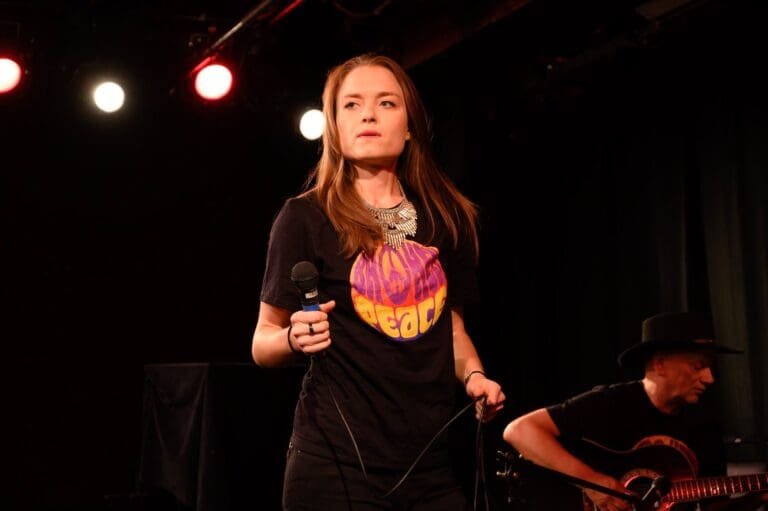
People who gravitate to the theater have passion and big personalities. They have to; the stage is hungry. And Justyna Kostek has spent her life feeding that hunger act by act, crowd by crowd. She’s made us laugh and cry, and she’s here.
I sit down with Justyna, and we discuss red velvet curtains.
RRX: You were born in Poland, near Berlin, and you were exposed to theater there, only to move to Copenhagen, where we can imagine your passion for it grew as you performed festivals throughout Europe. How does theater, as an art form, in Europe compare to other art forms like music, writing, and visual art? Is it different than it is here?
In Poland we have a long tradition of satirical cabaret that’s rather special and I imbibed some of that, and I was fortunate to have teachers and directors in Poland, themselves steeped in theatrical tradition, who could sense how eager I was myself for the freedom of the stage. That’s part of the reason why I teach theater and public speaking to kids now among many other things I do, because I know how influential art can be in early education. And then yes, as you say, Copenhagen, and the wonderful Commedia School. How much I learned there! The art of storytelling, cabaret, buffoon, commedia mask work, physical theater…. All provided me with wonderful tools to use on stage! And taught me how to create original theater. I am so grateful to have continued that journey of physical theater in NYC at the Circle in the Square Theater School with great teachers as Shelley Wyant and Christine Sang among many others.
Honestly I think I was inspired as much by my grandmother’s singing as by anything to do with theatre, strictly speaking. She performed traditional songs and dances and instilled in me a sense that anything is survivable. Like so many Poles of her generation her sufferings were great during the war, very great; however, she never lost the spirit of affirmation and joy I can hear in her voice even now when she sings to me on the phone.
But you asked me about differences between theatre here in the US and in Europe. One clear difference is that unlike in the US, live theatre is subsidized by the government. That has advantages and disadvantages, of course. But when I went from festival to festival with my little company, we were always sure of a venue. And that’s an advantage, I must say. I do like a rich red velvet curtain, but I find it is little used anymore.
RRX: Forking from the previous question; so you have passion for and skill in theater performance that began in Europe and made the trip to America with you. And as I asked previously how European theater plays with other arts, I now ask; how is the American theater scene different than the European theater scene?
American theatre is break out theatre, its experimental, it has a different energy than plays from the –what a funny expression–Old World. Also, In America you have this glorious unique thing called the Musical! That’s what brought me to New York City from Denmark 7 years ago. My love for connecting music and theater. It is much more celebrated in the United States than in Europe. So when COVID took theater away from us – music still remained in my life and I am currently working on my first album with the extraordinary rock musician and beautiful soul Niki Kaos!
RRX: A few years ago, you directed and starred in Helen of Troy, NY. It played nearly two-hundred times in New York and came up here to rave reviews. What is it about? Can you describe it, and how was it coming up to the Capital Region and performing a play about the Collar City? Did anyone not like it for whatever reason?
Doing Helen of Troy NY was Don Rittner’s idea. We had just met and when he learned that I had a theater background asked me to codirect it with him. Don had the play for years and wanted to do it in Troy because the collar bosses in the city in 1923 would not let it play because it was a spoof on them. It was George Kaufman’s second play and a big hit in the city and around the country but not in Troy. Don wanted some poetic justice so he and I put the show together and had six sold out performances back in 2015. I also played the part of the French photographer. The original Helen starred Helen Ford who was born in Troy so we thought that would be a great hook also on doing it here. The play was about an imaginary Troy collar company and the two founders who fell out with each other but it was Helen who brought them back together by inventing a new collar. The music was written by Kalmar and Ruby the same guys who did music for the Marx Brothers movies. Don and I are talking about doing it again in Troy next year since it was so well received.
RRX: So let’s talk about your current project, Dietrich Rides Again, about the legendary Marlene Dietrich. She was a stunning actress and a powerful woman. She has qualities that I imagine would make anyone want to pay homage. Was there anything specific about Dietrich that caught your fancy enough to portray her?
In 2016 I was starring in an original musical Bound To Rise at the Medicine Show Theater in New York City and the music director of the show kept nudging me that I look and sound like this famous Hollywood movie star Marlene Dietrich and I must read up on her. By the 30th time he told me that I decided to read up on her and got so inspired by her life. I got together with one of the directors at Medicine Show – Oliver Conant and we co-wrote the show.
The fact that she used her international stardom to fight the evil during the WWII caught my heart right away. In 1929 when already so famous from her movies made in Germany, she moved to United States and joined the US army and performed on the war field for the American soldiers for the whole 5 years in Europe. She refused Hitler’s several requests to come star in his propaganda movies for millions of dollars. She saved many Jewish people from Europe and brought them to America. When she was as famous as Marylin Monroe and she didn’t even have to move her finger. I admire that so much. She died penniless.
The more I read, the more films I watched, I must say, I fell under her spell. Think of any of her film performances, how she holds her partner’s gaze. The way she has of admitting you to her beauty! There’s her stillness, something in her that may have belonged more to the theatre than to movies, and, of course, the lighting she learned from her beloved Von Sternberg, and something else, too. She’s a great clown. Now when I say that to Americans it can be misunderstood, but when I say she is a great clown I say it with utmost respect, as one would say it of Charlie Chaplin—whom she knew, of course!
RRX: Marlene Dietrich was unique for her time. She broke rules and norms, and she was unapologetic in being who she was. She operated in an industry run by powerful men and she didn’t flinch. She had to be a great character, but how do you portray her in an age where empowerment isn’t as revolutionary as it was during her time?
She had a good mentor: Mae West. I do think her example remains an empowering one to the LGBTQ+ community. Whenever I advertise my show at the Pride events in NYC I meet many other Marlenes. The theater industry is still run by men. On my journey with Dietrich Rides Again I certainly encountered and continue to encounter many things that Dietrich herself had to deal with as a woman in the showbusiness.
RRX: Dietrich Rides Again is an interweaving of theater and film, at least thematically. So I’ll ask this in a space where many people don’t experience both. What can we get in theater that we can’t get in film? And do you prefer films that started in theaters, or plays that take from films, if you had to choose one?
You know it’s interesting I was thinking of Cold War, which has some of the same kind of singing my grandmother did, and it’s certainly very theatrical! In old age, you know, Marlene dismissed her silent film career. In the wonderful documentary by Max Schell she even calls The Blue Angel, her first film, “quatsch’ or kitsch or whatever she says but I think its fun.
As an artist starring in the film you don’t get the immediate response from the audience where as in theater you are literally “serving the audience” your humanity. That is what’s different. Sharing the beauty of humanity together. Artists– serving, the audience- responding.
RRX: This is where you answer the question I didn’t ask. Any cool superstitions behind the curtain? Alternate uses for pancake makeup? Educate, enlighten, emote – the floor is yours.
In Europe if the script falls on the ground during rehearsals you must step on it before picking it up otherwise it’s “bad luck”. In Poland if you don’t take a shot of vodka before doing certain kind of traditional productions you will get booed by the cast. I believe in the Netherlands the shot of vodka is replaced with the joint of marijuana.