
What a weird and fun song!
Bailey Bennett -The New Paltz Scene, an Intimate Basement Venue and Power of Noise and Underrepresented Genres By: Joshua Reedy

Bailey Bennett is the exceedingly kind, humble and eloquent mastermind behind several mostly unnamed solo experimental noise projects. On top of using twisted tape loops to create churning, stunning walls of texture with which to accompany himself; Bennett also lives in and operates an intimate basement venue in New Paltz alongside several similarly talented roommates. After attending my very first post-COVID basement show, Bailey and I sat down for my first in-person interview since the lockdown to discuss his style of performance, the New Paltz scene and why noise music is deserving of a higher level of recognition.
RRX: I want to start things by just asking you, because this is a totally new scene for me, to tell me a bit about the New Paltz scene having spent time here in college. I know that’s a big question.
BB: I feel like if I were to give one comparison band, that people would know, to the New Paltz scene it would be King Gizzard (and the Lizard Wizard). A lot of bands here have that sort of jazz influence, a lot of people here get it just from being music students who study with the jazz professors. You get a lot of kids who love the heavy-metal and/or psych-rock scene. I think a band like Kablamo! who played last tonight is a really solid example of the quintessential New Paltz band. The noise scene, which is what I am a part of, is sort of non-representative; my whole goal is to promote that and the weird and not shown artists.
RRX: So, like, outsider music that normally isn’t accepted.
BB: Yeah, and I live with six other people but my goal with the venue is to uplift bands that don’t really get to play here. And we can really push the boundaries on what is unrepresented in New Paltz. I think it’s important to the health of the scene, to have a well-rounded lineup of bands. Yes, it’s important to have those psych-rock bands but it’s also important to have that fucking weirdo, prurient-type noise artist included.
RRX: Right. And before I get into what you do as an artist, I want to touch on the venue here itself. I want you to describe what living in a house with a bunch of other musicians and running a venue out of the basement means to you.
BB: It’s really liberating. We’ve just utilized this power. And I threw together this bill, without much of a democratic process (laughs), because On Pink was looking for any shows they could play on July 12th and I just said “You guys wanna play my house on the 14th?” and they were like, “Yeah!” I threw together most of the acts, but it really became a collaborative effort and to me it’s really intoxicating to be able to have, not only really talented musicians in our space giving their all sweating their ass off in this basement, but also having people want to be there and experience it all is amazing. I love music and performers, so being able to act as the intersection of where music becomes performance and visual art that people can engage with is great.
RRX: And it’s no doubt we were all sweating our asses off tonight (laughs). But I’d say having this kind of performance go on in a basement definitely brings a new layer of intimacy and I’m sure the bands would agree.
BB: Yeah! And I think that that intimacy that’s strived for is owed to a lot of the pre-existing house venues here in New Paltz; Nacho House is one that comes to mind. Nacho House had a great festival my freshman year here, but they’ve had a really great four to five years of band performance and audience attendance that was really impressive for a small intimate basement. Seeing that, I really strive for that level of community which I don’t think can really exist without the proprietors of the scene despite the differences in taste and music.
RRX: And that’s a good segue because I was going to ask you about other venues around here and what kind of community there is here. In Albany, it can be very limiting at times with different sides of the scene feeling opposed to each other and trying to bridge that gap can be tough. I feel there may be a tighter sense of community here just due to the sheer amount of art being pumped out by the college scene.
BB: Yeah that’s a really good topic. Post-COVID has created a new canvas that all of these artists now have to fill; that may be a pretentious way to frame it (laughs) but I think there was an emotion that was felt tonight. Very few of us have had this opportunity to sweat together in a basement; I think that’s what makes the cornerstone of the community. I remember being here as a freshman and having venues like Crazy Dan or Nacho House which I mentioned, or the Groove Grove who got a ton of great bands. Laveda has played Groove Grove, which blew me away. There are so many venues that I couldn’t name them all.
RRX: And this is the first live show I’ve been to since COVID and first in person interview I’ve done since COVID as well. We can have a little bit of a collective sigh of relief for this very recent return to normalcy.
BB: It really is like a blessing. I feel so lucky that this could happen at my house with my friends and people that I know and care about. With all of us being vaccinated and some of the fears of COVID being sort of subdued, we were able to have this really excellent experience, and to be the epicenter of that is phenomenal.
RRX: So now I’d like to get into what you do with art personally. To start things broad, I’d like you to try and summarize what your goal with music.
BB: First of all, I can’t exist without Swans (laughs).
RRX: They are a great reference point!
BB: A lot of people will pick up on that. Public Castration Is a Good Idea is one of my favorite records.
RRX: He’s not just saying that folks, it’s the name of an album!
BB: Right (laughs). That record; it was incredible for me to hear as a longtime Swans fan. The first time I heard it I just felt that they had perfected this industrial style that had already been minimized to a point where it’s almost solely percussion. And they use rock instruments to create that sound. What I do couldn’t exist without Swans and their live performance. I’ve never been in a band, it’s always been my dream to but I can only sort of do my solo stuff right now. I have a tascam 464, which is a great piece of machinery that I’m so lucky to have; to me, that is my bandmate. I will play something, and I’ll stop the recording and I’ll just be like “What is this?”
RRX: You must be like, “Nice work tascam! I love what you did with that last part!”
BB: (laughs) Yeah, it really just either cuts a high end or boosts a low end that sort of makes it this team effort. Listening to an album like that Swans record, it shows you how to take a piece and simplify it down to those very angry, primal roots. And the world itself is angry, despite whether or not you want it, the world is angry and violent.
RRX: So now that we’ve talked a bit about your goals, let’s get more into what exactly it is that you do. You mentioned the tascam already but tell me more about the tape manipulation setup.
BB: So, tape is inherently organic; It’s a vessel that contains a sound that otherwise cannot be captured. If you have a tape, and you play it ten years later it will sound different. With the tascam it has built-in pitch modulation, it has a switch that activates a high and normal speed, which a lot of tape machines don’t have access to. Access to these features creates a very organic relationship with guitar, which I already feel is a very dynamic instrument. Taking a visceral style of guitar playing and filtering it through an analog system creates a very intriguing setup. There was actually a time tonight where I played a melody, and I stopped recording, listened back and I was like, “did I just fucking play this?” It’s a humbling situation where I don’t feel like that master.
RRX: You’re being guided by the sound instead.
BB: It feels very spiritual and cathartic.
RRX: I want to talk about some of the unconventional ways that you play the guitar. Tonight we saw you using a bow and rusty nails to get some crazy sounds.
BB: Listening to an artist who decides to take an object and uses it to play guitar and create these textures is always cool. I was working with my dad one summer in my hometown of Saratoga and I found all these really big, old rusty nails. To me, they were gorgeous.
RRX: So, you didn’t pick those up at Guitar Center?
BB: (laughs) No, but I really enjoy the Fluxus movement because they did not care about the outcome; to them it was the tools and the process that made up the art. When I use those old nails, using the rust and the dirt, it creates a different feeling.
RRX: As we come to a close, why don’t you talk about some other New Paltz bands and the bill tonight. I know On Pink is made up of some of your buddies.
BB: Yes, and shoutout to Lip Critic, they’re incredible as well. Nazca Plate played tonight as well as Kablamo! who are also in another band called Bby Carrots.
RRX: Yes! They played the Byrdhouse in Albany.
BB: Right! Shout out also to Delphino and Proximity Crush and the Byrdhouse people. Oh, and Jack Lynch of course, who also did a set tonight.
RRX: Do you have a stage name you’d like down or should it just be you?
BB: (laughs) I don’t know, I struggle a lot with ego stuff so I suppose it should just be my name.
Follow Bailey on social media:
https://www.instagram.com/bee_person1800/
Video of the Day: Honey Hahs – Beer Fear (Rough Trade Session)

These young ladies have old souls. Really enjoy this performance at Rough Trade Records!
John Hebert: Mage of Pages- X-Men, The Punisher and the History of One Man’s Pencil By: Phil Sawyer
Superman, Batman, Captain America, The Punisher, X-Men. All names that used to be known only to the comic book and movie geeks, now have become mainstream, even an eighty-year-old woman could tell you who Batman is. I recently sat down with Marvel comic book artist; John Hebert. We discussed his career and early start in the comic book industry during the 1980s.
RRX: So, John, when did you become interested in being a comic book artist, or artist in general?
JH: As a kid I lost my father when I was very young, and was raised by my mother and grandmother, and Channel 6 started broadcasting the strange show, Batman! And I was hooked! My favorite episode was a cliffhanger and I sweated for 24 hours! How would they get out of it? I actually drew it on my mother’s parlor wall…
RRX: So, what was your first exposure to the comic book world?
JH: When I was about 15 I was featured in a newspaper article about some of my artwork in the Troy Record and I always had an interest in drawing, and of course as a young kid, my mother introduced me to comic books. It was a way of helping me read through high school, and I was involved in plays, painting the scenery signs and I even designed the yearbook cover for my graduating class. I was always kind of the go-to guy for when somebody needed something drawn.
RRX: So, did you have any type of formal training?
JH: Drawing on my mother’s wall when I was seven. After high school, I attended Junior College of Albany (JCA) and met this amazing teacher, who saw my artwork and gave me a lot of instructions! As I progressed, she was able to introduce me to an artist who was active at the time with Marvel. Mike Zeck, who was working on Captain America and The Punisher. I received some great advice from him, and I graduated from JCA. My first professional artwork was introduced to me by a friend at a comic book store called Fantaco. It was one of the first comic book stores in the region, opening in 1979. My friend Rodger Green, who worked there, asked if I was still drawing, and I showed him my portfolio. His intern showed it to Tom Skulan who was publishing black and white comics. This was a time when color was king, so black and white was a daring venture. At the time, I called potted and drew an inch comic, called Sold Out. It ran for two issues and a mini-series, which featured at the time, and predicted the future of the comic book industry. So, before my 25th birthday, I was already a published author and artist, so it was really kind of a fun adventure! That’s how it started!
RRX: So, break down how a comic book is made.
JH: Well, you start with a script. Then you plot out the art as you want it to appear. Then you draw it and send it to an inker who darkens and retraces what you’ve drawn. Then you find a letterer who fills in the dialogue and a colorist who adds the appropriate colors which help bring the drawing to life. And of course, an editor has to approve the overall look and feel of the book. When it’s time to press, presto! You get your comic book. It’s generally done in the matter of two months ahead of its release, so, very fast pace.
RRX: Tell me about the comics you drew.
JH: The companies? Well, Comico, Marvel, Fantaco and so, so many others. I also drew a Dungeons and Dragons style comic for a few years for Steve Sullivan, called Twilight Empire. Which was great at the time! I drew, let’s see… The Punisher, X-Men Adventures,
Deathlock, Newstraila, Johnny Quest, and I was the first artist to adapt Ann Rice, who authored The Mummy books, but is also famous for the Vampire Lestat, adapted into a film with Tom Cruise and Brad Pitt, Interview with a Vampire, so that was exciting!
RRX: Who are your inspirations in the industry? Writers? Artists?
JH: Well, I worked with Mike Zeck, who at the time, was drawing Captain America and The Punisher. He was a major star in the industry and an amazing artist! And let’s see…worked on Stan Lee’s last published work as an artist, and of course, the legendary William Shatner on one of his books, so that was a fun project.
RRX: Working with Captain Kirk! Wow, and the legendary Stan Lee! Those are amazing names everyone knows!
JH: Yeah, it was cool!
RRX: So, what do you think of digital comics?
JH: Good and bad… I like the physical comic in my hand. I want to have it at my disposal as a keepsake. Some like digital, some don’t. Physical comics will always be here…
RRX: Do you have any advice for budding artists and writers?
JH: School! Draw and draw! If you’re a writer, write! Keep practicing and don’t give up!
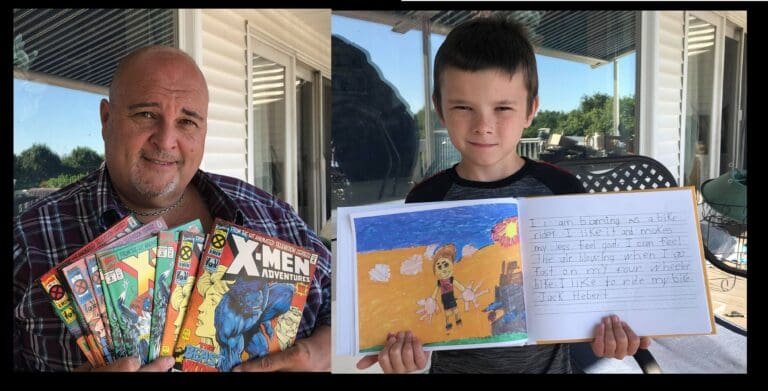
RRX: By this time, a young, struggling artist named Jack Hebert came up to me and showed me his first published art and story! Jack is one of three of John’s children, and he is a seven-year-old twin to Brett. They’re younger brothers to their sister Ari. I teased John Hebert about his son being seven and already published! Good job, Jack! I believe he will follow in his dad’s long career in the business.
For artwork by original comic items and commission art work, contact John on Facebook at John Hebert. John was born and raised in the Troy, New York area and graduated from Troy High in 1983. He’s married to Jody Hebert and they have three great kids! Follow John on Facebook as he posts comic convention appearances!
Video of the Day: Darrin Bradbury – “Artvertisement”

Really support all the great music that Anti-Records puts out!
Linda Gail Lewis -A Natural Talent Comes to the Region From A Talented Family By: Ed Conway

Coming up on August 14th, Linda Gail Lewis will be stopping by to the Hangar on the Hudson in Troy, NY as part of her northeast tour, backed by The Lustre Kings. If you aren’t familiar with Linda, she is the sister of Jerry Lee Lewis. While her brother is considered to be rock n roll royalty, Linda, is a darned good piano player in her own right. With her ever present smile, and boogie woogie style piano, she commands the stage and let’s everyone else in on her party. I’ve had the pleasure to see her a couple of times, once, warming up for her brother, and another time, backed by Los Straitjackets, and was blown away both times to see how much talent runs in that family.
While many in NY’s Capital District may view The Lustre Kings as a local band, Mark Gamsjager and company are highly respected throughout the world. They have played many of the major music festivals and have toured extensively, throughout the US and Europe.
They have backed such acts as Marti Brom and the Queen of Rockabilly herself, Wanda Jackson.
For those that don’t know, Jerry Lee suffered a stroke back in February 2019. Therefore, my first question, when Linda and I sat down and had a chat over Facebook, of course had to do with her brother, despite the fact that it was an interview regarding her upcoming tour and visit, so please forgive me.
RRX: First is more of a personal question, how’s your brother doing?
LGL: He’s doing really well and almost completely recovered from the major hemorrhagic stroke he had.
RRX: Great to hear!! So, was piano your first instrument and do you play any others
LGL: I have always played chords to accompany myself on piano. I played when writing songs. In 1988 I started my solo career and had problems getting a piano player who could play Lewis style. I decided to do it myself. I’d never played rock n roll and boogie woogie before so I had to practice a lot. I was blessed to be able to remember what my brother showed me back in the 60’s and 70’s. It took a few weeks of playing a lot at home and also on gigs, but I figured it out. I only play one instrument.
RRX: You sound like you’ve played your whole life. What was your first performance?
LGL: Bridgeport Connecticut. I flew up from Memphis to play with the Barrelhouse Boys. I assumed they had a piano player. They only had a piano and expected me to play so I did. It wasn’t my best but we got through the night.
That was 1988
RRX: That’s great! What have you been doing during the pandemic to keep busy?
LGL: I’ve played some gigs here in Texas and I was in Memphis last year a few times. Played a gig on my birthday July 18 2020, played in Meridian, Mississippi when they inducted Jerry into the Mississippi Arts and Entertainment Hall of Fame, then I played at Jerry’s birthday celebration at the Lewis Ranch September 29. I wrote and recorded a song “Oh Pandemic”. Did duets with Lawson Vallery from Norway, Ezra Lee from Australia, Paul – Romney Angel from the UK, and Dale Watson
RRX: Sounds busy, but I’m sure you’re looking forward to your northeast tour, besides Troy, where are you playing?
August 13 – The Sportsman Tavern, Buffalo, NY
August 15 – Sennebec Farm, Union, ME (Private Event)
August 17 – Lenny’s, Westbrook, ME
August 18 – Askew, Providence, RI
August 19 – Café Nine, New Haven, CT
August 20 – The Saint, Asbury Park, NJ
August 21 – Buckley’s, Valley Stream, NY
RRX: One last question, the last time I saw you was at Viva (actually I’ve seen you there twice, once warming up for your brother), but the last time was with Eddie Angel and Los Straitjackets along with your daughter and son in law, will Annie and Danny be joining you on this tour as well?
LGL: I love my kids and we play together a lot. I would have loved having them with me, but It would’ve been a long way for them to travel and they have a lot of gigs here in Texas. but hopefully they can join us next time.
I’m so excited about the tour. I’ve always wanted to play with The Lustre Kings. They backed my mentor Wanda Jackson.
RRX: The Lustre Kings are local favorites and The Hangar on the Hudson, in Troy, is one of our favorite venues, Brian Gilchrist takes good care of everyone. Eddie Angel is also from the area, and he loves the Hangar as well.
Thank you very much for your time, and I can’t wait to see you perform again.
LGL: Thank you so much Ed. I’m looking forward to seeing you
RRX: Is there anything else you would like to add?
LGL: I’d like to say that I’m very excited about my tour with The Lustre Kings. I’m happy to have new places to play. I’m happy to do more shows in my own country.
It’s wonderful that we can enjoy music and gigs again. The pandemic was really hard for all of us.
RRX: Very nice, thanks again!
LGL: I would like to thank Fernando Pinto for booking the tour.
Video of the Day: Hans Gruber and the Die Hards – We’re All Gonna Die

What a fun band and to see them live is even better!

Billy Cobham: Song and Influence Interview By: Liam Sweeny

Everybody has a favorite band. Well, if you like music enough, you have a favorite band. You may have worn their record or tape or CD to death, if you’re of an age to have had those things. My band was Mahavishnu Orchestra (MO), a jazz fusion band of amazing talent that lasted just a handful of years. They were addictive if you were into their sound, a true supergroup.
Bill Cobham was the drummer for Mahavishnu Orchestra. He’d also worked with Miles Davis, and spearheaded his own band, Spectrum. He’s taught drums online, and continues to tour the world.
I sit down with Bill and we discuss sonic decoupage.
RRX: I was so influenced by Mahavishnu Orchestra, when I discovered you all, I didn’t listen to anything else for a whole year. How did Mahavishnu start? Was it formal, in the sense of everyone was recruited, or were you all musical friends that got together one night and saw that you had something?
BC: The MO was conceived by John McLaughlin. He invited me to help him play a few themes that he was working on. Since I was not working much I had the time to commit to assisting him. A few days after we were getting comfortable working on these tunes, John brought in Jerry Goldman to join us. This collaboration led the three of us to Electric Lady Land studios for the recording of My Goals Beyond. We recorded with bassist Charlie Hayden. A few days later Jan Hammer and Rick Laird joined us. All in all, I think it took the band about two weeks to finally be “road worthy”.
RRX: You were one of the founding members of a truly groundbreaking jazz fusion group. You all were first among equals. I could ask you what it was like to work with John McLaughlin, or just as easily ask John McLaughlin what it was like to work with Bill Cobham. You also worked with Miles Davis. Were you ever able to just take that all in?
BC: Working with other artists is a learning process. So, one of the main elements that I found to be important is that I make those in my immediate social sphere of influence feel comfortable being around me. The way that I did that was to be punctual, prepared to play, be quiet yet secure in my actions. It worked for me.
RRX: Three years and done. I had read that Mahavishnu imploded due to just getting so big, so fast. I bet you have a better explanation. Do you all, or any part of you, still talk? Do you think supergroups can really last a long time when they’re continuing to get better with every album, like Mahavishnu (yes, my opinion.)
BC: I think there might still be a Moody Blues. I might speak with John on a rare occasion…. The rest even less.
RRX: I asked Mahavishnu questions because the band changed my life, but you were playing with Miles Davis before that, and you went on to found Spectrum after that. Did it ever dawn on you that what you were doing meant more than just the sounds you were coming out with? Did you feel the history you were creating?
BC: No, I was just focused upon the task at hand. I believe that the ego takes a back seat to everything else that goes into playing the music.
RRX: In 2001, you were in the 25 Most Influential Drummers by Drummer magazine. And so, I guess this goes to the previous question. But in particular, you’ve influenced drummers by the way you set up your kit, and the use of Chinese cymbals. Are there any things you do, kit-wise, that most people, most drummers, don’t really know about?
BC: I will add an additional snare or more in certain performance situations. I might use a field snare drum for certain effects. I will incorporate a Cajun with a special bass drum pedal. As well. There’s more, of course……… but, I leave them.
