

By Charla Earney.
A Journey of Self-Belief
Troy’s Monument Square sits at the center of the city like a small cultural heartbeat. Preparing for an interview invokes within me a certain kind of curiosity that requires my attention and presence. From a corner of the triangular plaza, you can look up at the statue perched atop the monument: a woman raising a trumpet toward the sky. I had passed through the square countless times over the years, but on that morning, I was moving at a different pace and thought New York strikes me as a little irrational. Late winter will offer warmth and sunshine, a hint that spring is finally on its way, then a few days later, it reminds us that we misunderstood the arrangement entirely. The cold simply waits patiently behind the curtain, apparently with a very good memory. As the warm weather shone through, a single sentence had been circling in my head: When one’s own self-belief becomes mandatory, one’s own truth becomes a liability. It’s a complicated thought, maybe more complicated than it needs to be at 11 a.m. in Monument Square. But the idea and phrase lingered. We move through life with a set of well-maintained self-beliefs, adjusting them as we go without even realizing it. And sometimes we quiet the voice that asks the simplest questions: Why? Who? What? When? It is the voice of curiosity.
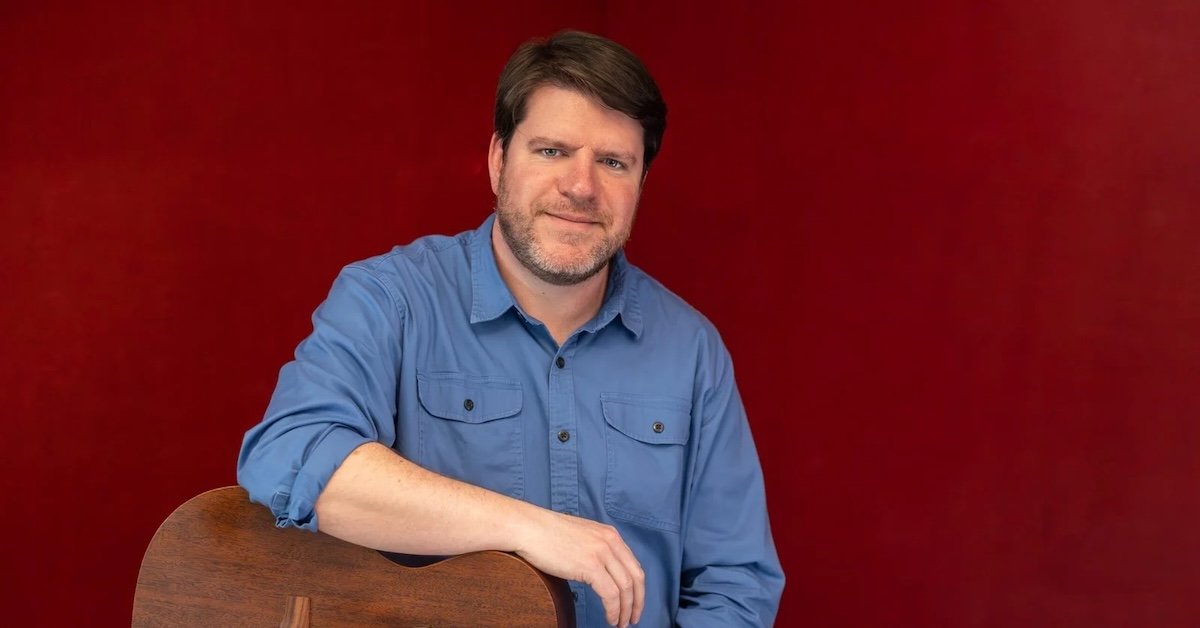
A teacher once pointed out that people often move through life without really noticing what is in front of them. Some individuals, however, tend to notice things. They slow down. They listen. They pay attention. They get curious. That ability to hear, listen, and learn is part of what defines local artist Trevor Collins. For Trevor Collins, music did not begin with a dramatic moment. There was no grand stage, no sudden revelation. It began quietly and curiously. There was simply a guitar in the house. “My dad had a guitar in the basement,” Collins told me. “He didn’t really play much. Maybe a couple chords. But that’s how I first got my hands on one.” That guitar, a Silvertone electric, became Trevor’s introduction to music. His parents were not active musicians, but they recognized curiosity when they saw it. The instrument opened a door.
Later, when Trevor bought his first guitar for himself, he chose an acoustic Takamine, known for its rich tones and reliability. It’s the kind of guitar that doesn’t try to impress you at first glance, but wins you over the longer you listen to the warmth it is known for. Like most musicians, Trevor did not learn through a single path. His playing developed through a mixture of influences, experimentation, and a staggering number of hours spent practicing. “It’s a combination of listening to music my whole life and picking things up from people I idolize,” he said. “And then there’s just sitting at home practicing, trying to figure parts out.” No shortcut there. No secret formula, just time and repetition, which is less glamorous but significantly more effective. From a writer’s perspective, it is simply impressive. But practice alone only gets you so far. “What really rounds it out,” he added, “is playing with other people.” Collaboration changes everything. Add a drummer, another guitarist, maybe a keyboard player, and suddenly the music becomes a conversation rather than a monologue. “That influences where you go,” Collins explained. “What the other players are doing shapes your sound.”
In his early years, Trevor played mostly with a pick. Fingerstyle guitar came later, during his twenties, inspired in part by players like Mark Knopfler and Tommy Emmanuel.
“Fingerstyle lets you tell a story,” Collins said. “You can play the bass line and the melody at the same time. It’s almost like playing piano.” He eventually developed a hybrid technique, part pick playing, part fingerstyle, that allows him to shift seamlessly between the two. Sometimes, mid-song, he literally folds the pick into his palm so he can transition to his fingers. (So cool to watch!) He admitted with a laugh that it took a long time to learn, which felt like a polite understatement. Unlike some fingerstyle players who rely on long fingernails or thumb picks, Collins prefers direct contact. “I like the feel of skin on the strings,” he said. “I use my fingertips.” Years of playing have left their mark: calluses that make contact effortless and allow him to play with both precision and control.
When the conversation turned to gear, a topic that can easily consume guitarists for hours, Collins offered a refreshingly honest perspective. “People obsess over equipment,” he said. “But honestly, it’s eighty to ninety percent your hands.” That realization tends to arrive right after someone buys something expensive. “You need decent gear, so nothing falls apart on stage,” he added. “But your technique drives your tone.” In other words, the guitar matters. But the player matters more.
If guitar playing is the craft, songwriting is the puzzle. For Collins, music almost always comes first. “The guitar part comes pretty quickly,” he explained. “The lyrics can take ten times as long.” Rather than writing about a single moment or relationship, Trevor tends to build songs from several pieces of real life. “A lot of times a song is a composite,” he said. “One line might come from one experience, another from somewhere else.” Listeners, of course, hear something different. A song that feels intensely personal may be built from fragments. That ambiguity is part of what makes music powerful. It leaves room for interpretation, for someone else to step in and make it their own.
Trevor’s life eventually expanded beyond music. Adulthood has a way of rearranging priorities, usually without much warning. Creative pursuits often get pushed aside—not because they lack value, but because life demands stability. Bills tend to be very persuasive. Trevor stepped back from performing regularly during those years, but he never truly stopped playing. “It’s always been my stress release,” he said. “I’ve never stopped playing at home.” Music remained part of his life, even when it wasn’t part of his public identity. During one of our conversations, Trevor described himself as shy. That may surprise people who have seen him perform, because the confidence he displays on stage suggests something different. But confidence and belief are not always the same thing.
For years, Trevor supported other musicians. He played in bands. He contributed his skills to other projects. Standing in the spotlight himself was not something he felt ready to do. “I just didn’t think I was good enough,” he admitted. That belief can saturate a person and is more common than they’d like to admit. Eventually, the right beliefs began to surface and ask the right question:
Why not me?
That question led Trevor to a stage much farther from home. After winning the Capital Region Blues Network competition, he earned the opportunity to travel south to compete in the International Blues Challenge in Memphis, Tennessee. The event draws musicians from around the world. Trevor performed in the quarterfinals at Pig on Beale, a lively barbecue restaurant along the famous Beale Street strip, and later at King Jerry Lawler’s Hall of Fame Bar and Grill, a venue that manages to celebrate both wrestling and music, which feels uniquely appropriate for Memphis.
“It was an incredible experience,” Collins said.
The experience was less about trophies and more about standing among fellow musicians who share the same devotion to the craft. Collins often references guitarists like Tommy Emmanuel, who reminds audiences that dedication matters more than raw talent. “If you practiced as much as I did, you’d be just as good,” Collins said, paraphrasing. It’s an encouraging idea, right up until you consider how many hours that involves. After years of supporting other musicians, Collins is now focusing on building his own project as a solo artist while gradually expanding toward a full band. “I’m doing a lot of solo acoustic shows right now,” he said. “But my goal is to build a consistent band and start doing more studio work.” He already has new music on the way. His acoustic single “Carry On” was released on March 31, a fitting title for an artist who never truly stopped playing, even during the quieter years.
For Trevor Collins, music never vanished. It was simply waiting. If you happen to be around town, looking for the blues, make a point to hear Trevor Collins. You might recognize something familiar in the sound. You will hear the work of thousands of hours, certainly. I heard something else. I heard tell of the moment a person stepped out of their own self-limiting belief into curiosity. Then he listened and responded to a simple question: Why not me?
When you hear Trevor Collins play, you no longer wonder why. You simply know.

