

Danny Schuler (Biohazard) – An Xperience Interview – by Liam
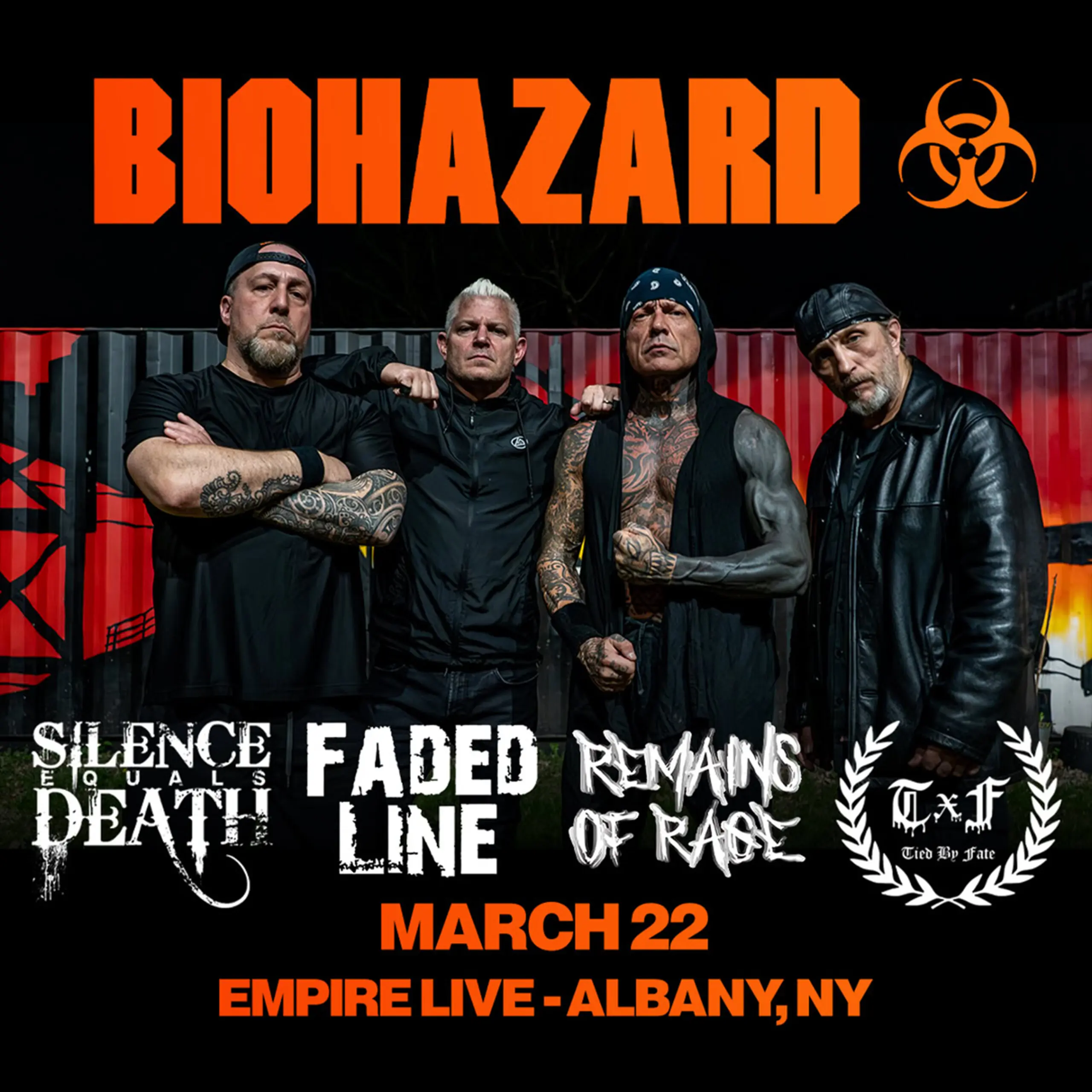
Four guys in a band. That’s what Biohazard’s Danny Schuler said. But these four guys have toured the world, reached a level of success that most bands don’t, and redefined what it means to be metal and hardcore. We welcome Danny and talk about the band’s new album, “Divided We Fall” and their show at Empire Live on March 22nd.
RRX: You’re on tour now and you’ll be at Empire Live in Albany on March 22nd. Now, Biohazard being from Brooklyn, it’s not like coming to Albany, you’re gonna be worried about getting lost. New York City and Albany are kind of locked in with each other. Do you have any cool Albany stories?
DS: We have a lot of friends out there, Albany, Troy, Saratoga, all those areas back in the day. We used to play Saratoga Winners back in the day. There was always a great crew of people up there that we became friendly with and a lot of the bands we became friendly with, so we feel like that’s like a second home for us in a way, the upstate area. I always think back to those Sunday afternoon matinee days that Winners going up there playing and how cool that place was and how great the team was up there. We definitely had some wild days there, wild shows.
RRX: So your latest album is called Divided We Fall. I’m listening to it, and it’s powerful. It’s totally authentic. Biohazard absolutely, but it feels bigger. It feels like there’s more power that kind of hits you in the chest, and I can’t really figure out what it is. Not taking away from the songs themselves, but the recording quality is great, and that’s where some of that power, I think, comes from. Can you tell me anything about what went into the recording?
Danny Schuler: We started recording it last year, and it all came together kind of quick. We didn’t really have the songs; we had a bunch of ideas. Our manager at the time suggested we work with Matt Hyde, who ended up producing the album. That turned out to be a really crucial decision in getting this thing done … because once Matt got involved, we all sent our song ideas to him. He kind of picked through everything and was like, “I think these are your best songs, what do you guys think?” And it was exactly what I was thinking. You know, like he picked through all this stuff, and picked out what he thought was the best song, and that was what I thought was the best song. So for me, I kind of felt like, “Wow, this guy really gets it.” And something Matt said to us early on was, “I know what you guys sound like, and I really think you guys just got to relax and do what you do best,” and that was exactly what I was preaching.
The whole time that we were talking about making a record … everybody always compares everything we do to “Urban Discipline” or the “State of the World Address” albums. Everybody always compares everything we do since then to those moments, and that’s great. It’s flattering that people love those records; so do I. We were at our best.
I think that bands sometimes resent it, like they try to get away from that. They try to do something smarter or try to do something more … trendy, or something like that. When it came time to record “Divided We Fall,” I was adamant. You know, like, “Guys, we gotta make a record where we’re doing what we do best. We do well with what comes natural to us.”
So, in the spirit of that, you know, Matt called me up, and he was like, “Where do you guys wanna record this record?” And I said, “Man, I got a studio right here on the East Coast, cause everybody lives all over the place.” I wanted to do a record close to home, close to New York, close to where we’re from. So my friend has a great studio here. Joe DeMaio’s got a place called Shorefire Studios. Amazing, big room with all kinds of great analog gear and all the new stuff and everything. And for Biohazard, it’s always better to have all of us go in a big room together and just play totally live. And that’s what we did. That’s how we recorded “Divided We Fall,” all of us in the room. Most of the takes are one or two takes on the basic track, and that’s what I think helps to give it that live feel.
RRX: This is interesting. I was watching interviews today, and I saw you guys talking about the 8×8 recording room, this tiny little recording space. Is that something that was a part of “Divided We Fall”?
DS: No, for “Divided We Fall,” we recorded in a big room all together. But what you’re probably alluding to there is about two months before we started recording the album, we met up at a studio in California to work through some of the song ideas. It was literally an 8×8 room, like a tiny little room, all four of us crammed in there playing all our sh** together, pulling together some of the songs for the record, and it was just a cool thing to do. For me, it was a good reminder that we don’t need sh**. All we need to do is just play together. We don’t need fancy kit. We don’t need expensive studio. We don’t need nothing. We just gotta have the spirit of the music. We just got to be inspired. That’s how it all came together, man: inspiration and the right people coming together at the same time.
RRX: I saw a video interview with Billy [Graziadei], and it was Dave Ellison; his show. He said, “The basis of rock and roll is that everything isn’t awesome.” He was talking about the internal stuff, you know? Billy said that if people have strong enough ideas, they shouldn’t compromise just to make people happy. I agree with both of those. Does one lead to the other, do you think?
DS: Well, in a band, there’s always compromise. Always. Compromise can really suck because sometimes … when it’s clear to me that one guy in the band is very inspired, like has a really big energy … I will gladly take a backseat. And help them realize their vision, their way. Because that inspiration comes from somewhere outside of our brains, outside of our bodies, you know what I’m saying? So sometimes you’re a participant in the inspiration, sometimes you’re an assistant. So there is always compromise in a sense, because when you got four guys in a band, and everybody has a different idea for a song, only one guy’s thing is gonna work … and this is pretty much what I think Billy was actually talking about.
RRX: You’re right, he was talking about “if I have this idea and I feel that strongly about it, then anybody who comes up to me with another idea, they should feel that strongly about their idea.” Whoever’s got the strongest idea, whoever’s most inspired, I think that’s what he was talking about. So I think you and he are on the same page.
DS: Yeah, I mean, for me it’s all about inspiration. Like, where is the energy? When I walk into a room of musicians, and they all have ideas. It’s easy to sense where the best or the strongest energy is. I like to collaborate, and I like being part of a band, so I like to latch on to that energy and try to get inspired by it as well. It’s not all about me just pushing my energy. I’m going to make this happen. I’m going to try to help make this happen for all of us. There is kind of a compromise when you create, so I kind of agree with both points of that. But yeah, if that’s what the question was, I mean, I get it … you got four guys in a band, we argue, we fight, but at the end of the day, the true inspiration should be the energy that pushes the idea through.
A lot of us back in the day saw Biohazard as synonymous with New York hardcore, but it wasn’t totally that way. I heard that Agnostic Front and Cro-Mags had a huge influence on bringing you guys into that fold. How did you meet those bands?
RRX: Well, uh, I grew up in Brooklyn. We grew up mostly in the five boroughs in New York City. That time period of the late 70s, early 80s was kind of like the time when a lot of punk and hardcore bands were kind of establishing the beginnings of their scene. I mean, fans like Agnostic Front, Cro-Mags were huge influences on us. They came before us. They invented this stuff and being where we’re from, we were able to know those guys, to see those guys early on. I mean without the influence of of the bands that came before us we definitely wouldn’t even exist right now but in that sense also.
In all due respect to those bands, they do what they do best, and like nobody can do what Agnostic Front does better than that. Nobody could do what Cro-Mags did on Age of Quarrel better than them. Nobody could do what the Bad Brains did on the raw cassette better than them. So when we came along, you know, we were very inspired by those bands and, and a lot of other bands too. But it was an important part of our mission was to take inspiration, but we also wanted to innovate something new. We didn’t want to just copy what those guys did because those guys, you ain’t gonna do it as good as they do it, you know what I’m saying? They’re the best at what they do, and there’s no disputing that. But we wanted to come up with something that was uniquely our own thing too, that contribute to the culture, you know, because we felt like, We felt like where we were coming from was a little bit different. We were coming from Brooklyn, there was a lot more of a hardcore, hip hop kind of thing going on in the streets back then and like where we were from Brooklyn, the neighborhoods were a little different and life was a little different than lower Manhattan. I think that rubbed off on us and rubbed off on the music in a certain way.
I think it has a different kind of sound, the way those guys innovated funk and hardcore and everything. We wanted to honor them. We were inspired by them, but we didn’t want to just copy them. We wanted to take the inspiration of what they did, and we wanted to put our own kind of signature sound on it too, and I think we kind of did achieve that in a way. Like you said, Biohazard wasn’t purely a New York hardcore band. There was a lot of other things going on within Biohazard, and in the music, and there still is. But without a doubt, the prime inspiration and motivator behind the beginning of the band and, and even now was absolutely hardcore and the New York hardcore bands from that, from that early time of hardcore, punk, you know.
RRX: Growing up, we would automatically have considered Biohazard New York hardcore, like back during Urban Discipline, that’s what we thought. That’s just how we saw it, you know, we didn’t know that there was any kind of question.
DS: To have somebody call you that is an honor. It’s like a badge of honor, and it always was for us. But to us, our heroes were Agnostic, Cro-mags and the Bad Brains. We never felt that we were on the same level as them, you know, we always felt like we were the little stepchild of all those great, great bands, you know what I mean? So to be mentioned in the same breath as Cro-mags and AF and Murphy’s Law and all the great original bands who created this sh*t; that’s like a big honor. We didn’t wanna disrespect that honor by just copying them. We wanted to try to bring something new to the culture too, you know, and keep it growing, keep it moving.
RRX: I’m sure you guys, because you’ve been around so long, I’m sure everybody’s like, ‘hey, you should do this, you should do that, social media, we gotta, we gotta follow the trends, all this, and that’s not internally, that’s all the industry people and fans and like everybody outside of the music. How do you keep from, from going nuts from all that or trying to do too much to make too many people happy?
DS: I don’t do too much of any of that stuff. I can’t speak for the band, but my life is very simple, and I like to keep it simple. I enjoy playing the drums. I enjoy writing music and recording music, and that’s pretty much all I do in my life aside from hang with my family and my friends and play with my band. So, you know, all the other stuff that goes along with being in a band and the social media stuff and everything else, I’ll go up there and post when I have something to share. And I, I pay attention to social media because it’s a great way to link together friends and other bands that I love, so I pay attention, Yeah, I don’t know how this shit works in the music business. I really don’t. I don’t know how it works. I don’t know. I don’t know the function of the music business. I don’t know how, what you gotta do to sell records and make music. I really don’t know. All I know how to do is inspired by music. I love music. I love listening. I love being a part of shows, going to shows, playing shows, and just keeping that energy, and, you know, that energy feels like life to me. So that’s all I’m ever looking for in my own life. And with the band, when it comes to our shows, we all just wanna have like a great time and keep the energy good and strong, and that’s what we’re really focused on. We don’t, We don’t as a band focus on the business side of music too much because like I said, I don’t even know how to do that stuff. I have no idea. I don’t know what works anymore.
RRX: I don’t think anybody does at this point.
DS: I think there’s a lot of people who say they do, and they probably charge a lot of money to teach people how to do it, but I think what comes across is being genuine and having good energy. That’s the thing that draws people in and, and writing really good f**king songs, being good at what you do. These are things that are important to me.

