Photography by: Tim Reidy


Photography by: Tim Reidy
If you are reading this and you are under 65, God bless you and all you stand for. If you are 65 plus, you will appreciate this, and perhaps you have experienced something similar. You know how they call the times of being a senior citizen “The Golden Years”? I’m going to add two words, “The golden years my ass.”
Consider this a word of caution to anyone still in the workforce and not even seriously considering retirement. Believe me, when you hear my story, you’ll be on the phone to your elder-care lawyer by the end of the day.
As of this writing I am 66 and hoping to hit 67 if my vital organs hold out. The story begins when I hit 65 and was required to sign up for Medicare. It seemed initially easy; my wife was still employed, and I was on her health insurance plan. When I spoke to my Medicare rep, I was instructed to just take Part A, and not to worry about Part B, C, D or any other letters we’re informed about from Joe Namath, Jimmy “JJ” Walker and William “I’m Kirk dammit” Shatner.
That all worked until this past June, right after my wife retired from the State of New York. Suddenly, I couldn’t get any more meds, for someone who has had a heart attack, has high blood pressure, diabetes, sleep apnea, kidney issues and has a “member” that looks like a bent carrot, you can see there was a problem.
In essence, all of my medications, 99% them vital, would have to come out of pocket. If it weren’t for GoodRX, I would be writing this piece without an arm and a leg. That also meant no medical appointments, no blood tests, no pee tests, no drug tests (well maybe that one was ok), for nearly three months. Fortunately, I stock up ahead of time on my regular meds, plus the samples provided by my medical providers helped somewhat.
Why did all this happen? An easy explanation, my wife retired before 65, and could stay on her health plan. The problem was I was not signed up for Part B, so my health care plan dropped me like a hot rock. Wait, you say, why didn’t the Medicare people tell you about this? Why didn’t your wife’s employer tell her about this? Why didn’t the health care plan people tell me about this before her actual retirement date? If I had a word that rhymes with douchebag that would be my one-word answer.
Let me pause for a moment to send praise to my wife. I’m having major panic attacks (and without happy pills that ain’t easy), minute by minute I thought I would play Fred Sanford and have “the big one”, and not one person I call can give me the proper answer, and passes me off to someone else, or gives me the “You should have read the fine print” story. My wife was a true rock, she calmed me down as best as she could and told me it was gonna be ok, we’ll either fix the problem and all will be well, or I will drop dead and she won’t have to listen to my bitching and moaning anymore. I’m a lucky, lucky man.
So, cut to the chase, it took a while, but I finally got signed up for Part B. That was the easy part, now I have to get Medicare to get that information to my wife’s employer STAT. Once they got it, I then had to have her employer get that information to my health care plan, also STAT. You would think STAT means immediately. You would be wrong. As of September 1st, my health insurance is now back, I have drugs again, I’m damn near an official Medicare member, and I’m seeing doctors again.
Let this be a lesson, no matter what your age is right now, plan, plan and plan. You are never too young to be ready to get old, it creeps up in no time. As for my wife and me, we’re all good from now through the next three years, when she has to go on Medicare herself, and the merry-go- round starts up again…bartender…
Be hearing you.

RRX: I’m so happy to be talking to you.
CL: I’ve had 14 coffees so good luck to you.
RRX: (Laughs) That’s a lot of coffee.
CL: That’s lite for me.
RRX: So you’re playing at Pauly’s Hotel in Albany, this Friday October 14th at 8pm. I don’t know if you’ve ever been to Pauly’s Hotel.
CL: I’ve heard a lot of good things. First of all, it’s small, it’ll be like a pre-European work-out. We’re doing a couple of dates. We’re doing Long Island at a small club and Pauly’s just before we head to Europe. It’s good to get warmed up a bit. It’s a great opportunity, a small hall apparently, the sound I hear is very good. So I’m looking forward to it, you’ll be there right?
RRX: Yeah, you know it! I’ve played there a few times myself the sound was always good. Also, Pauly’s is a very historical place, it’s like the oldest tavern in the area.
CL: That sort of goes with me because I’ll be the oldest drummer.
(Both Laugh)
CL: The oldest living drummer I guess.
RRX: So speaking of playing drums for a long time, I stumbled on some information that you actually played with The Ink Spots at one point.
CL: The Ink Spots, yeah that was my first gig in the public. Well, I won’t call it a gig, I was actually in charge of the stage. My brothers were working at this cabana club north of Montreal and I would go up there; so they got me a job assisting the stage. Every weekend they’d have people coming up from the Catskills. This particular day when they had The Ink Spots coming, coincidentally at the time the unions were on strike, so they didn’t have a back-up band. So there I was sweeping the stage in the afternoon, they walked in and asked where were the musicians? Here I am 10 or 11 years old and I said I don’t know but I heard something about a union strike. They were like The Temptations of their time.
RRX: Absolutely.
CL: They had their guitar player and he said “while you’re sweeping can you do a little brush work on the drum set?” So what happened at night time was I sat in, I had my bow tie on and everything. It was a dinner club, sort of a night club setting. Here I am a little white kid on the stage with The In Spots. There’s a photo in the book (we’ll get to that later), it must’ve been 1959 or 1960. That was the first time I played in front of an audience. I sat there, I looked out and I noticed that all of these people were looking at me and smiling. I’m sure they were thinking what’s that little white kid doing up there?
(Both Laugh)
CL: But I didn’t give a sh**! Then the lead singer introduces me, “here’s little Corky Laing on the drums, he’ll be helping us out.” The audience loved it.
RRX: That is amazing.
CL: Warm applause and that was it, I was hooked.
RRX: That’s a hell of a first gig!
CL: A lot of people don’t even know who The Ink Spots are because we’re going way back. That was the beginning of the beginning, you know?
RRX: I’m a big Ink Spots fan, I dove into my parents music collection but my then I dove into my grandparent’s collection as well.
CL: I didn’t think of it at the time but as time moves on you realize if you remember that band, historically they were big in their time.
RRX: Most certainly. Now as far as musical success obviously Mountain is the band that you are known for and I read somewhere that before you joined Mountain that you actually wrote some of the lyrics for Mississippi Queen and some of the drum ideas.
CL: When I wrote Mississippi Queen, I was in a local band out of Montreal, we were playing Nantucket Island at the time. What happened was we were playing a cover song “Up on Cripple Creek,” and it turns out an artist friend had a girl come up from Mississippi. She was drop dead gorgeous and she was wearing like a see-through knitted dress and it was 130 degrees in this hot club. This really funky club. The lights went out on the whole island, it went black because that summer was the first summer that they used air-conditioning in Nantucket. I remember the emergency light was shining on her (Molly from Mississippi). So in the the middle of the song the f**king lights go out and the only thing left is the emergency spotlight on her. She’s beautiful and I’m looking at her like I don’t want her to stop dancing so I keep playing. The first thing that I hit was the cowbell because everybody knows when a cowbell is playing you’re going to dance. It implies dancing. So I’m hitting the cowbell and I’m screaming out “hey, Mississippi, Mississippi!” because there’s no mic, I had to scream. I had taken some soul pills that night, whatever that was. I remember screaming and losing my voice screaming “Hey Mississippi, Mississippi Queen, what are you doing?” Then I started singing these lyrics, it was like a rap song. “Mississippi Queen, you know what I mean,” that type of sh*t. She’s looking at me like I’m going to get lucky. She’s dancing with my friend but looking at me. Anyway he got lucky, he took her home. What I did was I took the lyrics that I remembered from that night.
Back then we had no record deal, it was just a cover band. I remember taking it back to New York, where we were staying in a loft on 39th Street. It was really hot! This was August in New York, hot town, summer in the city. I was sitting there thinking I’ve got to finish this song, these lyrics. The reason why I liked it was because percussively the way it sounded you could dance to it. With the band I said you’ve got to help me finish this, I have “went down and around Mississippi” but I needed a city way down south. It needed two syllables, it had to be percussive. A friend of mine David Rea, who I was down there hanging with says wait a second, in Mississippi there’s a town called Vicksburg. That’s a real percussive word Vicksburg, so I stuck that in the lyrics at the time. There’s was nothing going on with the band by the way at that time, this was just dreaming. I remember telling David I’m going to give you ten percent of the song if anything ever happens. Ten percent for Vicksburg! Well wouldn’t you know it! After all these years go by, life goes on and it became something. I don’t think he believed me but I’m from Canada so I’m true to my word.
So anyway I wrote all of the lyrics at that time. Fast forward to when I hooked up with Felix, Leslie and the band. We’re sitting in Leslie’s apartment, just Leslie and myself. Leslie says “we’re going to have to write some songs, we have no material,” he asks “do you have any lyrics?” Sure enough, wouldn’t you know it I had the entire Mississippi Queen song written out. I pulled the sheet out and Rob… within five New York minutes we had the “buh na na nahp” (guitar riff). He screamed out the lyrics as he was playing the guitar. It wrote itself.
That was the song and we brought it into Record Plant where we were recording “Mountain Climbing.” We told Felix we’ve got a song. He listened to it, of course he didn’t write it so he wasn’t that excited. He says “it’s alright, take it home and work on it.” I said “that’s it Felix, this is what we have!” So anyway we put down the track and sure enough that was the track.
If I’m rambling on you know I did tell you about the coffee.
RRX: (Laughs)
CL: At Record Plant Jimi Hendrix was recording “Band of Gypsys” with Buddy Miles, we were right next door. Felix says to me “I know you’ve crossed paths with Jimi up in Montreal years ago, maybe go and ask if he wants to listen to Mississippi Queen.” I said “well, okay.” I knock on the door, “Mr. Hendrix could you possibly just take a minute to listen to a song that we just finished?” Jimi had already played with Leslie on stage in a club that summer, so he knew sort of who we were. So he came in the studio with me and of course all of the guys were f**king shaking. He sits down behind the desk and we put on Mississippi Queen, the final mix. He’s listening with his head over the board and there’s nothing, total silence. At the end of the song he picks his head up Rob and says “cool.”
RRX: Wow. That is so cool though.
CL: Needless to say we all looked at each and thought well if Jimi Hendrix thinks it’s cool, it’s f**king cool!
RRX: Ain’t that the truth?
CL: And I don’t mean to drop names or be that kind of guy. I was just very lucky to play, record and perform with a lot of these amazing players. I don’t like to boast but at this point in my life, why the f**k not?
RRX: Now I know Mountain played Woodstock and Jim Hendrix of course as well but you were just shy of doing that right?
CL: (Laughs) Just shy? I’ll tell you a quick story. Dig this, on the Woodstock record they put Felix’s version of Yasger’s Farm. So I was there in spirit because he played a song I co-wrote. I hope you’re taking notes. So I hook back up with Felix and Leslie again in the studio recording “Mountain Climbing.” Next door they’re mixing the Woodstock album, the first one. There was a track by Ten Years After called “Going Home,” but what happened live at the show was the microphones on the drums didn’t work. They somehow broke down, so they didn’t have a drum track. They knock on our door and ask “Corky, can you help? Can you take a few minutes and put drums on this song?” I go next door and sit down at the drums, I asked what’s the song called? They say “Going Home.” I said okay how does it go? They replied, “going home, see my baby going home” I said that’s nice how does the chorus go? They said, “going home, see my baby going home” I say, that’s a piece of cake, how does it break out? They say, “going home…” I say okay.
The only thing I didn’t know was what sort of medication Alvin Lee was on because the song went on for like nineteen minutes, it kept speeding up and if you know anything about trying to play along with a track, it’s not the easiest thing. I finally got the whole thing down and they said Corky thank you so much let’s fill out the papers and we’ll get you paid up. I said forget about that I’m going home.
About two weeks later I get a knock on the door and there’s a big brown package. I open it up it’s the gold record for “Going Home” at Woodstock. I said wow I didn’t expect this. I said that’s fantastic. At the time I managed to snag a beautiful old apartment in the village with brick walls. I put this beautiful gold record on the brick wall and Rob did it shine, boy! I thought Corky you are happening! Two weeks later another knock on the door and another brown package. Do you know what it was Rob? It’s another gold record for Yasger’s Farm because I co-wrote the song. I said wow! I take this second gold record from Woodstock and I hang it beside the other gold record. I’m looking at these gold records Rob. I’ve got two beautiful gold records for Woodstock and I wasn’t even f**king there!
(Both Laugh)
RRX: That’s great!
CL: True story and I’ll stick to it. You know when people say I wasn’t there, you bet the f**k I was, I’ve got two gold records on this beautiful brick wall. Anyway that’s the story, it worked out even better. Every time I see him over the years he’s like “Corky why the f**k are you telling everybody that it’s you on that record?” Hey, it wasn’t my fault, it’s a great story, I’m not going to give up a great story, that’s all we’ve got in this business. We’ve got t-shirts, posters and stories! Hope the stories are the most colorful.
RRX: Speaking of stories, you’re still making stories. You have a book and you are working on another.
CL: The book that I wrote with my girl. Years back she found letters that my mother kept that I wrote her over the years of being on the road from 69′ until 98′. Whether I played a show at an armpit in Nebraska or at Carnegie Hall, I would go back to the hotel and it would always be tremendously quiet and lonely. So depending on what I was smoking, I’d sit down and write my mother letters that I didn’t know she kept over the years. Tuija my girl found this box of letters as it was passed on after my mother passed away. She said Corky this is much better than a memoir, use these letters. The book is called “Letters to Sarah.”
Each letter talks about a certain place or show, whether it was the Atlanta Pop Festival or Radio City and I’d talk about what I was doing, what songs we played, that kind of thing. It’s in the book. The book has been around for about a year or two and it’s been revised a bit. It will be available by the way, on Amazon and if I sound like a promo slut, I am. It’s really something, it’s a good book and it has the stories, probably some of the same ones I’m telling you but what the hell, right?
So that’s that book but then I get a call from an English publisher. They want to do a quintessential Mountain book. You know when you go and get a book about the Grateful Dead, a book about nothing but the band. I’m working with this publisher and we’re writing a Mountain book, going through the albums underneath the undertones of the band. We’re doing a comprehensive book about Mountain. I like the idea because there’s no book out there and of course there’s nobody around to write that book except me. I seem to be the last man which I’m not very happy about, I’d love the band to be together. We were best friends. A lot of bands claim to be brothers and sisters, whatever and it’s bulls**t. It was a very strange combination of symbiotic relationships of music, habits, wives and drugs. It was quite something. It wasn’t just Mississippi Queen and that’s it. We were starting to build the Nantucket Sleighride. We were on our way right up the scale with what I consider some credible, melodic, beautiful rock.
RRX: Definitely
CL: That’s the way I like to think about it. Of course everything goes through changes. With Leslie I went through like ten marriages, fourteen contracts, divorces, all these things. Yeah they’re ups and downs and ins and outs but they’re stories. It’s almost biblical. It’s 50 years, you know? Leslie just passed away a couple of years ago and we’re doing a tribute. A friend of mine is doing a tribute in Staten Island this weekend actually on Sunday to Leslie. I wouldn’t call them cover bands or tribute bands but they’re doing shows with Mountain material. Which is really good. The shows that I’m doing like at Pauly’s Hotel is Corky Laing’s Mountain. I’m not professing to have the same vibe as it was in 69′ or 70′. What’s past is past, but what I’m doing Rob is I am just keeping the repertoire. That to me is the goal. A lot of people don’t realize how many songs were classic songs all over the world. I didn’t even realize but if you go to Spotify there’s 180 million Spotify hits for “Never In My Life.” So I’m keeping the repertoire alive. We still jam out on it the old fashion way. People like Gov’t Mule and Warren Haynes are still major fans of Mountain. As a matter of fact he invited me to play Nantucket Sleighride New Year’s Eve 2011. I remember Warren saying to me, “do me one favor Corky, before you get on this, learn your f**k’n part.” He’s a perfectionist. Leslie and I took some of those songs and jammed a little too much.
RRX: You were having fun! Real quickly tell us about the guys that you’re traveling with now.
CL: A fellow by the name of Richie Scarlet, he played with Ace Frehley for years and he played with Bonnie Parker, a lot of Long Island bands. He’s a star himself playing guitar but Richie played bass during the 90’s with Leslie and myself for years. So when the time came he was one of the few people that could get Leslie’s tone. Then we have our friend Mark Clarke back in the loop. Of course he was playing with Colosseum and Uriah Heep during “The Wizard” days. A great player and a great singer, so we have him for this show at Pauly’s. It’s a great pleasure for me to have these guys. I thank my lucky stars!
RRX: Anything else you’d want to promote while we still have time?
CL: Well I have a new album I just finished in Finland called the “Finnish Sessions,” there also are the “Toledo Sessions” which I put out right before Covid, so that’s still hanging around because nothing much was happening. I love both of them, I can’t stop playing Rob or I’m going to die if I stop. I love writing and at this point Rob, I’m sort of on my own. I don’t have a band, I don’t have any sort of brand to match up to or feel obligated. Frankly the freedom is sometimes very scary because you don’t know which way to go.
RRX: Thank you so much.
CL: It’s an honor to be able to play anywhere at this point. Thank you very much for the support!

Photography By: Tim Reidy


When we think of the creative world, we think of the artists and the musicians, the writers and the sculptors. We might think of the venues, that cool club or the concert hall that’s the talk of the town, but there are other people out there who form the structure upon which the creative word is built.
Elissa Halloran is just such a person. She is a jewelry maker, and she sells her designs on Lark Street, along with the work of innumerable local artists. She’s made so many of our creatives feel welcomed in the Capital Region, and she’s a creative
RRX: Your shop on Lark has played host to a lot of local artists’ work. And in some cases, being in your store might have been their first break, a sign that they’d reached a point in their art that they wanted to reach, an excitement. It’s a very emotional thing. Can you think of a time that you knew an artist needed to be in your store beyond sales?
EH: So, during the first year of the pandemic, I spent a lot more time looking at things on Facebook than I did normally. I saw some work by a local artist- Sarah Holub Schrom. It was colorful, fantastical, full of imagery that spoke to me at that difficult time in the world. I became obsessed with her work. I bought three original pieces and wanted to sell prints of her work at my store. I just wanted to share her work with the world! She got picked up by a local gallery. I was very happy for her but was not able to carry her work until just recently. She is prolific- always making art – it is her calling. My love of her work helped me through a difficult time.
RRX: Being on Lark Street, you have a great view of the Lark scene. I am a passionate connoisseur of local scenes, as much as I can while never actually leaving my house. And I know through my non-exploration that every scene has a unique character. Every scene has something that sets it apart. What does Lark Street have?
EH: Lark Street has an energy that is almost unexplainable. I was drawn to it in high school. I used to shop at all of the cool stores with my best friend. It was the mid 80’s, so Lark Street had a very punk rock feel then. It is an ever-changing street. I have had a store here for 21 years and have seen all of the ups and downs. Throughout these changes, it has always been artsy and interesting and fun. I say too often – there is never a dull moment on Lark Street.
RRX: You’re not just a store owner. You make your own jewelry. Some people consider that more a craft than an art; I’m not one of them. I’m also not one who thinks that crafting involves any lesser talent than formal art. It’s a full creative pursuit, especially the way you do it. How does someone start, but really advance in jewelry making?
EH: I think to advance in jewelry making, you need to have great teachers and mentors. You need to listen, observe, and ask lots of questions. I had a wonderful teacher who worked at the Arts Center of the Capital Region, Mary Wheeler. She was/is wonderful and supportive. We became great friends. I also worked at Drue Sanders Custom Jewelers for a short stint. Everyone there was great to me and I learned so much before I opened my store. I really relate to other women in business – not just other jewelers. It takes a special person to undertake the opening and nurturing of a business.
Come see me at the store!
RRX: The only person we had in the paper who was practiced in 3D media was artist Royal Guy Brown. And jewelry making is 3-dimensional media. When you make a piece, are you as aware of the shape of the piece as you are the stones you’re putting together? Is it just about having a pendant having a flat back?
EH: When I find some beads, or a pendant, and can almost immediately visualize what I want to do with them. I get impatient and want to move onto the next piece while I am in the middle of making the first one. I also make “skeleton guys”- whimsical people that I make with wire-found objects, and skeleton heads. I have been making these for about 15 years, but when I was closed for two and a half months during the pandemic, I made about 100 of these. I would find a weird object and shape each “guy” around that object. Making them kept me sane, they are fun, so it took my mind off of all of the scariness and uncertainty of the pandemic.
RRX: One of the things we see a lot in artists is the fact that their work is a physical product for sale. With musicians, their stuff is usually for sale digitally, and it’s usually dirt cheap. But artists can’t be dirt cheap. Paint isn’t dirt cheap. semi-precious stones cost something. How hard a time do you think artists have not selling themselves short?
EH: It’s hard to figure out pricing when you first start making art. My confidence in my skills and product was very low in the beginning. I always joke that you know you have made it when your first stranger buys your art. (It’s usually family, coworkers and friends that buy your art in the beginning.) I think it takes years to learn the value of your trade.
RRX: As was said in the beginning of this interview, you’ve seen a lot of artists come up, you’ve helped a lot of them up, and you still do. And I know you can’t give me a favorite artist without possibly hurting some feelings. So, let me dodge that by asking you to tell me a story about any artist that you’ve had that touched your heart in a unique way?
EH: Artist who touched my heart in a unique way. I think that would have to be my mom. She is an artist- a collage artist and printmaker now, but in the past she did macrame and soft sculpture. She also taught kids painting classes at the Arts Center of the Capital Region. She exposed me and my siblings to many art forms and was always supportive of what I did. She and my dad came to all of my art and craft shows that I did before I opened my store. I have also featured her art at my store over the years. Her advice and love and support have given me my livelihood and my love for all things art.

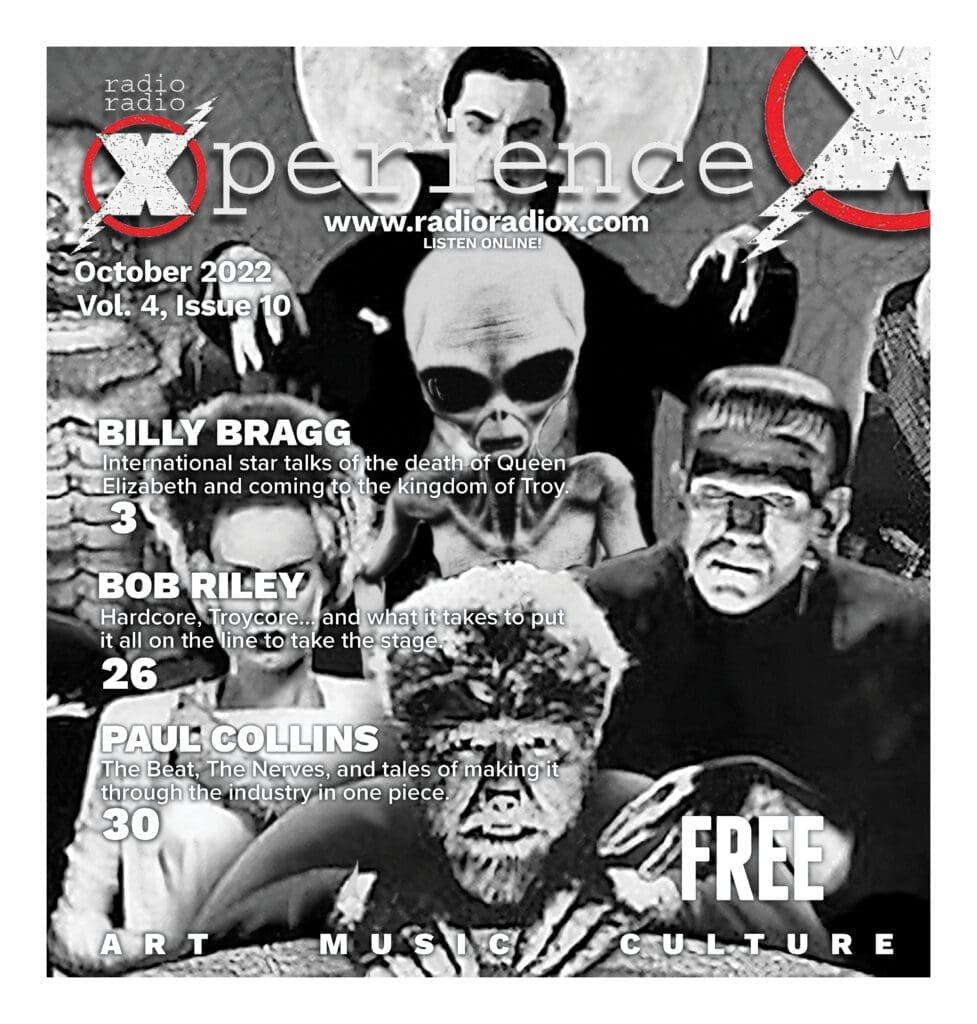
It is the scariest month of the year, and what could be scarier than the October 2022 Digital Edition of Xperience! Featuring sensation Biully Bragg, legend Bob Riley, and groundbreaker Paul Collins. Happy Halloween!

Photography By: Tim Reidy


One of the enduring mysteries of music, all art really, is that the performer exists and the person exists, and if you didn’t know both of them, you might not guess one would inhabit the same flesh and bone of the other. Art gives people a chance to step out of the confines of who they are, who an orderly society needs them to be, and become who they need themselves to be, and in that transformation, a little magic escapes to the crowd.
Bob Riley is a singer extraordinaire, in more than one groundbreaking hardcore band, blazing a smoke strewn trail from Troycore to New York Hardcore. He’s fury and force, and a guy who sits down with his morning coffee and enjoys the peace of Motown with the waking dawn.
RRX: Murderer’s Row is the name of your band. It’s a historical term, coming from a bad section of the tombs in New York City, and also a fearsome section of the 1927 Yankees lineup with Ruth and Gehrig. Was there a tie or a nod back to the history of the phrase, or is the idea of a Murderer’s Row just universal?
BR: No, Murderers Row is definitely a nod at the Ruth, Gehrig Yankees lineup of 1927. The original lineup of Murderers Row would get together every Sunday to rehearse and watch the Yankees game. We would play during commercials. I suggested the name knowing it had been used here and there in the past but seeing as how we are Yankee fan New Yorkers and live three hours from the stadium that we would use it. Bring it home back to NY!
RRX: Murderer’s Row, by all accounts, would be considered Troycore. There’s a lot of sentiment surrounding all things Troy, and Troycore has a deep vein. But what does it mean? Is it a situation of everybody living in Troy, so a geography, or is it a unique sound, like Muscle Shoals or Chicago blues?
BR: There has always , long before me, an us vs them attitude with Troy people. South Troy against the World is an old saying long before my dad and his friends were using it. It most certainly stems from Troy having so many factories back in the day. The “Collar City”, as we are nicknamed, was and still is very working class. Also, the “Home of Uncle Sam” Working people are tough and proud and that’s Troy in a nutshell. It’s only natural that angry proud music is made by Troy people. We labeled ourselves “Troycore” to say, “Hey, we are the outcasts of the outcasts, and we are proud of it!” There’s some old school people who believe that the original five Troy bands Cranial Abuse, Dead End, Final Terror, Direct Attack and Rude Awakening was Troycore and that’s it period it’s over. I don’t agree at all. I love that these newer kids in bands are flying the Troycore banner keeping it alive!
RRX: You been down the long road with hardcore and punk. Cranial Abuse, Stigmata, Murderer’s Row and more that I don’t know, more that maybe no one except the people in the room knew about. You’re in a good band then you’re in a good band; you’re in three, then maybe it’s you who got something. What’s the secret to having something?
BR: I’ve been involved in music my whole life at this point. I love what I do and it shows. People can sense that, especially a live audience. You can’t fake it. I’m so happy and very lucky I have people who want to make music with me. I’m so happy I have people buying our music and coming to see us play. Music has given me so much it has gotten me around the world many times. And I’ve met so many great people. I love what I do so maybe it’s just as simple as that!
RRX: Hardcore gets a bum rap among the pleasant folks in the PTAs and the Homeowners’ Associations. Because those people listen to hardcore too. Violence and aggression, but people in the scene, people deep in the scene, including, have a pretty laid-back mindset. Is hardcore cathartic? If so, why do you think that is?
BR: It’s easy to see outsiders see hardcore metal or punk as negative because sometimes, well, it is. It’s many different things to many different people. Hardcore gives you that platform to complain about your bad day that jerk who cut you off or that crappy 9 to 5 job or worse. For me it was to get my anger and negativity out. Yell it, scream it, pound it out as loud and as angry as possible into people’s faces. So yes, aggressive music can be very cathartic.
RRX: You bring a ton of energy to the stage when you’re on it. And that; I can’t imagine its always easy. Do you have to prepare yourself, punch yourself in the face in front of the mirror backstage? Punch someone else in the face backstage? (kidding.) How do you go beyond just bringing a melody to the stage to bring a strong feeling?
BR: Thank you for the compliment but nowadays I do a lot of pointing. I was more energetic was I was younger. Jumping off the stage into the crowd. Fell off the Saratoga Winners stage so many times. And bashing my head off the beam above the drum riser so hard I saw stars. As I’ve gotten older, I put together Murderers Row because I wasn’t so angry anymore and I could use my humor in my lyrics. I also wrote a song for my daughter called “My Little Molly”. If there’s violence in an Murderer Row’s song, and there is, I compare it to Three Stooges violence. Nowadays, I’d rather laugh than fight.
RRX: Everybody thinks of match-ups. But let’s go a little weird. Instead of wishing you had such and such a person on drums, let’s say you could have a nameless drummer that is a master of one kind of fill. Can you give us that? Not people, but specific talents. What specific instrument talents would you want in a dream team?
BR: That’s a good question because I’ve made music with a lot of amazing musicians over the years people who played in big named bands. Machinehead, Possessed, Danzig, Biohazard, Cromags and even Glen Campbell. I’m going to mention some names and only those living. If I was to put together a heavy rock kinda band dream team for myself Phil Rudd: drums, Harley Flanagan: bass, Tom Warrior: rhythm guitar, Michael Schenker: lead guitar.
RRX: Here’s where you answer the question I didn’t ask. Comments or remarks? Hype and promo? Educate, enlighten, emote – the floor is yours.
BR: Keep making music, live hard, love hard, work smart, make mistakes but learn from them! Have fun always all ways! Thank you, Liam, and Xperience!

Vulnerability.
It’s a thing none of us are good at or want to be. It’s uncomfortable. It doesn’t feel natural. It’s a sign of weakness. We’re taught to bottle up our emotions and put on a strong face; suck it up, princess – somebody has it worse.
But just because somebody has it worse, doesn’t mean that what you’re going through doesn’t matter. Somebody will always have it worse, and somebody will always have it better. That doesn’t invalidate your bad days, your fears, or your sadness, nor does it invalidate your good days, your success, or your happiness – at least it shouldn’t.
So, let me be a little uncomfortably vulnerable with you all.
A little over a week ago, I had a full-fledged breakdown on the floor of the El Dorado after I closed out my shift. It was the smallest thing that sent me over the edge, but you guys know how these things go, it’s a build-up of shit that you stuff down and compartmentalize, telling yourself that if you can just make it through the day, if you can just shove it somewhere in the vast corners of your mind, if you can just make it to bed, if you can just – it’ll eventually disappear.
And sometimes that works. But not always.
This was one of those cases.
It had been a rough couple of weeks, one thing after another, couldn’t seem to catch a break, when-it-rains-it-fucking-pours couple of weeks. That smile you continue to beam and that mantra you continue to repeat to get yourself through the shitstorm stops working, and then you’re just left feeling pissed off and burnt out. Pissed at yourself for not being able to shake it, pissed at all the little things you’re letting get under your skin that you typically brush off no problem – pissed that you’re pissed.
This breakdown was not pretty. It was downright ugly. Uncontrollably crying, shoulders shaking, snot running, why do I even try, what’s the fucking point sort of ugly.
The trivial thing that served as the catalyst for my mega-meltdown was only a front for the bigger culprit of my tipping point, something that had been said to me and was weighing on me heavy:
“Yeah, people were reading your article at the bar – a lot of them liked it – others were laughing.”
It wasn’t really the annoying new POS system that I was pissed at, and it wasn’t even Trish being extra-Trish (IYKYK) that day that I was really pissed at; it was hearing one of my biggest fears spoken out loud to me that took the cake. It validated my fear of failure and of not being good enough.
Putting yourself out there is hard. Many of us don’t think of ourselves as creatives, but I think that’s a cop-out. We’re all creative in some capacity, most of us are just too scared to even try. If we put ourselves in a box first, if we label ourselves before anybody else can, well then, what can they laugh at? How can they judge us? We beat them to the punch. Ha.
I read something recently that said the things we enjoy the most, we keep the closest to our hearts. We keep them in privacy and guard them fiercely. We’re terrified of sharing them with the world for fear of what others will say. We may dabble in creative outlets and surprise ourselves by how much joy we receive from doing so, but we don’t dare make a post about it. We won’t think twice about posting our avocado toast, lattes and new Target throw pillows on social media, but God forbid, we post the drawing or song we’ve secretly been working on that we’re actually quite pleased with and proud of. If it’s not perfect, then why bother?
What I’m about to say is likely going to make a lot of you cringe, but I’m going to say it anyway. For those of you into astrology, I’m a triple Virgo. Triple. Fucking. Virgo. For those of you who don’t know the significance of that or simply don’t give a shit, it means I’ve battled the illusion of perfection my entire goddamn life, and with that illusion comes the exhausting struggle of people pleasing, which is why hearing that sliver of criticism cracked me wide open. It’s funny how you can hear a thousand praises but it’s the negative comments that stick out and seem to define your worth.
So, I cried. A lot. Had my pity party of one and then realized – I don’t care. A very badass woman whom I consider one of my many mentors in the field told me to stop apologizing. Don’t say sorry, don’t write for anyone else but yourself, find your voice and hone your craft, everything else is just irrelevant background noise. Perhaps to some, my writing style is too optimistic and overly flowery. Perhaps it isn’t as pragmatic and hard-hitting as you’d like. I could do hard-hitting – I have done hard-hitting, and I’ve won awards for some of those pieces.
But what I’ve come to find is that my favorite pieces to write are the ones where I draw from my own experience, and those of others, and wrap it into one collective think-piece that will hopefully lend a new lens or resonate with someone in whatever way they need. Not everyone is going to like or relate to what you put out into the world, but that’s kind of the point. Not everything is for everyone, and that’s okay.
So, whatever shit you’re going through this month, I encourage you to let it out. Express it in some way and let yourself be vulnerable. Allow yourself to feel all the feelings and then share that with someone, even if it’s a total stranger (or in my case, a whole slew of strangers). Afterall, it is now officially soup season – the season for slowing down and checking in. The world is a much better place when we all stop pretending to be such hard-asses.
Till next time…

RadioRadioX & The Xperience Monthly
© 2018 - 2026 Imperial Broadcasting. Most Rights Reserved.


