Dacre Stoker – An Xperience Interview
Written by Staff on October 1, 2025
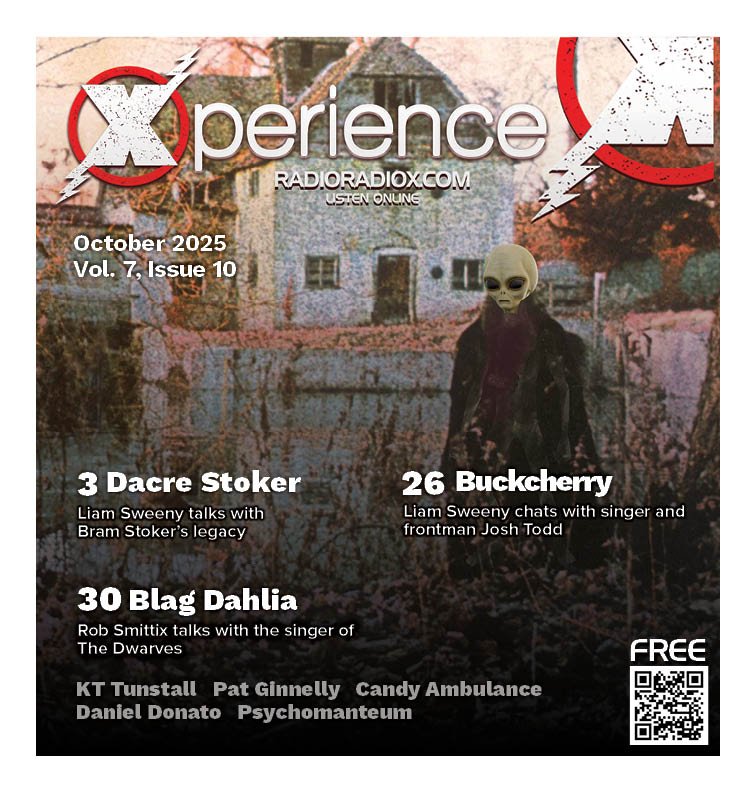
Dacre Stoker – An Xperience Interview – by Liam Sweeny.
Some families have legends, and others have curses. But when your ancestor is the famed author of “Dracula,” Bram Stoker, the question will always be about separating fact and fiction. We welcome Dacre Stoker, great-grandnephew of Bram.
RRX: You give tours to locations that your great-granduncle based Dracula on. Where would you say is a location that Bram Stoker had used as a scene in Dracula that people would be surprised by?
DS: The fact that Bram never visited Transylvania but was able to glean a lot of very detailed information from six books written by adventurers who travelled there and published information about their journeys, which included information about the local customs, history, descriptions of traditional dress, superstitions, and folklore. Two of the books even contained very detailed maps; one of them showed the name Borgo Pass in the Carpathian mountains. Bram scribbled down specific lines of longitude and latitude, pinpointing an area close to the Borgo Pass, which included an extinct volcano. It is here that he set his fictional Castle Dracula. It took a long time for Dutch researcher Hans De Roos to notice this entry in Bram’s notes for Dracula.
RRX: You’re Bram Stoker’s great-grandnephew. And all families have a certain amount of homespun folklore they pass down, even if it’s little more than “old wives’ tales.” I imagine your lineage has lent itself to a lot of very strange folklore. What was something you’ve carried with you?
DS: Sorry to disappoint you, but it is not like relatives of Bram Stoker live like the Munsters or the Addams Family in old gothic mansions complete with spooky vibes, traditions, and folklore. However, our Irish ancestors (of which Bram was one) instilled a respect for the spirits of those departed, particularly on Halloween. We look at the event as a solemn period to think about and pay our respects to the spirits of those whom we remember.
RRX: Since Bram Stoker really brought to the world consciousness the notion of the immortal undead, it has gone from nightmare to, in some cases, sexual fantasy. What do you think it is about vampires that people have warmed up to? How do you think Vlad the Impaler became Lestat, or Edward?
DS: That’s an excellent question. Bram’s supernatural vampire villain is a blend of Vlad Dracula (the Impaler and the Devil) and his boss, Sir Henry Irving’s portrayal of Mephistopheles. Bram capitalized on real vampire scares in New England in the later 19th century, as well as other parts of eastern Europe in the 18th century. His count was not sexy at all; in fact, he resembled more of an unattractive revenant from the grave than a runway model of today’s vampires. In short, the transformation, which I think Bram would have approved, resulted from his novel being adapted to stage with the assistance of his widow Florence, playwright Hamilton Dean, and producer John Balderston. The leading man needed to be welcomed into British high society; thus, the dinner jacket and refined appearance.
RRX: Do you think people have normalized a Dracula because there’s an Ed Gein, or a Jeffrey Dahmer? Is there a counterbalance, do you think, between the elegance of this porcelain immortality and the pure dirt and decay of the modern serial killer? Are your quiet neighbors the new monsters?
DS: I believe that, 128 years after the publication of Dracula, literature, theatre, and film have well established and, to some extent, normalized Gothic horror. We have progressed beyond Frankenstein’s monster and the other “ugly” classic monsters to more human monsters that can blend into a crowd and can appeal as a romantic figure.
RRX: So people must come up to you all the time with their pet theory. I have my own, but I’ll spare you. What is the coolest take on vampirism and/or Dracula that someone has barged in on your dinner with?
DS: Believe me, when I am at conventions, I get hit up with a lot of stories, theories, and requests by horror fans. I respect how passionate they are, and at the end of the day, some of the more obscure pet theories make me smile. One in particular was a request to collect some of my Stoker blood in a small vial that they could wear around their neck. I respectfully declined.
RRX: You’ve overseen countless Dracula books, movies, comics, and I imagine you see everything from nail-on-the-head adaptations to works that may be “Dracula in name only.” What elements do you see in a work that make you feel that the heart of the original novel is intact in the work?
DS: Most screenwriters, playwrights, and authors follow, to some extent, the “vampire playbook” that Bram created back in 1897. He did extensive research on different cultures and listed three pages of vampire traits in his notes. He used many of these traits when writing Dracula, many of which are still adhered to today. Obviously, writers have altered or tweaked some traits to modernize stories and help make them more interesting; for example, they made sunlight destroy vampires. Bram’s Count Dracula is allowed to be out in the daylight, but he did not have all of his powers during the day. I am totally ok with “customizing” modern vampires; this keeps fans on their toes and helps them remain relevant. After all, one of their enduring powers is their ability to shapeshift.

 RadioRadioX