Bill Ackerbauer – Thanks for Asking!
Written by Staff on January 6, 2026
Bill Ackerbauer – Thanks for Asking! – by Liam Sweeny.
Bill Ackerbauer is a singer-songwriter and multi-instrumentalist based in the Adirondack foothills and Mohawk Valley. He is a founding member of The Insolent Willies and has previously performed with The Doghouse Carpenters, The Bentwood Rockers and other acoustic Americana groups. Bill is the founder and coordinator of Johnstown Arts & Music Inc., a nonprofit which hosts the Johnstown Midsummer Concert Series and promotes a number of live-music events in his hometown.
Bill’s solo albums can be found on all major streaming services, including his Bandcamp page:
https://smokinbill.bandcamp.com/
RRX: Cover art is cool. It shows listeners what the artist thinks the album is all about. Because music can be felt visually. If you had to give the public a visual image that you think they would see and just “get” your groove right away, what would it be?
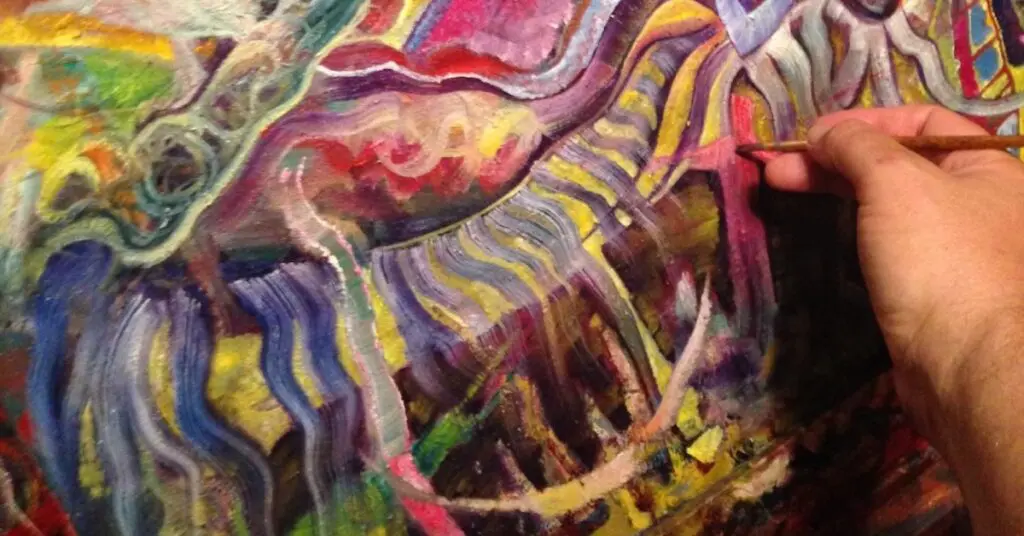
BA: I love to design my own cover art as well as publicity materials such as show posters, etc. I dabble a little in visual arts, so the cover design for my 2025 solo album, “Blue Period,” featured one of my paintings, “Self-Portrait with PBR,” which is sort of a cheeky reference to the first track on the album, “Cold One Blues.” I’d like to think that my visual art style comes from the same place as my songwriting: it’s all “folk art” one way or another – expressive and whimsical without any attempt at pretention.
RRX: We have to play somewhere, and sometimes those places have more going for them than a stage and a power outlet. What is a memorable place you played, and bonus points if it’s not a well-known place.
BA: I’m lucky to have had a relationship with the Caroga Arts Collective, a non-profit here in the South Central Adirondacks which hosts a summer music festival featuring world-class performs in many genres, from all over the world. The most fun I ever had performing happened during the COVID pandemic, when normal music venues were shut down and the only gigs available were socially distanced in the open air. Caroga Arts invited me to be part of a series of “boat tours” on several Adirondacks lakes in which musicians were ferried around various lakes and would pull up to docks and marinas and perform for folks on the lakeshore. (Here’s a video clip from one such performance: https://youtu.be/lBqVX4le0b8?si=_Hda63Edgo7b1zZz)
RRX: Part of learning to be a musician is to fall in love with a song, an album, and hammer away at your instrument until you can play that whole thing. What was that song for you? Was there a hardest part?
BA: Over the decades, I’ve had a series of obsessions with certain songs and songwriters. Early in my career as a guitar player, I fell in love with the music of Mississippi John Hurt, and I spent several years learning his material and trying to adopt a fingerpicking technique that borrowed heavily from his style. I’d like to think there’s still a little Mississippi John in my guitar playing, but anyone who really knows his music knows the guitar technique is only one small element of his greatness. The magic was in his warmth, humility and irrepressible humanity. I don’t think I could identify a single MJH song as my “favorite,” but one that has always delighted me is “Let the Mermaids Flirt with Me.” (Have a listen: https://youtu.be/Gjb6Vc5_VqE?si=0V_q3sGxPmY6riEj)
RRX: Would you rather have one of your songs blow up and make you a one-hit wonder and household name, or would you rather have all your songs be solidly received, but no chart-climbers? (You have to pick one or the other here.)
BA: No question. I’d rather keep writing, recording and performing songs that mean something to me, and if they happen to entertain or move a few of my listeners, that’s great. But I have no interest in gaining the attention of the mainstream or getting rich and famous. If your goal is to write a song that appeals to the whole world, you’re probably not being true to yourself.
RRX: With services like Spotify, streaming revenue can be pretty dismal. Without spilling secrets, do you have a promotional mindset or philosophy?
BA: Trying to “win” streaming revenue in the modern era is a fool’s errand, from what I have seen. The lion’s share of any money I’ve earned in the music business has been from playing live shows and selling merchandise, and the latter is getting harder and harder now that so few people listen to music on physical media such as CDs. But if you keep playing live, making an honest effort to promote your shows and connect with audiences, you’re bound to make enough money to keep going. I’ve done a lot of busking over the years, and I’ve found that the most delicious sandwiches I’ve eaten have all been paid for with a stack of bills that piled up in my guitar case after a street-corner performance.
RRX: What historical era would you like to visit if the sole purpose was to put together a Battle of the Bands? How would you set it up?
BA: One of the things we have lost (or almost lost) in the Internet era is the concept of community music. Prior to World War II, every small town in America had several bands, songwriters, and jam sessions, because before the advent of commercial mass media, people had to make their own entertainment. There was a piano, guitar or banjo in everyone’s living room. If I could go back in time, I’d visit my own hometown in the 1920s, round up the best musicians and organize a giant jam session on the courthouse steps. Now that I think about it, that’s kind of what I’m doing today. Musicians aren’t as prevalent today, but we have some great ones among us, and I enjoy nothing more than getting a bunch of them together in the same space to play and sing and see what kind of trouble we can stir up.
Continue reading

 RadioRadioX