Julianna Joy: The Shape of Abstraction – Where Speaking Becomes Survivable
Written by BradQuan Copeland on February 20, 2026
We’re really not effective as artists or activists if we’re not in tune with our emotional worlds.
This world doesn’t make way for the unbowed who embody the shape of abstraction. Instead, they must press forth on the outskirts of repression, bearing only conviction, fueling the will to radiate through regularity.
This philosophy first presented itself through a tactile creation by Julianna Joy, simply titled “The Work,” showcased at the Albany Center Gallery. At first sight, it brought me into a space reminiscent of a forgotten abandonment, grimy, yet strangely inhabitable. Transmuted by the encounter, I stood within the density of a room where starving air lay stagnant, its windows unsplit for years.
To describe the work, abrasion and scarring on the desecrated plyboard hold muddy browns and blacks, littered with nails, earth matter, a mousetrap, and a frozen explosion of shattered mirror shards shouting from within its nucleus. Reminiscent of something dragged through the dregs of trench warfare. Phrases scribed around the work, “What does it mean to be, to feel,” “Safe,” and “Touch Me,” form a spirit blend of emotional questioning, incoherence, and an invitation that doubles as a threat. It urges the viewer to endure a reality of pain deeply rooted in a paradox: the desire for safety in the wild is a lie.
“Alignment of body and mind is how I conceptualize the soul,” she said during our meeting, as we swam through the ripples of psychospiritual territory. Dressed in cold weather attire boasting a homemade feel, emitting tones of autumn, she sat to the left of me within the chilly but livable back hall of Stacks Espresso Bar in Troy, as I slouched in an upholstered armchair with my coffee planted beside me, gazing through the smokescreen from my THC pen. Speaking on place and community, she noted, “Living in Troy and this Capital Region is a massive privilege, because people uplift each other and do community work.”
But it’s not all confidence.
“There’s fear that I speak what I believe to be the truth, and yet everything around suggests it’s not safe to say that.”
I find further exploration of her fears in her poetry, not merely as a conceptual concern but often as a physical condition.
“…her nervous system screams…
each hand to either side of her abdomen…
it’s okay it’s okay it’s okay…”
Language gives way to regulation, with laughter and tears occupying the same breath.
“each hemisphere speaks in tandem “thank you” — “thank you”
In “the black hole of mind”, doubt becomes gravitational, tightening the chest and shortening the breath, pulling her inward towards a threshold of collapse: where a psychic spiral resolves with integration only as its conclusion.
“body and mind aligned, is soul as i so definte”
Elsewhere, intimacy is rendered as risk, refusing protection in deference to honesty—an acknowledgement that love both burns and sustains.
“…am i the flame or the candle”
What reads as madness across these works functions as a bridge rather than a breakdown, granting an emotional reference point so immediate it strips judgment of distance once accountability has already taken place. Meaning doesn’t arrive intact, or even guaranteed, but is rebuilt through repetition and conscious vulnerability, converging in an epochal realm where speaking becomes survivable.
What begins as an internal reckoning inevitably presses outward, asking what alignment demands once it exits the body and enters the world.
“As an artist, I think there’s a real danger in attracting people who appreciate you for the things you needed to embody, but need to move beyond. It’s hard to leave the past behind us. We get used to performing through familiar forms of fear and get a dopamine hit when we’re called courageous—but the work is always one step deeper.”
The conversation drifts toward Marxist theory as an ethical curiosity rather than political doctrine, circling classlessness as a condition that might relieve the psychic strain imposed by an unjust hierarchy. She reminds me, “We have agency,” illuminating that we each can present a disruption to power structures in our own way, holding an unwavering focus for social justice that I admire dearly.
Granted a sense of serenity at her intuitive comfortability given the depth of our dialogue, a feeling of genuine familiarity between two strangers grew. She’s protective of her energy, and witnessing her wings unfurl, I felt us constructing a pyramid, one ashlar at a time, with seeds of thought preserved within.
The excavation then amplified, placing the interface of the humanity center stage.
Her humanity.
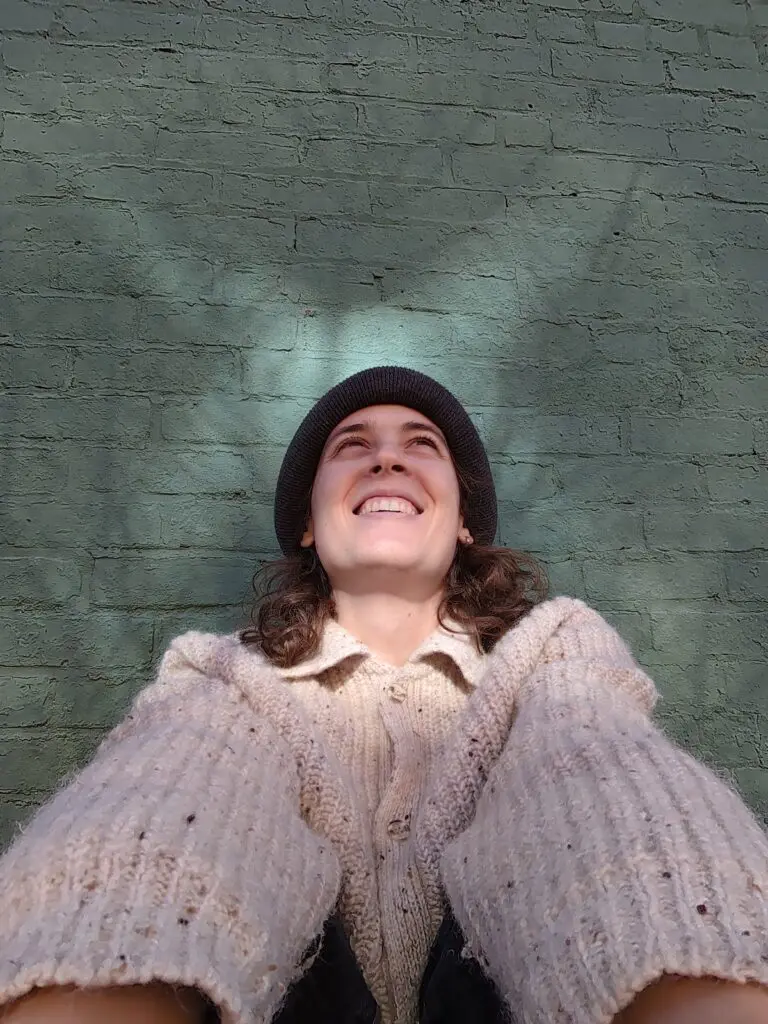
RRX Interview: Julianna Joy
RRX: In your artworks, there’s a return to the body as a site of conflict and revelation. Do you feel the tension between safety and freedom playing out elsewhere in your life?
Julianna Joy: It’s funny to think of where I exist outside of art, because so much of my life is consumed with it at this point, and that’s intentional. I think the dance of art is the dance of my life. The space outside of art that connects most with safety and freedom is activism and social justice. I’m not nearly as active as many of the people I look up to, and a lot of that comes down to not having a secure income right now. I’ve been trying to figure out how to continue this journey of art while also making enough money to pay rent and take care of myself, and get to a place of stability where I can give back more.
I think the ways that I see myself engaging with resisting oppressive dynamics—capitalism and government forces—is where I feel that tension the most. Every time I take one step further into speaking out loud, there’s fear, because it feels like once something is said, there’s no going back.
RRX: In the poem, you describe the “black hole of mind” as a portal rather than an end. When did you begin to see your inner struggles not as something to escape, but as something that could transform you?
JJ: Probably about four years ago, when I was in another transitional part of my life. I was forcing myself to make creative work that wasn’t flowing, and I was in a relationship that needed to end. I remember sitting in a studio, completely spiraling, unable to do anything productive, and eventually just crying on the floor. I had met a very talented songwriter who let me use her apartment studio, and when she arrived and asked how it went, I couldn’t hide how broken I felt. I ended up crying on her floor, and she cooked me dinner and told me to have more breakdowns.
Around that time, I had my first mushroom trip and started learning about relational codependency and childhood trauma, which became a bridge from being lost in the void to understanding what it felt like to reach into dark places and come back a little more authentic. It’s been a process of engaging with places of hurt, some from childhood, some from later, and realizing that moving through those places doesn’t destroy me. It brings me back with more clarity.
RRX: I see a resistance to erasure—of feeling, of memory, of self. What parts of yourself have you actively protected from being made small by the world?
JJ: My struggle when it comes to acceptance around transness hasn’t been so much erasure as misunderstanding and mischaracterization. The way I understood transness, neurodivergence, and ADHD growing up was fundamentally unsound.
I didn’t realize it was possible that I didn’t understand myself, or that my body could tell me things before my mind did. I’ve had to protect myself from letting old habits erase who I am. It’s about staying open without giving up agency, and allowing curiosity to lead instead of fear.
RRX: You write about a spiritual war between “two tiny mes (masculine and feminine)”, certainty and doubt. Does this apparent conflict show up in your daily life?
JJ: There’s a part of my gender journey that engages with femininity as a way to change my relationship to masculinity. The archetype of masculinity I was given wasn’t something I wanted to accept.
As for certainty and doubt, I’ve moved away from needing certainty in order to move forward. I used to think I needed everything figured out before acting, but the best work doesn’t come from that place. I’ve learned to comfort the part of myself that thinks certainty is required. The more I do that, the more opens up.
RRX: I don’t think your work offers clean resolutions. It acknowledges fear while still moving forward. How do you personally define courage?
JJ: I see myself as courageous of love. Courage, for me, is the willingness to hold space for growth with other people…staying open even when it’s uncomfortable, and continuing to move towards connection instead of retreating into protection.
RRX: So healing isn’t linear, but recursive. How do you know when you’re revisiting a wound to understand it, rather than reopening it?
JJ: There’s a phrase that’s become part of my practice: feeling an emotion without becoming it. Healing happens when there’s an overarching structure of safety that allows the inner part to fully experience intensity and then return to center.
I used to just feel things and become the emotion. Now I’m learning how to feel grief or regret while still holding it as a whole person. The spiral is my favorite image for this. You pass the same point again, but you’re not in the same place. You’re moving forward.
RRX: There’s a quiet belief in what I’ve seen from you that insists meaning exists even in pain. What does it mean to you?
JJ: I think pain is more than just a sensation. It’s how our body and brain process information. Pain isn’t always helpful, but it’s always meaningful.
A lot of the hurt I’ve experienced came from unprocessed things, and it was the act of processing them—speaking, singing, embodying them—that allowed me to move forward. Pain becomes meaningful when it’s allowed to communicate instead of being dismissed.
RRX: You often work with materials, language, and imagery that carry a sense of prior use or history. Honoring what something has been. Does that shape the way you imagine what you and the art can become?
JJ: I hate unnecessary waste. There’s something deeply meaningful about taking an object that has a story and refusing to let that story end.
I’ve lived much of my life with a sense of failure, and taking something discarded and saying, ‘This is art now,’ is freeing. What makes it art is the care I give it. That process mirrors how I relate to myself and to other people.
RRX: When people encounter your work, they may project their own experiences onto it. How do you hold space for their interpretations without letting them overwrite your truth?
JJ: …I don’t think anything anyone can do will overwrite it for me. The work that I make is meant to be shared. That’s why I make it the way I do. I leave space intentionally.
I speak to emotions in a way that allows people to see themselves in it. It’s how I heal, and it’s how connection happens.
RRX: If your art and writing are acts of alignment—body, mind, and soul moving closer together—what parts of your life are still catching up to that clarity?
JJ: Spirituality is something on the horizon. It feels both real and totally made up at the same time. It’s real because we experience it, and made up because we all experience it differently.
Healing the wound between my intellect and my emotional life—learning to let them listen to each other—is where integration happens. Art is part of that, but real life is still catching up. I’m learning to move forward without resistance to myself.
The conversation doesn’t resolve so much as it returns, reframed. Like the black hole she describes, it compresses, transforms, and releases without offering a clean departure. What remains isn’t assurance, but an understanding of how to hold steady inside complexity without dissolving into disorientation. That’s the shape of abstraction. It’s a form that transcends arrival. It’s an ongoing practice that’s deliberate and irrevocably human, enacted in the steadiness of breath and presence, in the midst of a calculating institution of dehumanization.
Continue reading
 RadioRadioX