

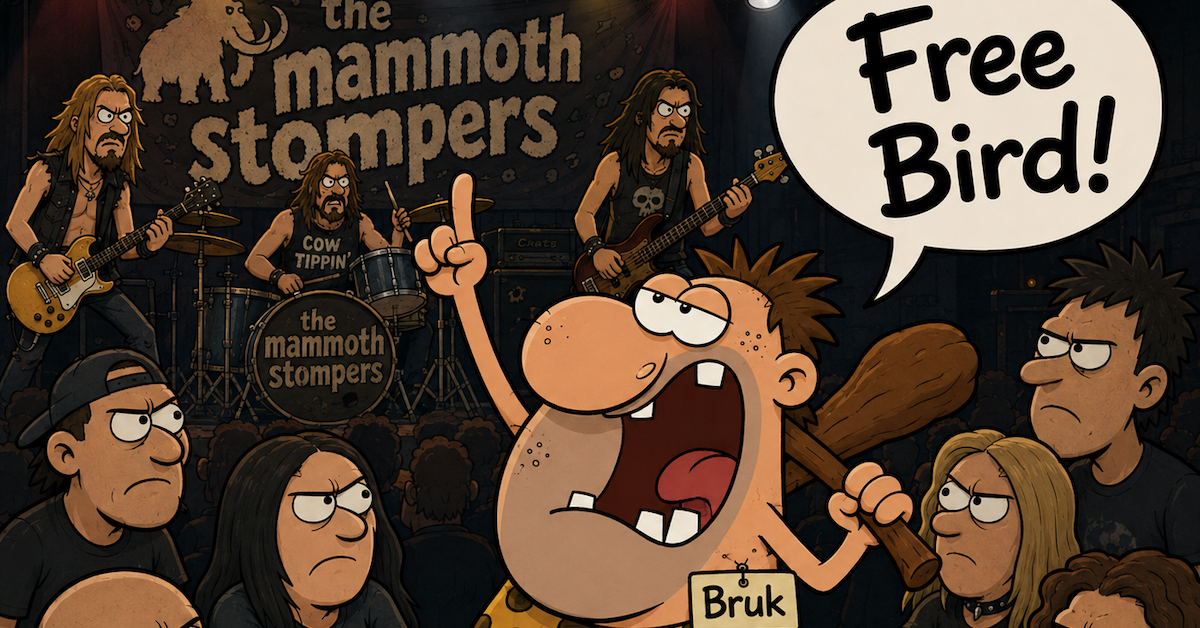
An original story by Jason Irwin.
Long before concert halls had velvet curtains, before electric guitars could make your pants vibrate, and before anyone had invented the phrase “Please silence your cell phones,” there lived a young man named Bruk. The ancient historians describe him as “a child of great potential,” which was apparently the polite way of saying, “Nobody knows what happened to this kid.” Bruk was not a particularly bright child. He wasn’t the brightest member of his family. He wasn’t even the brightest member of his cave. One afternoon, he spent three hours trying to eat a rock because his father told him it was a “stone sandwich.” His father eventually admitted that he had made that up, but by then Bruk had swallowed two pebbles and was feeling pretty good about lunch.
His parents, Ug and Munga, were not exactly what you would call good parents. They loved Bruk in the same way a bee loves a fish: they acknowledged his existence, but mostly left him to figure things out for himself. Ug spent his days hunting and his nights complaining about the quality of the mammoth steaks. Munga spent most of her time yelling at Ug. “UG! YOU BRING HOME NO MEAT!” “I BRING HOME MEAT YESTERDAY!” “THAT WAS YESTERDAY!” “THEN WHY YOU STILL TALK ABOUT IT?” It was a difficult household, and Bruk was raised primarily by whoever happened to be closest to the fire.
Because Ug and Munga were too busy arguing to actually teach their son anything, they decided to simplify his education. They taught him two words: “free” and “bird.” That was it. “FREE,” Ug would say whenever he found something that didn’t cost anything. “BIRD,” Munga would say whenever there was a bird. Eventually, Bruk put the two concepts together. Free bird. This became his favorite phrase, his personal philosophy and, eventually, the beginning of one of the great curses ever placed upon live music. He didn’t know what a metaphor was, or a simile, or even a noun, but he knew that if you put those two words together loudly enough, people tended to look at you.
One afternoon, Bruk wandered through the woods and spotted a small bird trapped beneath a branch. He lifted the branch, the bird flew away, and Bruk raised both arms toward the heavens. “FREE BIRD!” he shouted. He had done something good. Unfortunately, this was also the high point of his intellectual development. A few days later, Bruk discovered that if he walked into the village marketplace and shouted “FREE BIRD,” people would look at him. This was very exciting. He didn’t understand why they were looking at him, but he had discovered the intoxicating power of attention, and Bruk was a man who could never be accused of knowing when enough attention was enough.
So he began shouting it everywhere. At the fire. “FREE BIRD!” At the river. “FREE BIRD!” During tribal council while the elders were discussing an upcoming woolly mammoth hunt. “FREE BIRD!” The elders were not amused. One elder finally stood up and said, “Bruk, please stop yelling that.” Bruk nodded solemnly. He understood. Then, approximately nine seconds later, he yelled, “FREE BIRD!” By the time Bruk was a teenager, the village had developed a warning system. If someone saw him approaching, they would shout, “BRUK IS COMING!” and everybody would hide their birds.
As the years passed, Bruk became known throughout the region as the man who shouted “Free Bird” at inappropriate times. He yelled it when hunters returned empty-handed, during weddings, during funerals, and once while a man was having a tooth pulled with a sharpened stick. “FREE BIRD!” The dentist dropped the stick. The patient screamed. Nobody knew what Bruk wanted. Neither did Bruk. Scholars would later debate whether he was requesting a bird, demanding that somebody release one, asking for a bird without paying for it, or simply being an idiot. The scholarly consensus eventually became: yes. One particularly respected elder suggested that Bruk might someday develop a third word. The elder was mocked for such wild optimism.
Then one evening, something happened that would change the course of history.
A traveling group of musicians arrived in the village. They called themselves The Mammoth Stompers. They had drums made from animal hides, rattles made from bones, and one particularly talented caveman who could blow into a hollowed-out log and produce a sound remarkably similar to a dying moose. The entire tribe gathered around the fire. The musicians began to play. The crowd danced. The Mammoth Stompers played faster. Everyone cheered. It was, by all surviving accounts, the greatest concert the Stone Age had ever seen. And then, from somewhere in the back of the crowd, came a familiar voice. “FREE BIRD!” The musicians stopped. The dancers stopped. The moose stopped dying. Everyone turned around. There stood Bruk, grinning like a man who had just discovered fire for the second time.
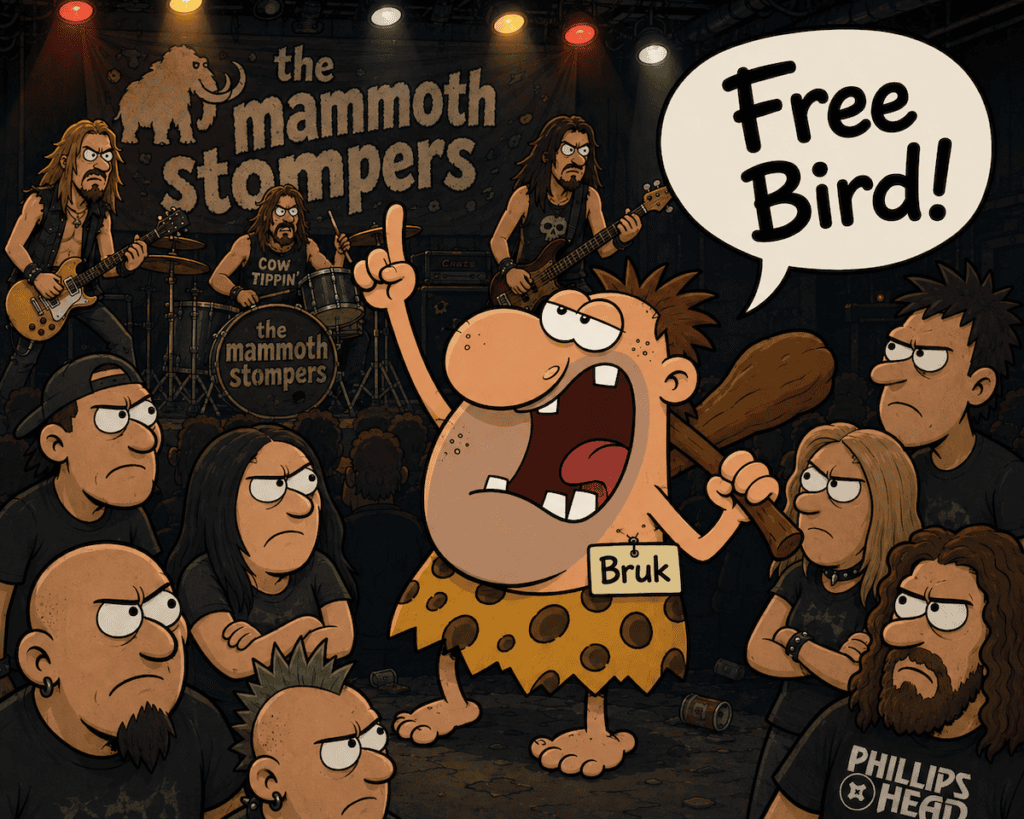
He had created something magnificent. He had yelled “Free Bird” at musicians, and everybody heard him. One finally asked, “What does that mean?” Bruk thought very hard. He looked at the musicians, the crowd, and the sky. Then he said the only words he knew: “Free bird.” The musicians shrugged and started playing again. When they finished the song, he yelled it again. “FREE BIRD!”
This time, one of the musicians threw a drumstick at him. Bruk ducked. He thought it was part of the show. He loved it. From that day forward, Bruk became convinced that shouting “Free Bird” was the highest form of musical criticism. It didn’t matter what kind of music was being played. Drums? “FREE BIRD!” Flutes? “FREE BIRD!” A woman singing a beautiful ballad about the death of her husband? “FREE BIRD!” A choir performing a sacred song at sunrise? “FREE BIRD!” At that point, even the elders agreed that perhaps Bruk should be hit with something.
Eventually, the tribe simply stopped inviting Bruk to musical events. But this did not stop him. He hid behind rocks, climbed trees, and even once crawled through a tunnel beneath the village so he could pop his head through the floor during a performance. “FREE BIRD!” The musicians were furious. The audience was furious. The elders were furious. Bruk was delighted. He had no useful skills, no trade, no ability to hunt, and absolutely no understanding of music, but he had discovered that if he interrupted other people’s hard work loudly enough, strangers would remember him. In the primitive mind of Bruk, this was fame.
And so the legend of Bruk was passed down through the generations. The wheel was invented. Fire was improved. People learned to write. Empires rose and fell. Ships crossed oceans. Concert halls were built. Amplifiers were invented. Electric guitars appeared. Humanity sent men to the moon and put tiny computers in nearly everyone’s pocket. And somehow, through the mysterious passage of history, Bruk’s spirit survived.
His descendants are still among us. They wait through an entire concert. They listen to the opening act, the second song, the guitar solo, and the singer explain how much a song means to them. They may even spend $80 on a ticket. Then, at precisely the moment when everyone is enjoying the music, they summon the ancient wisdom of Bruk. “FREE BIRD!”
Nobody knows why. Nobody asked for it. The band probably isn’t going to play it. And there is a very good chance the person yelling it doesn’t even particularly like the song. It is simply tradition, a sacred ritual passed down from a poorly supervised caveman whose parents taught him only two words and apparently never followed up with a third.
So the next time you’re at a concert and somebody screams “Free Bird!” at a band that has spent years writing, recording, and performing its own music, remember Bruk. Remember the ancient cave. Remember the two-word education. Remember the bird that flew away. Remember the great civilization that somehow invented the electric guitar but failed to invent a way to prevent Bruk from getting into the building.
And remember that somewhere, thousands of years ago, a confused young caveman discovered that yelling two random words at musicians got everybody’s attention. He never learned anything else. He didn’t become a warrior, a hunter, or a farmer. He didn’t invent the wheel. He just yelled “Free Bird.” And somehow, against all odds, that became his greatest contribution to civilization.
And, if you missed the moral of the story, it is this: If you are the person standing in the crowd screaming “FREEEEE BIRDDDDD!” at the band, congratulations. You have achieved what generations of human evolution have tried desperately to avoid. You are a stupid caveman. Somewhere deep inside you, Bruk is smiling. He is probably holding a rock, wondering if it is a sandwich.

