

Cinderklous – An Xperience Christmas Story – by Liam Sweeny.
What a handful of explorers know, upon placing foot and flag on the ephemeral vortex of the North Pole, is that there is absolutely no way to tell that one is at the North Pole. The air is as cold there as it is in the town of Longyearbyen in Norwegian Svalbad, and through 20/20 vision, both are, on average, formless and white. If there were a factory led by a jolly regent in red velvet and fox fur cuffs, no human had ever laid eyes on it.
He gripped the iron shovel and hoisted it, arms raised, hanging for a moment before they slammed it into the ice. He evacuated mere chips from the frozen ground, and after the day’s work, he had a sharp, ragged hole into which he could’ve buried a dog. But reindeer are much bigger than dogs. And the one lying bound and stiff two yards away was well fed and of good stock. And old; very old and very dear to the man, and would need a burial plot not for its size but for its stature.
“Pater,” Bastijn put his hand on the man’s shoulder. “Let me help.”
“Go inside, Bastjin. Mother needs help with recipes.”
“She doesn’t want help.”
“Neither do I,” the man said as he rested the shovel, tip to ground. “Did you raise this beast from its seed? No, you didn’t. A man’s calf is his burden.”
“We’ve never had this burden before.”
“No,” the man said. “And we won’t speak of it to mother. She is not like us. She is of them and she will worry about the future, for hers runs out to a point. She is not us.” The man raised the shovel and forced it through the ice again and again, grunts like primer caps, his exhausted breath their recoil.
“Pater,” Bastjian said. The man wiped his brow and picked up the shovel.
“Pater,” he repeated. “Santa.” The man, Santa, turned around.
“You know you’re not to call me that,” he said. “You’re my baern, you are not an elf born of the loins. You are my son. They are offspring.” Santa hunched over and balanced his upper body on the shovel handle.
Bastjian stood by his father and they peered into the hole he had dug. “Why are you in pain, pater? Why does your swing barely bite into the ice?”
“It is a long story,” Santa said. “But it is your birthright. It is as much your birthright as the sleigh, and in very much the same way.”
“The sleigh is off-powered, to speak of it,” Bastjian said. “We tested it yesterday. You didn’t seem to care when I told you.”
“The difference between not caring and not showing it.” Santa handed Bastjin the shovel. “If you wrap yourself in heavy enough clothes, it keeps the world inside as much as it does outside.”
“Mother is fraught. I think she’s angry with you. She always shuffles her recipes when she’s fraught with you.”
Santa sighed and with his index finger directed Bastjian to dig while he pulled his pipe from his pocket and tapped it with his index finger to light it. He took a drag and coughed.
“She knows about the muscle aches, the pain in my joints,” he said. “She’s looking in the old papers for soup recipes.” Santa puffed, the glow of tobacco embers painting the contours of his face. “She won’t find anything. Half of those recipes are from the Dark Ages. The ingredients are extinct.”
“Would soup work?” Bastjian took a strike at the earth and pulled up more than his father had all morning.
“I am not ill, baern.” Santa said. His second puff brought another fit of coughing.
Bastjin descended into the hole to judge its depth. “It’s Christmas spirit, isn’t it? The elves are talking. It’s fading.” He hopped back out and pitched the shovel into the growing crevasse. Santa walked over to the reindeer and knelt beside it, stroking its stiff fur with a bare hand liberated from its glove.
It was dark by the time they finished the grave and buried the reindeer. It was dark when they started, and with the exception of the auroras, it would be dark until March. Santa put his hand gently on Bastjian’s shoulder.
“We’ll walk through the workshop,” he said. “There’s something you must know.”
In the New World, in a Victorian city in New Amsterdam called Troy, a poem would be printed that would fracture Santa’s domain more than the Inquisition or the crusades. That poem was titled “The Night Before Christmas,” and it created in the North Pole a time before it, and one after it.
Before the poem, Santa, while flying his sleigh on Christmas Eve, delivered gifts to the children of the world by bouncing through time to and fro over the previous year, minutes here, minutes there, using magic to change fate in ways that would benefit the children. After the poem, expectations changed.
Santa and Bastjin hugged the center column and climbed a row of granite stairs scuffed raw of age, finding their way to a room with walls of windows, from where the entire workshop was in view.
Santa pointed down to Line Three. “We didn’t need tools back then. I know you don’t remember that.”
Bastjian rubbed the window clear of dust and grime and put his eyes to it. “I only remember the sound of the machinery,” he said. “And the tool-working before that. It’s been so long.”
“You left for an age, Bastjian.”
“I stayed for an age before I left,” Bastjian said. “And you never called for me.”
Santa leaned back against the seat that served the front desk. “You’ve not seen an age, Bastjin, not a true one,” he said. “I wanted you to have a life in this new world, baern. I wasn’t a father before you were born, in the ages that came before; just ugliness wrapped in crimson, soaked in bitter tears. Not a father. By the time you drew your first breath I knew the roads and the forests would have to care for you.”
A shriek came up from the floor. A whisp of iridescent blue vapor burst into a glittering cloud.
“There is so much you don’t know, Bastjian. All of the tinkling of the bottles on the center floor by the aged elves, and the smell of mint and brimstone… have you yet gathered what it’s for?”
“Mother-,” he said. “Claudette, she said they make Christmas spirit.”
Santa laughed as he removed his thick coat, revealing fading rings of sweat around his neck and down his chest.
“Christmas spirit,” he said. “There isn’t any. There’s never been. Parents speak those words to their children like gloss, covering over the fact that they don’t see the tricks we play behind their backs.”
Bastijn moved to hold his father’s arm and found it stiff. “Pater, something is wrong.”
“It’s potions,” Santa said. “Petty spells that make poor mothers find hundred-dollar bills on the street. Put cheer in a CEO’s check writing hand. A grimoire of lucky pennies, cool rocks that might be fossils and well-timed snow days.”
“Why do you say such a thing to me?” Bastjin said. “Are you testing my faith?”
“I haven’t been in an actual house or down a red brick chimney in my life.”
They left the control room and descended the granite steps on the other side, emptying out onto the outer edge of the workshop. Santa pointed at an elf peering at a dusty book two ounces beyond his weight.
“He’s dying,” he said. “That book isn’t for bringing cheer.”
Bastjian walked over to the elf, flipped the book cover to read the Ogham title before quickly returning the book to the reader. He walked back to his father’s side, wide eyed and crestfallen.
“Father, you know what is happening. I want to know. As your heir, I demand it.”
“You say that with the conviction of a wind-up toy,” Santa said. “I said I needed to tell you something. We’ll walk, and you’ll not rush me.”
“Okay Pater.” Bastjian’s eyes grew wide and he wrapped himself in his arms.
“And don’t ever demand anything of me,” Santa said.
They walked miles, through square footage that would’ve been impossible if the building was planted in Pittsburgh or Detroit. No one knew how big the workshop was, not even Santa. But he knew where the basement was, and eventually he and Bastjian found the door.
Santa grabbed a torch and gripped the greased canvas bulb, causing it to catch fire. The basement was ancient and never updated. It smelled of rust and oil and the air was balmy and thick. Bastjian covered his mouth as they walked down the stairs but soon stopped as it was a pointless gesture.
“Father, what’s in here? No one is allowed down here.”
Santa grunted as they neared the bottom. “The truth is down here, baern,” he said. “I’ve buried it metaphorically and physically.”
When they got down the stairs, Bastjin shielded his eyes from the glow of the basement’s seeming showcase content. It was another pointless gesture once the glow subsided, and Bastjian walked over to it to feel it. Santa grabbed his hand.
“You don’t want to do that,” he said.
“What is it?” Bastjian said.
“It’s a harness.”
“Who is it for?” Santa was silent.
“Pater, who is it for?” Still silence. Santa was transfixed by the harness.
“Pater…”
“It was for me,” Santa said. “At one time, it was for me.”
Santa took Bastjian deeper into the basement. It was a treasure trove of fine dishes, candlesticks, iron swords, meticulously engraved silver shields and sacks filled to the brim with coins, nothing newer than Medieval. Santa sat Bastjian down on one of the sacks, he on another. He lit his pipe and held his forehead with his free hand. If Bastjian could’ve seen clearly down there, he would’ve seen a deflated version of the Santa that decorated lawns and soda bottles.
“I came into being at the end of the fourth century,” he said. “I had to look that up. In my time, everything was seasons. There was no need for me to count years, as I was alone.”
Santa picked up a gold coin that only looked brand new.
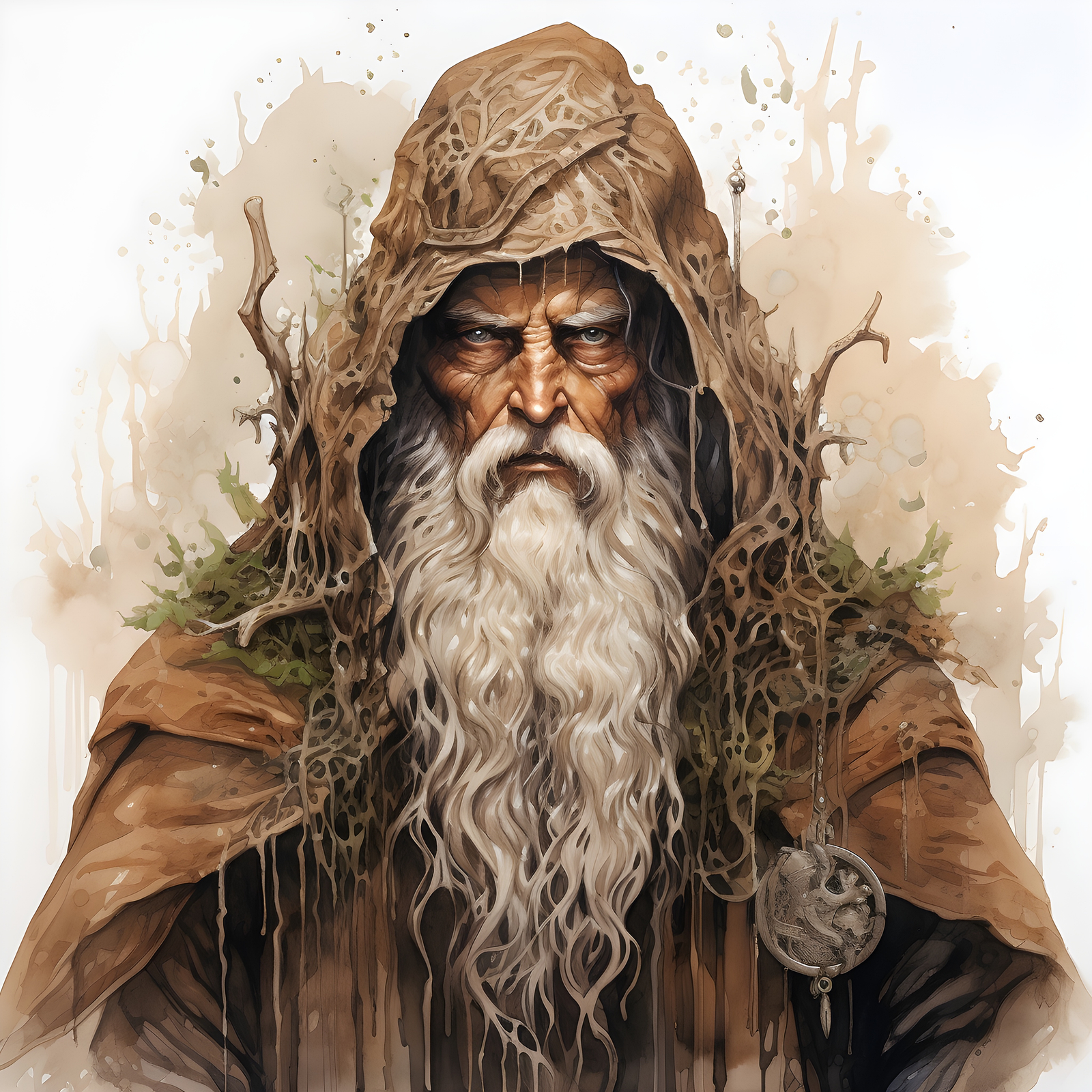
“I was called Cinderklous. A pagan demigod of the forest. The learned men said I was a minor demigod, as my forest was small. My name is similar to that of a Catholic Saint, so my story has always been clouded. That is a good thing for us, bearn.”
He coughed and gripped Bastjian’s shoulder.
“I had a good existence for many years,” he said. “The nearby villagers brought me gifts, what they could, and I would fly up and talk to the sky to plead their case for rain, wrestle the earth to release their harvests. It was good, bearn, I was happy.
“Then the Romans found me,” he said. “And they filled my forest with the most lavish gifts. Gold and silver, copper and brass, fine cloth, rare spices, dishes and candlesticks. I didn’t own a house, bearn, and I hoarded these things. And they lured me into the villages of their enemies, told me their children were being raised to cut down the forests, my forest and every forest. They wanted me to get in their homes and…” Santa dragged his pipe through never-spoken words
“Did you kill them, pater?”
“I did,” Santa said. “And I put them in my sleigh and I drove it through those villages to terrify the enemies of Rome.”
Bastjian didn’t speak, which, for a young man of endless questions, drew up a panic in Santa. He’d never told anyone of this, bearn or not. He knew he had to continue.
“It went on for twelve seasons. Until I was sent to a village near my home, to a village that was one of my villages. I wish I could say I came to my senses, but I had not. I had every intention of murdering their children. Until I was confronted by a group of Druid monks.” Santa spit. “Powerful Druid monks.
“They laid a curse on me,” he said. “They made me immortal, forced me to live the farthest north a thing could live. And once a year I would be compelled to fly my sleigh over the entire world in an act of penance, giving a gift to every child, just like the gifts the Romans gave to me.”
Santa knew he had to wait for Bastjian to speak. There was no more to say, no redeeming arc, there was simply acceptance or rejection – of his story, of his life. Bastjian had to come to terms with his own origin story being a fabrication three days before Christmas.
Bastjian wandered the corridor, picking up items of treasure and dropping them as if he were told they were coated in plague. Santa could hear his breath, shallow and ragged in between the rapid-fire clearing of his throat. He was a child, a baern, even at two-hundred and thirty-four years old he had the look and the mind of seven years, his ears barely tipped to a point, easily passing for full human.
“Is this why you’re falling apart?” he said. “Is it the curse?”
“It is. It’s lifting. The curse; it’s lifting.”
Bastjian touched the harness and it shocked him, making him withdraw his finger. “Is that not a good thing?” he said. “Curses lift, is that good?”
Santa sat up from the bag of coins and pocketed his pipe. “Some curses are meant,” he said. “And some curses take on a life of her own.”
Santa snapped his fingers. He and Bastjian were in the sleigh, hundreds of feet above the North Pole. From above, and to anyone who could see it, Santa’s workshop looked much like the Kremlin with its colorful, ornate cathedrals.
“This curse of penance,” he said, “my curse; it’s grown. It encompasses the entire world now. It has become the hope of a promise to the children, from parents who murder them every day with processed food and deforestation and whatever degenerate lech they vote for. Without that hope, without the umbrella of that curse and the compulsion to atone, we’ll quickly return to the Dark Ages.”
Bastjian gripped the front edge of the sleigh, stooped forward and looked down. “Pater,” he said. “Will we die?”
“Me, yes, though I don’t know what it means to die when you’re a demigod.” He tugged the reins as if to steer a sleigh driven by no reindeer. “I don’t know if you will live, Bastjian. I wish I could tell you better.”
They floated above the arctic, neither a word between them. Santa smoked pipe after pipe, Bastjian scanned the skies and played with a coin he found in the basement.
“Can you use your magic to fix it?” Bastjian said. “Re-curse yourself?”
Santa stayed silent. Bastjian studied his father’s face.
“Pater? Did you hear me?”
“I did.”
“Can you?”
Santa turned away, into the wind.
“You would let the world go dark?”
“The cost is great.” Santa said.
Bastjian snapped his fingers, the coin in between them, and it zipped before the sleigh before being quickly overtaken.
“So you know how to cure it.”
“I do,” Santa said. “The same way I brought it on.”
“You need to kill children.” Bastjian said, not a question.
“I need to kill one.”
Santa dipped the sleigh and it banked on Bastjian’s side. The aurora slithered in faded indigo and vibrant green, punctuated by stars that had seen it all before.
Bastjian picked at a frayed hole in his tan corduroys. “Pater, why are you telling me all of this?”
“Bastjian, you must understand that I am in a position of no choice.”
“Pater…”
“You are my thirtieth child. Children, not offspring. And without deceit I can say that you are the first I’ve had the capacity to love. I believe you are more than a boy. You are the very lifting of the curse.” Santa sighed. “But, again, this is bigger than me. Bigger than us.”
Bastjian had little room to move away from his father, but he claimed every inch.
“I’d like to go back to the workshop now, please.”
“…Humans go to war with bombs that fill the skies with death, all for the sake of ground it is impossible to truly own. They claim that they are making the world safe. Would they put their bombs away if the generals could sacrifice their own sons and save millions?”
“Pater, I’m scared. I don’t know what to say right now. Please tell me what to say.”
Santa glanced over, his face hard, wrinkles like canyons, tears of a desert rain descending from eyes that didn’t want to look over at his child, but knew he must.
“Say you understand, baern,” he said. “Or speak no more.”
Santa twirled the sleigh suddenly, swiftly, pulling enough gravitational force to be withstood only by the grip of adult hands. Bastjian’s scream trailed as Santa guided the sleigh out of earshot.
He felt the moss-green glow of the Druidic sigils once again burning into his ancient skin. He felt the primordial urge to atone, for a new sin, the murder of his own heart. He know he would need the harness once more.
Christmas was saved.

