

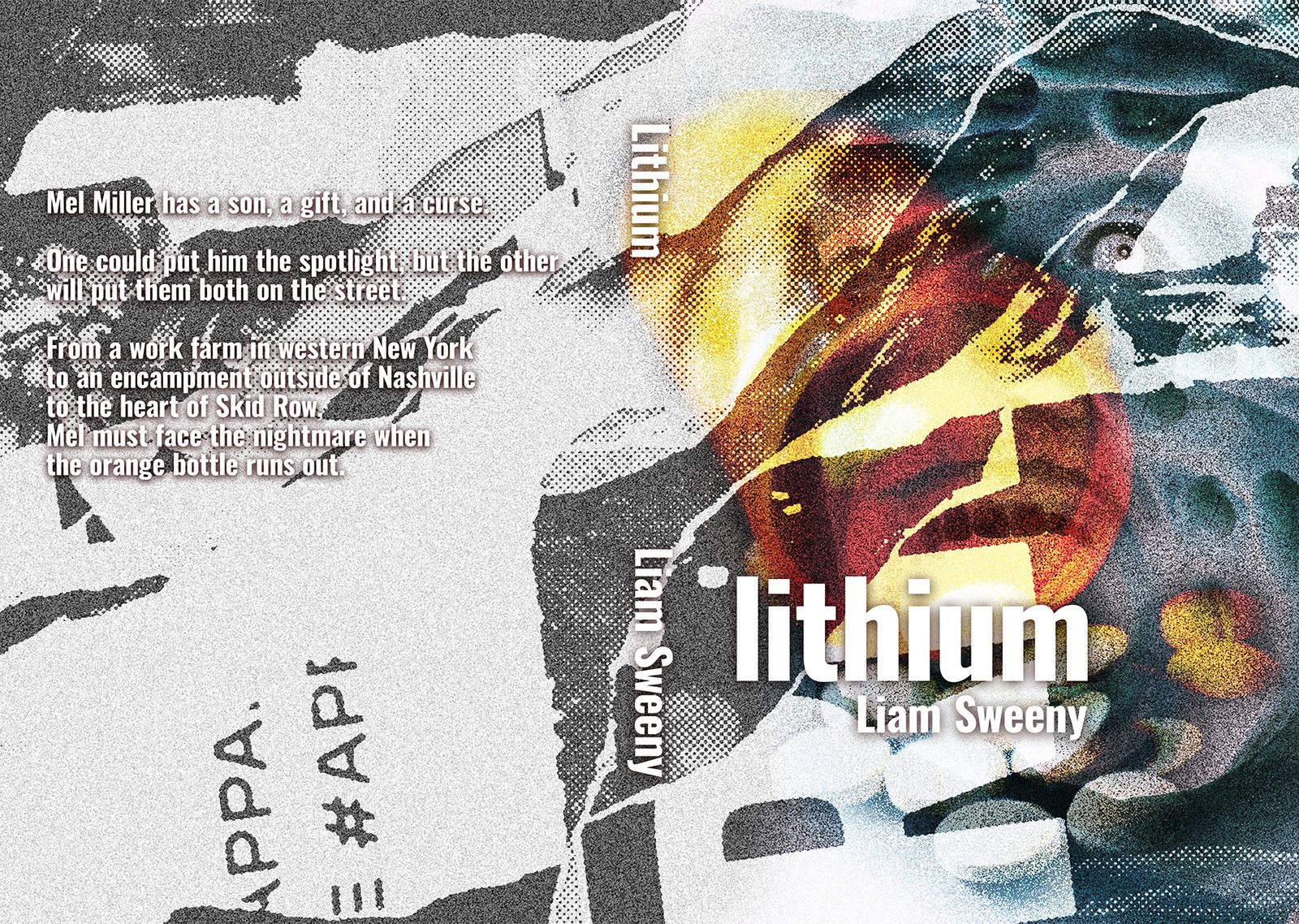
Lithium – Chptr. 23 – Xperience Fiction – by Liam Sweeny.
Mel found a flow with whatever pill they gave him, and it was to go with the flow. Be agreeable. Go along. When he resisted, or when he set about continuing the big esoteric battles, he nodded off. The med forced him to shut up and listen. He tried to wonder how effective it would be if administered to the mass public, or if they were already doing that, and he nearly fell dead out in the hallway.
There was a four o’clock group called “Mindfulness.” Mel thought it was about training for people with full minds, and he figured with that kind of training, he might be better able to fight the void and rescue Andy and Hope. Maybe he could learn enough to become the void, and no rescue would be needed, because as the void, he could bring them anywhere.
He walked in and there were eight people in the room, with a young woman wearing a light cream-colored sweater with tulip embroidery. She stood opposite the door, and she had a stack of handouts. As Mel sat down, he noticed that Critter was there, across from him, by the young woman. Everybody had name plaques composed of a strip of pink construction paper, single folded to stand upright. There was one by each seat, including Mel’s.
He walked over to the middle of the table to pick up a marker, when the girl sitting next to it said, “I would have slid it over to you.”
“Thanks anyway,” Mel said. He scribbled his name on the paper, ignoring his usual flourishes.
He looked around at everyone’s name, and tried to tie one observation each, a mnemonic trick he picked up when he learned he had a photographic memory. Ted; spiky hair. Magda; birth mark under nose. Critter; tail, already know him. Ramon; thick, dark eyebrows. Sarah; fake red nails. Orren; Coke-bottle glasses. Maurice; lip ring. Patricia; sweater, handouts.
“Okay, everybody,” Patricia said. “I’m going to hand these out. In today’s group, we’re going to talk about anxiety. I know talking is difficult, and we have some new people.” She glanced at Mel. “So let’s just try our best, okay? And please, no interrupting each other. Raise your hand, and I will call on you as soon as whoever is talking is done.”
Mel was itchy to walk. Not that he could do anything but listen to the sounds of the ward, but he was restless, and his leg muscles wouldn’t hold still.
When she’d handed out the papers, she sat down.
“When we talk about anxiety, it’s helpful to separate it into two types of anxiety,” she said. “Because not all anxiety is bad. Can anyone tell me an anxiety that’s good?”
Orren raised his hand. “When you’re doing code, and you’re worried that it won’t compile, so you go through every line to make sure you didn’t miss some semicolon before you go to compile,” he said. “That’s a good anxiety, because it makes you more careful.”
“So you’re talking about programming, Orren?”
“Yeah, programming.”
“Okay,” she said. “Anyone else?”
“When you fall in love, and you don’t know if they love you back,” Sarah said.
“Yeah, okay,” Sarah said. “One more, maybe from someone new?” She looked over the square of tables. “Mel, do you have one?”
Mel wasn’t ready to be called on for anything. So he just pulled from a place he didn’t need to think about.
“Having a kid,” he said.
“What about having a kid specifically?”
“Worrying you’re not going to be a good dad.”
“And that’s a good anxiety?” Patricia said.
“Makes you try harder.”
“Okay, so similar to what Orrin said about programming.”
“But a kid is more responsibility,” Mel said.
“Writing code for an insurance company puts hundreds of thousands of lives in your hands,” Orrin said. “A kid is just one life.”
Mel felt the steam hit his face, and if he could’ve told Orrin off in better words, he would’ve, even though Orrin had somewhat of a point. He’d have to revisit it when he could shake off the med.
“There’s a lot of responsibility in both,” Patricia said. “So obviously stress, and anxiety can help us perform better at important things. And overall, anxiety is natural. It’s one of our emotions that exists to protect us. It makes us aware of a threat, whether it’s a sabretooth tiger, or whether we’ll find a relationship, or how we’ll handle a big responsibility. Anxiety is natural.
“But when we talk about anxiety in the sense of anxiety disorders, we’re talking about anxiety that doesn’t help us, that gets in the way of our performance. Even gets in the way of our lives. Anxieties of this type; well, picture phobias. Does anyone have a phobia?” Everyone except Critter and Mel raised their hand. Mel didn’t raise him hand because his attacks could happen anywhere, over anything. He tried his mnemonic with everyone’s phobias.
Ted; heights. Magda; big dogs. Ramon; deep water. Sarah; spiders. Orren; heights. Maurice; needles.
“And I have a fear of avalanches,” she said. “Glad I live in SoCal. So, the thing about phobias is that we get phobias. We’re not born with them. And it’s a phobia if the fear is not in proportion to the threat, but it’s basically a response to something that happened to us, and a lot of times we can’t remember what that was.
“Just like phobias, the anxieties we have, the destructive ones, are fear responses that were at one point valid and useful, but they outgrew their usefulness,” Patricia said. “And in this group, over the time you’re coming to them, I want to teach you the skills to get at the bottoms of your anxieties. And if you don’t have anxieties, you can go to the other groups. No one is required to attend a group that won’t help them.”
The group went better than Mel expected. It was tough for him to listen and think about what he was listening to, but he had no problem just listening. Whether he’d be able to retain any of it was anybody’s guess.
As they walked out, Critter patted him on the arm with the back of his hand.
“I’m not going back,” he said. “What about you?”
Mel looked back in the room.
“I might.”
***
The sun stung through the windows in the day room, windows that went floor-to-ceiling. It was breakfast, and Critter had taught Mel a trick he was planning on using when they brought in the menu. Surprisingly, they let the patients pick from a menu, displayed on a slip of paper passed around after breakfast. He’d gotten one the day before, and he picked scrambled eggs, a turkey sandwich for lunch, and boiled chicken for dinner. Not the most appetizing choice; really the best of bad options. Today he’d simply write ‘cheeseburgers x 2’ on the side of lunch and dinner, and they’d bring it.
Mel wasn’t running from the void anymore. He realized over the night, another of little sleep, that he could no longer see the void because he’d become the void, and it would be like looking for his own face without a mirror.
He noticed that being the void wasn’t as intense as running from it. He knew what he was, but in the same way that he knew he was a man, or that he had named his son Andy after his grandfather. It was a fact. He tried not to think of Andy, or Hope, because as the void, he didn’t have them. They must have escaped. He avoided thinking of any more explanations.
But at least he could put thoughts together again.
The med line stretched around the east-running corridor all the way to the start of the rooms. He got in line behind Critter and let his fingers tap his thumb.
“Magic fingers,” Critter said. “I had those. But I was on a shitload of meds,” he said. “I used to hate it, but I told people I was doing hand exercises for guitar. Fuck ‘em.”
“You play?”
“Yeah, I was in a band, the Noogie Collectors. Punk band. You ever play?”
“I had a punk band too, called Biscuit. I played mostly jazz and blues, but punk was a music my dad hated, so I went for it.”
“Nothing like pissing off daddy, huh?”
Mel couldn’t tell if that was an insult or not, but he didn’t care to ask.
“We got all our equipment stolen at a trap house.” Critter said. “We were renting a whole floor to live there and practice, but it was a trap house, so…”
“They let you practice there? Wouldn’t that draw the cops?”
“Not in that neighborhood. Gunshots didn’t bring the cops unless they hit the mark,” Critter said. “Nah, they were just meth heads, did a credit card in the door. They were shitty doors in that place. It was actually the dumbest move we made, and we argued, and fought, and that was it.”
“Ours was in high school,” Mel said, “We graduated, got jobs, went to college, so we just left it at that.”
“Too bad they won’t let us have guitars in here,” Critter said. “We could jam.”
They got up to the nurse dispensing meds. All the Dixie cups were in the waste basket except Critter’s and Mel’s.
“Uppers, downers, and way-downers,” Critter said as he downed his meds. Mel looked in the cup, still not recognizing what was in there.
“Can I find out what I’m taking?” Mel said.
“Right now, I have to do some paperwork, make sure everyone is accounted for,” Amanda said. “But after that, I can come and tell you.”
“Can you show me what they look like in the cup?” Mel asked.
“I can as long as you can wait.”
“I can wait.” Mel wandered away to pace the corridoes, as if the exercise was effective in anything at all.
Amanda did come to get him around eleven, after he attended a group about hygiene. He found out that he was taking the same meds he had been on, with the addition of the haloperidol that he already knew about. They were also giving him a multivitamin, to make up for any deficiencies from being on the streets. They looked different because of the manufacturers.
At two-thirty, Mel was in the day room, playing checkers with Ramon when Amanda poked her head in.
“Mel, you have a visitor.”
Mel got up and walked over. “How do I have a visitor?”
“One of the names you gave us when you first came in here. She’s here. Do you want to see her?”
Hope. It had to be Hope.
“Please,” Mel said. “Bring her in.”
Hope looked like she had just taken a shower and changed back into dirty clothes. But they were different clothes than she had; only the jacket she brought when he was with her remained. Her eyes and her smile showed wear.
“Mel, how are you? Are you any better?”
“I’ve evolved,” Mel said. “But it’s no matter. I was looking for you. In my mind. But I couldn’t find you.”
“Oh, Mel, you’re still out there. You look good, but there’s something I need to tell you, and I don’t know if you’re able to hear it.”
“Where’s Andy?” Mel said. “You two are a set.”
“That’s just it,” Hope said. “When we brought you in, they had us wait. I didn’t want to, but I didn’t think-… Mel, they took Andy.”
“Who took Andy?” Oh God, the void got him before Mel became it.
“DFCS. Department of Family and Children’s Services,” Hope said. “I couldn’t do anything. I’m not his mother. I’m not any relation to him.”
“So where is Andy now?”
“With them. They might put him in a foster home or send him back to New York to be with Debra.”
“Debra? She’ll kill him.”
“I’m sorry, Mel. There wasn’t anything I could do.”
“You led us here,” Mel said. “You’ve done enough.”
“I led us here? Your ego led us here,” Hope said. “You had to go to the Getty Center because of your painting. There are two million homeless people in this country. Camps in every city. We could’ve gone anywhere, and you picked the worst place. Don’t you blame me. I feel shitty enough.”
“It’s been nothing but bad luck since I met you,” Mel said. “You’re a living curse.”
Hope got up from her seat. “If I’m a curse, you cast me on yourself, asshole.” She went to the nurse’s station to get the door buzzed.
Mel made it to the middle of the corridor, to the row of prints of semi-famous paintings, the likes of which one could find in any budget motel, before he started tearing things apart in a fury he could barely understand. The nurses shouted but didn’t intervene. Who did intervene, after a few moments of freefall, were two massive orderlies. Mel was wrestled to the ground, and he couldn’t move, but he could feel the pinprick that would kick him to the dirt.
He spent the night in a small, windowless room in four-point restraints.
***
The only thing more disturbing than waking up in restraints was trying to sleep in them. The restraints were thick leather, the color of cherry or maple, The straps that fed in to tighten them had thick slats; everything about the restraints were thick. They were connected to the bedframe at the head and foot, and they were taught enough to pull his legs and arms apart – not much, but enough to make any comfort a dream denied.
A nurse or a nurse’s aide sat in the doorway on a padded folding chair with a clipboard and a newspaper, or more likely a phone. They barely talked, only to answer pleas and requests for water and a bedpan, which they had to assist. Then, fifteen minutes later, they switched with each other. Amanda was on, must have had a double shift. She took her turn in the watch seat.
“I’m better now,” Mel said. “Can I get out of here?”
“I can’t,” she said. “The doctor’s orders are to keep you in here until tomorrow at the earliest.”
“The earliest?”
“If you’re calmer tomorrow, they’ll let you out. If you’re still combative, they’ll keep you in here longer.”
“It’s not fair,” Mel said as he struggled to get comfortable. He tried not to think of the itch building on the tip of his nose.
“You trashed the hallway.” Amanda set her phone in her lap. “You could’ve hurt somebody. Even if you had a good reason, if we didn’t put you in here, what kind of example does it set for everyone else? We’d have people doing that every fifteen minutes. You see what I’m saying?”
Mel nodded, though she probably couldn’t see it.
“I lost my son today.”
“I’m sorry,” Amanda said. “What happed?”
“That girl that came in told me that something called DC-, or DFC-, something like that; they took him.”
“Oh, so he didn’t die. It’s DFCS. It’s Child Services. I think it’s called Child Protective Services in New York.”
“They’re going to ship him back to Debra. So he’s as good as dead now.”
“Is she his mother?”
“Yeah. She abuses him, but she’s a chameleon. She has a different face for judges when she’s in court. She’s whatever they need her to be. At home, she’s a monster.”
“So you should work on getting better,” Amanda said. “Get yourself well and go back and get him back. That’s really all you can do, right?”
“I can’t do that. I’m homeless. I’m broke. I’m never going to be able to get to Albany ever again. I’m a failure. I did what I said I’d never do. I failed my son, and I did it worse than my dad failed me.”
“How did your dad fail, if you don’t mind my asking?”
“What else do I have to do?” Mel said. “Discuss the latest trends in bondage?”
“Let’s not,” Amanda said.
“My dad, he… he suffered. He had this… gift, curse, whatever. And when he was growing up, you didn’t have this thing without spending your life in a rubber room, so if you had it, you hid it.
“He’d never admit that he had it. When it came to him, there could never be anything wrong. Wrong with him, that is. Nothing could be bad in him that was because of him.”
“Do you blame him for giving you bipolar?”
“No,” Mel said. “Well, yes, no. I mean, I didn’t get it from mom, so simple cause and effect. But I can’t blame him exactly. Even if he was on meds, he couldn’t control passing it on, and again, if he got help, rubber room, electroshocks, no me in the first place.”
“It’s okay to blame him, you know,” Amanda said. “I blame my mom for giving me bad skin. A fact is a fact. I think it’s just; does it help you to blame them?”
“My dad suffered, but he was a piece of shit too,” Mel said. “I hate him. I really do. He’s been dead for years, but I stopped talking to him decades ago, so he’s been dead to me that long.”
“I’m sorry to hear that.”
“Not sorry to say it.” Mel shifted in place, with difficulty. He felt the edges of his eyes starting to float.
“I had one gift,” Mel said. “I have a photographic memory, and I’m really good at painting, whether it’s what I see, or abstract. I can create portals to other realities, other universes. And my father couldn’t let me have it. It was his, I was what leaked out of him when he let his sperm go. He told me, more than once, that I stole his power, that my ability was really his ability, and me having it was why he didn’t have it.”
“That sounds terrible,” Amanda said. “It must not have been fun growing up like that.”
“Wasn’t so bad at first. He bought me paints, encouraged me, let me do all the painting I wanted. But when I was eleven or twelve, about Andy’s age, I saw one of my paintings in a gallery near our house. Dad must’ve been lazy because there it was, my painting, with his signature, big, in the lower right corner.
“It started to get worse then,” Mel said. “The accusations, the resentment. You know one of my paintings was in the Guggenheim, with his name on it?”
“Oh, wow, that’s insane,” Amanda said.”
“It got sold to the Getty Center; that’s why we came to L.A.”
“Well, maybe when you get on your feet, you can pursue that.”
“I have to get out of here if I have to break out. Get my boy. Get my life together.”
“When you’re better, there’s nothing stopping you,” Amanda said. “You signed yourself in here. As long as you’re not a danger to yourself or others, you can sign yourself out.”
“So I can sign myself out, what, tomorrow?”
“I wouldn’t do it tomorrow,” Amanda said. “In fact. I’d highly recommend waiting until they discharge you. We don’t get anything for keeping you here longer than we need to. And most people that sign themselves out AMA end up back here pretty quick, usually worse. Usually involuntary.”
“I like you,” she said. “Promise me you’ll be smart.”

