

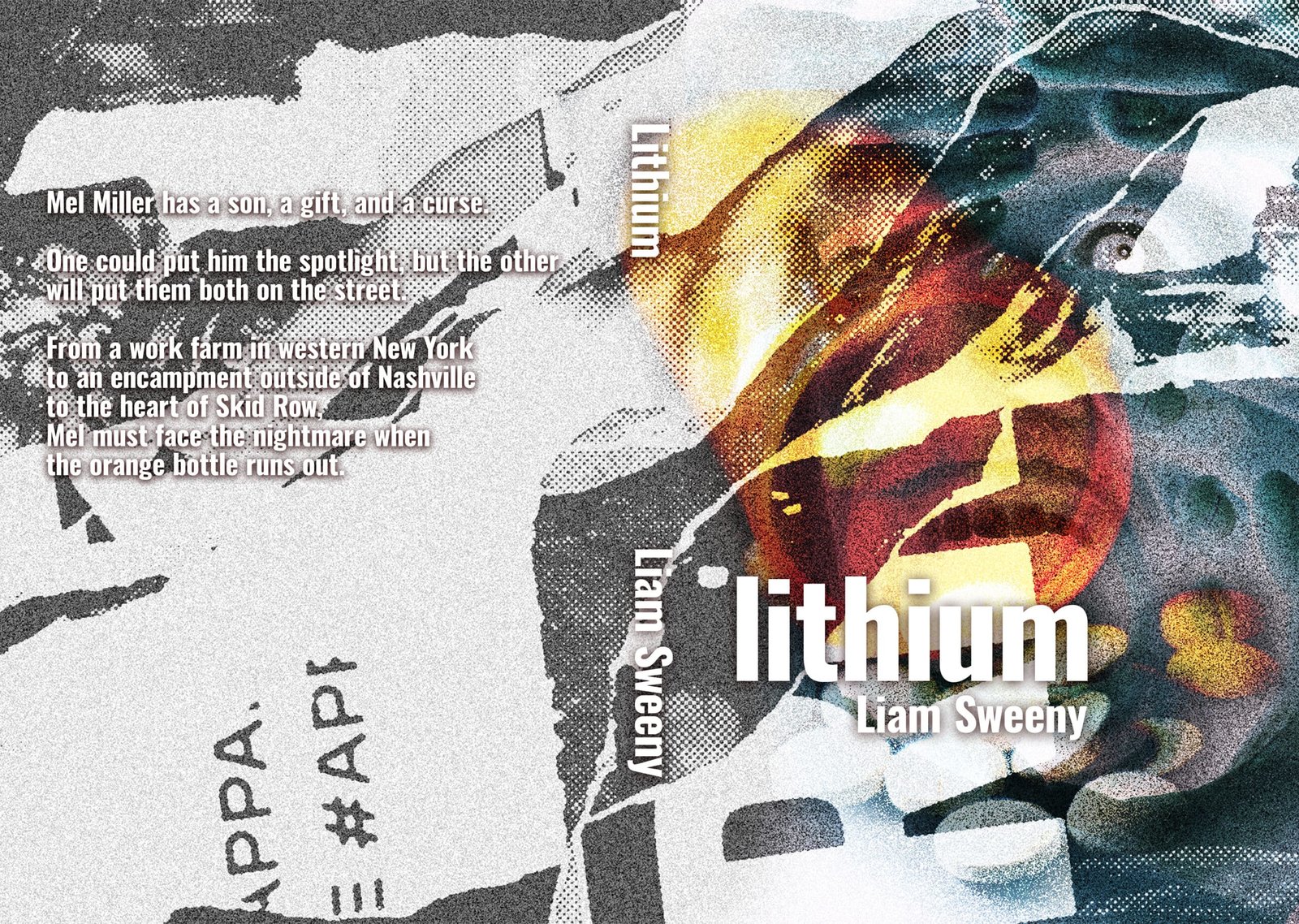
Lithium, Chptr 10 – Xperience Fiction – by Liam Sweeny.
It was a dance if Mel thought about it like that. Lifting the sledgehammer, arcing it through the air and giving gravity just a tiny bit of assistance in bringing it down on the post. He realized that he had much more respect both for dancers, and for anyone with the misfortune of having to make time with a sledgehammer.
It had been almost two weeks since they arrived at the farm, and he wished that he felt like he had accommodated to it. But his muscles and joints protested familiarity with farm work. His back burned every night, and his arms and shoulders were untouchable, screaming as they brushed against anything. Mel was exceedingly careful wherever he walked. Even his ass cheeks were sore, making the simple act of sitting on his butt an unwise decision.
Allie found home remedies for him in her scroungings, like menthol rub and gel pads – so not exactly home remedies but close enough for people who had no homes. Allie was like a mother to the rest of the workers, which was odd because she was three years younger than Mel, only thirty-five. But she grew up homeless, so her years were like dog-years.
Allie’s care made him only more eager to leave the farm. Her care only gave him enough respite to make the next day’s punishment fresh. He would miss the camaraderie every night by the fire, even though the past three nights, there were no palettes to burn, just garbage. He had gotten to know the other workers, but he could easily tell that they were holding up much better than him. A few times, they even finished his work out of pity. He paid them back the best way he could, giving them every painting he had in the minivan except for the one he painted after Andy was born and he had to stay up all night on call for feedings. He called it “The Son.”
One minor blessing was the fact that, true to the scuttlebutt, Burle was eager to get Andy in the local school. The bus picked him up and dropped him off every day. But Andy didn’t feel so blessed. Especially not the day he came back with a shiner and bruises.
“They don’t like me, dad,” he said. “They call me ‘street rat’ and ‘scumbag’ and other stuff. I tried to fight back today, but they held me down.”
Mel felt fire tickle the space deep within his eyebrows. “I’ll handle this, kiddo. Don’t you worry about those little-,” Mel looked around for Burle. “Those little assholes.”
He knew there wasn’t anything he could do about kids at school, and Burle told him as much when he brought it up. And Burle refused to pull him out of school so long as Mel was working there. If Mel could’ve walked right then, if he had any place to go or any direction, he would’ve torn Burle apart in a well-crafted set of remarks. Instead, he had to ask a favor.
“I’m running out of my medications,” he said. “I need to go to a pharmacy to try to get my script filled. Can you take me?”
“There’s a pharmacy in Jamestown. That’s a few minutes north. I’ll give you tomorrow morning off if you need to.”
“Off the clock, of course,” he added. “I’ll give you the address. Better head out. I need you back by lunch. A lot of projects.”
At least he wouldn’t add insanity to his list of maladies.
Jamestown was a big city, insofar as there were actual neighborhoods and an actual downtown. Oddly enough, Mel and Andy felt good stopping at actual stop lights. Mel promised Andy they would go exploring when they could, but right then, gas dictated they do a straight shot for the pharmacy.
What they found was a small mom and pop operation with green-and-white curtains, drawn with a red sash, and an ornate mortar and pestle decal, gold. They walked into a set of angled shelves carrying every odd manner of goods, from beach balls to jumping jacks to calendars to seat cushions. The pharmacy was in the back, flanked by over-the-counter medicines, vitamins, and supplements. The pharmacist was a bald man, maybe sixty, nose down, likely measuring out pills. His assistant had her raven black hair in a ponytail.
“Hi,” Mel said. “I was wondering if you could help me out.”
“Do you have a script?” She asked.
“I do, but it’s in Medco’s, my pharmacy in Troy. It’s near Albany if you know where that is.”
“Roughly,” she said. “So you’re asking if we can get the script from Albany?”
“Troy, but yeah,” he said. “I’m living here temporarily, and I don’t have a doctor out here.” He leaned in closer. “It’s a psych med, and I’m running out.”
“Let me check with the pharmacist,” she said. “I’m not sure about what we have to do for Medco scripts.” She walked over to talk to the pharmacist and, though only six feet away, was subsonic. He nodded, then shook his head. Mel felt the sweat sheen, as he always did when getting his meds wasn’t a straight shot.
She came back. “Okay, sir. We can, but it’ll take about an hour, hour-and-a-half. Medco has a specific process, it’s time consuming. You can wait here if you want or come back.”
Mel looked to see three hard plastic seats in a row between the vitamins and the supplements. He wondered if they would frown upon him and Andy borrowing two seat cushions from the shelves.
“We’ll come back.”
They cruised the downtown, cutting turns whenever a street looked promising. Unlike Frewsburg, Jamestown was happening. If Mel had any intention of laying roots down in Western New York, Jamestown would make the list.
They stopped for sodas and hot dogs from a cart by a small park and ate in a white wooden gazebo. They weren’t as good as the hot dogs he could get back home, but that would’ve been close to a miracle. At least they had chili and cheese.
They took off and didn’t make it too far before they passed a brick building with a wide window filled with paintings – one of which was his.
***
When Mel was in third grade, his art teacher put one of his paintings up in the main window of the elementary school. Mel didn’t have long to be proud before his classmates realized it was his, and out of jealousy started calling him ‘psychoangelo.’ It wasn’t a crack on his bipolar because he didn’t have any major symptoms other than a bad habit of interrupting people. They just didn’t like him. He was a poor boy among the well off, and they reminded him of it, probably with no clue they were doing it.
His father had them take it down, much to the protest of Mel’s art teacher. Mel and his father made a deal after that; he would get all the art supplies he could use, plus Saturday trips to the Empire State Museum, and in return, Mel would let his dad sell his paintings to coworkers to cover the extra expense. Painting and art were how they connected. It was their bond.
His painting, this painting, took a center place in the gallery window, which, due to its smaller size, made it stick out. Also making it stick out was the tag on the lower right corner that read ‘Not for Sale.’
“Why aren’t they selling it?” Andy asked.
“I gave it to Burle to sell. I’m sure he sold it to them.”
“How much did you get?”
“Nothing yet,” Mel said. “But I’m gonna ask him about it when we get back.”
Andy placed his finger on the window glass. “Can we go in?”
“Sure, I don’t see why not. We got time.”
They opened the door to the smell of pine and cinnamon. For some reason, it smelled like Christmas. The three remaining walls were covered in paintings, as well as two standing walls parallel to the door. In the center of the space was a Zen rock garden with a waterfall in stages, starting from the ceiling and dropping into three serene pools which fed into the main pool on the floor. Mel saw fancy goldfish and real lilies.
They wandered through the gallery and took in the offerings. True to the fact that beyond Jamestown was nothing but farmland, most of the work was still life, nature images, and of course, farm images. He was surprised at the quality of the work. There was so much abstract work in Albany that it was easy to overlook the simple brush techniques of still life.
Mel glanced toward the back to see a woman; face turned to the Lucite counter behind which she stood. Her hair was bound by a black kerchief with sparkling gold trim, and her dress was of the same material, semi sheer with a strange embroidery look to it. She must have sensed his gaze because she looked up and smiled.
“Welcome to Horizons,” she said. “Is there anything I can help you with?”
“Yeah.” Mel walked over to her. “The painting in the window, the one that’s not for sale. I’m just curious how you got it, and what you paid for it.”
Mel, of course, knew how she got it. But he figured it wouldn’t hurt to ask.
“I got it from a farmer, actually,’ she said. “He said he picked it up at an estate sale. I asked him where the estate was, he didn’t say. I really wish he had told me.”
“So how much did you give him?”
“I usually don’t tell people what I pay for art,” she said. “Bad for business. But since I’m not selling it, I don’t mind. I gave him five hundred dollars for it.”
“You paid five hundred dollars.”
“That’s what he asked for. When I saw it, I got excited. I think he saw me get excited and brought up the ask. I don’t think he realized what he had.”
“And what’s that?”
“It’s a Roy Miller,” she said. “He’s a super obscure painter. Really like nothing’s known about him except that he lived in the Albany area and died in 2004. That’s it; that’s all I know.”
Andy tugged at Mel’s arm. “Isn’t grandpa-,”
“Yeah, he is,” Mel said. “We’ll talk about it later.” He turned back to the proprietor. “So how do you even know about Roy Miller?”
She slid away a notebook she was working on and came out from behind the counter. “I was in New York, you know, the city, for art school. And I spent my weekends at the museums, all the great ones. I mean when I could afford to go. Museum of Modern Art, the Guggenheim, and not to mention all the smaller museums and galleries. The first, and only, time I ever saw a Roy Miller was in the Guggenheim,”
“You’re putting me on, right?” Mel said. “The Guggenheim?”
“It was called ‘State Street’,” she said. “It was a view up State Street to the New York State Capitol building. It was so detailed, and with such, just, genius brush strokes, down to almost the micron; it was like you could walk right in the painting and be on State Street. It was like staring into an otherworldly photograph, only with texture.”
Mel stopped listening after he heard the word ‘Guggenheim.’
“So is it still there, you think?” Mel said.
“I don’t know. I haven’t been down in New York since art school, and to see Ground Zero. So I couldn’t tell you. But you could probably call.”
Mel glanced at his watch out of nervousness but realized that they needed to get a move on to the pharmacy, He took one of her cards as they left.
When they got to the pharmacy, he took out his wallet, as usual, but since expensive meds were involved, he’d have to pay with the EBT card he got from Social Services. He felt inside the front card slot on the left side. No dice. Then he opened up the wallet and pulled everything out. Still no dice. He turned his pockets inside-out and pulled everything out but his EBT Card, which was gone.
***
It was twenty minutes past the latest time the pharmacy gave him. Most of what was in the minivan was sitting on top of it or on the curb. Mel was under the seats, in the cupholders, in between every crease of crevice the minivan had, and there was no trace of the EBT card. He was furious at himself for losing it. He was even more furious at the fact that he couldn’t have lost the card. It was secure in his wallet, and he left it in the car so none of the workers would get the idea to rifle through his clothes when he was asleep.
In the back of his mind, he did realize that Burle had broken into it, and based on everything he’d been told, it wasn’t beneath the man to claim something as his, But why would he do that if he was going to pay Mel in a couple of days? There’d be no point.
Except to pay Mel with his own money.
“Dad, I don’t think it’s here,” Andy said.
“It’s not.” Mel put his hands on his hips. “How about you put this stuff back, and I’ll see if I can work something out with the pharmacy.”
Andy agreed and got to work. Mel walked in the pharmacy at a full sweat, only some of which was from tearing the car apart. He was going to have to do something anathema; he was going to beg.
He got up to the pharmacy counter. The pharmacist was on the phone and the assistant was nowhere to be found. The pharmacist put his index finger up to signal Mel to hold on. And hang on he did, for five minutes. By then, there were people behind him.
“You have a script from Albany,” he said before he went back to a wire rack with bags suspended from it.
“Yeah, actually, I’m having a problem,” Mel said. “I just lost my debit card, and the meds, even with my insurance, are too expensive for the cash I have. I couldn’t afford a ninety-day supply.”
“Well, we can hold on to it for you if you want.”
“I’m not going to be able to get back here before I run out. I gotta figure something else out.”
The pharmacist scratched his head. “I can’t just give them to you,” he said. “Full price on these in close to six thousand. We’re just a small pharmacy. Maybe a Medco could do it.”
“Where’s the nearest Medco?”
“Cheektowanga.”
“I don’t think I could get there.”
Mel could hear shuffling and exhaled breaths behind him. He turned back and said, “Sorry.” Everybody looked apologetic, which was usually what happened when people were confronted on their impatience.
“Can I get a partial refill? Like an emergency amount until I can get back here to pick the rest up?”
“If you can pay, I suppose we can do that. But you’ll have to wait a bit. I have a line, then I have to redo the refill. How many days do you want to pay for?”
Mel did some quick math, based on his insurance. “How about a week’s worth?”
“You got it. Come back in about a half hour.”
They were driving back to the farm, a weeks’ meds in hand. The wait was uneventful, which is the condition of much of life when you don’t have a penny to blow.
“I might have to ration my meds.” Mel said.
“Can you do that?”
“It’s either that or wean myself off,” Mel said. “I can always go back on when I get a job.”
“Wouldn’t going off your meds make it harder to get a job?” Andy asked.
Andy was right, but what was right wasn’t necessarily doable. Mel was feeling backed into a corner by Lithium and her plastic-coated buddies. They were a tether most times, but a prison is also a tether in a way, and the key to this prison either got lost, or was stolen.
“Look, don’t mention the EBT card to Burle,” Mel said. “He may have been the one to take it, but we’re kind of screwed without his paycheck. We’re between a rock and a hard place.”
“You could sell the last painting,” Andy said. “She looked like she’d give you hella’ money for it.”
“I’m not parting with it, not at all, I painted it when you were up all night as a baby. I’m considering it a family heirloom.”
“Dad, why did grandpa put his name on your painting?”
Mel sighed. “Your grandfather didn’t have much except the bipolar and some medals he got in Vietnam,” he said. “And he was a proud man. He was also a very tough guy to live with most times. They weren’t really treating bipolar when he was growing up. Not well anyway. Mostly they’d shock your brain. And there were always institutions. So he really tried to hide the illness in public, but at home he had to release.
“He had this thing where he thought his, genius, or whatever, was in me, but it was his, like it went to me when he conceived me. In a lot of ways, he resented me. I guess him selling my painting under his name was a way to reclaim something for himself.”
“That sounds weird.”
“It really was,’ Mel said. “When I wasn’t painting, he was mad that I wasn’t painting, like I was wasting his talent. It got bad sometimes. Definitely not a childhood.”
“Dad, if you go off your meds, won’t you end up like grandpa?”
Mel wanted to dismiss Andy’s question as excessive worrying, but Andy was spot on. Roy never got treatment, not even when it was available. Mel couldn’t have Andy live through the kinds of things he had to. When he got paid, he’d have to get back down to the pharmacy, even if he had to go on the weekend and drive others around for gas money.
“We’re going to be okay,” Mel said. “I won’t let you down.”

