

We Used to Cut the Grass – Thanks for Asking! – by Liam Sweeny.
RRX: Our style comes from the extension of our influences. It’s like an evolution. We’re influenced, and it inspires us to influence. What can you say about your influences, and what you feel you’ve done with their influence as a musician or band? Have you extended their work?
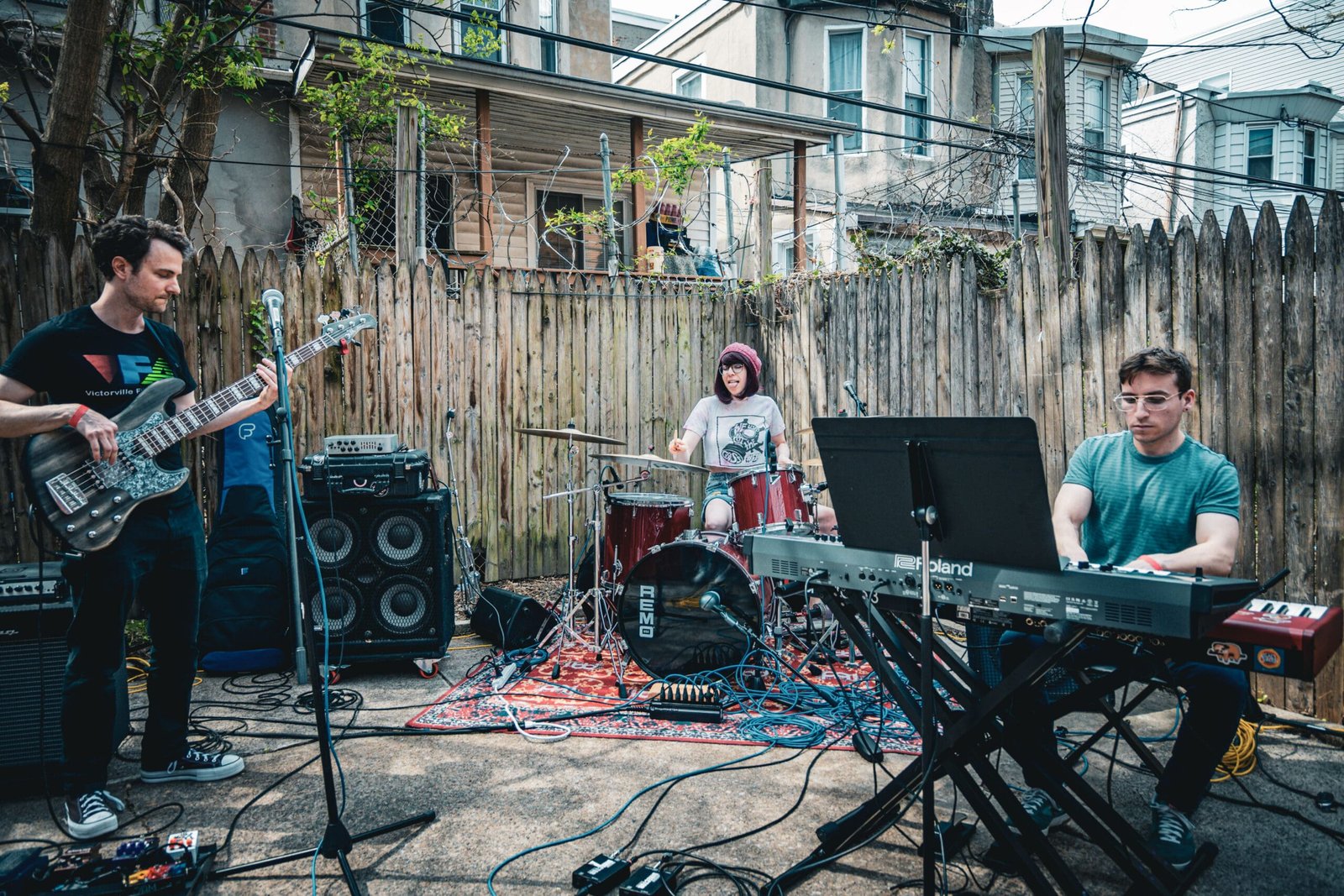
Cody: We actually started as just a drum and bass duo (myself and drummer Seamus Leonhardt) super influenced by bands like Hella, Radiohead and probably the biggest – Frank Zappa. For a short period of time we actually were touring a full Zappa tribute set with a 10-piece band, featuring the vocalist and guitarist from the Joe’s Garage era, Ike Willis. Zappa massively influenced my tonal vocabulary as a composer, and definitely the instrumentation for the band; our largest incarnation is kind of a mashup of his 70’s dual-drummer lineup with the four piece horn section from the 80’s band.
RRX: Every artist’s first song is a milestone. But so is the latest song. Describe the first song/album you recorded, and also the latest song/album you recorded; what are the differences?
Cody: Our first recorded song is called Woodpecker; we recorded it at an abandoned military base using 100% solar power from our drummer Kevin Grossman’s Sun Lab Studio (this was before our current drummer Faye Fadem joined the band, they both play together in our large ensemble). It was super inspired by some chords I was hearing (or thought I was hearing) in Stravinsky’s Firebird. I wanted to do something based on those stepwise cluster chords, but feeling that I was far from Stravinsky’s skill level, I figured while I couldn’t accomplish anything even close to the Firebird, by comparison, maybe I could swing a Woodpecker. One of our most recent compositions, which we just recorded a few weeks ago, is called Interdimensional Bigfoot, referencing my favorite variant of the Bigfoot conspiracy. It’s kind of an imaginary theme for a non-existent Kaiju film. In terms of differences, I’d say my composing style has since become a lot more nuanced and detailed, and obviously everyone in the band has gained a lot of technical facility over the last decade plus. However, I’m also a big believer in Zappa’s “Project/Object” theory, where each project is part of a larger, evolving object – so there’s still a bit of Woodpecker in everything we do, just as Woodpecker probably contained some foreshadowing for the new stuff.
RRX: Music genres are difficult for some artists. Some strictly adhere; others not so much. What is your perspective on the genre you play, or the genres you hover around?
Cody: Other than being mostly instrumental, we’re about as genre-bendy as it gets, I think. My perspective on it is that, back in the day, composers were sort of expected to be able to write in any style; that’s part of the fun of composing music, is that you avoid doing the same thing twice. Every song is just an experiment for us, and we’re happy to leave it to the listeners to decide what the overarching message is; the important thing for me is that I’m pushing our development as a band, and my development as a composer.
RRX: A band is a business. A business of love, but you got to work for it. Let’s pretend, instead of a band, you all owned a business. What would it be, and why would it be good?
Cody: It would be a coffee shop, and it would be fantastic, because we are all severely, severely addicted to coffee. I think that jittery caffeine-induced anxiety comes through a bit in our music as well. We actually sell our own coffee at our merch table, and on our online store, so in a way, we actually are a coffee shop.
RRX: We have to play somewhere, and sometimes those places have more going for them than a stage and a power outlet. What is a memorable place you played, and bonus points if it’s not a well-known place.
Cody: I’ll be honest, and this isn’t just me pandering to the town we just played, but No Fun in Troy was one of the coolest venues we’ve ever been to. It’s a great room and a great stage to start with, but the whole staff was just really trying to make it a great night – Derick Noetzl’s 3-wall projections were incredibly unique, and were responsive to the music as it was being played, and Hunter Simon did a killer job on FOH sound. To make it even more unique, Heart Support NY, a mental health non-profit, built a whole installation for people to anonymously write things they were dealing with and get anonymous feedback from others in the room. I think, especially at this juncture in history, stuff like that is really important, and should be more common at shows. It was honestly just such an awesome community to step into for one night, and we’re super grateful for it; we hope to be back soon. I should also mention the excellent bands on the bill – Horse Grave, Vethaken (whose interview I got to read in this very publication, as they were actively playing on stage – that was an interesting moment), and My So-Called Summer. Genre-wise, it was an extremely diverse bill, which is always my favorite.
RRX: In the universe of music, anything can happen. Bizarro doppelgangers can walk down the street in feather boas. Who would be your musical opposite and why? What do you think the “anti-you” band would sound like?
Cody: I think my musical opposite would be anyone who really enjoys making instant AI-generated music. Without even getting into the right or wrong of it, I get so much joy out of the lengthy and difficult process of composition. It’s like you’re gathering these little puzzle pieces, and you may not be sure how they fit together at first, or if they ever will, and throughout that process you take some pretty surprising turns. Often, complete accidents end up being vital parts of the composition; walking that tightrope between conscious and unconscious creation can be really thrilling. A little bit of chaos can go a long way towards breaking into the next part of something, and through the whole process you can really find out a lot about yourself if you’re paying attention. All of that gets lost when you just type a prompt into some water-sucking data center somewhere, and I’m glad that method of composition seems to be generally reviled in the music community right now.

