

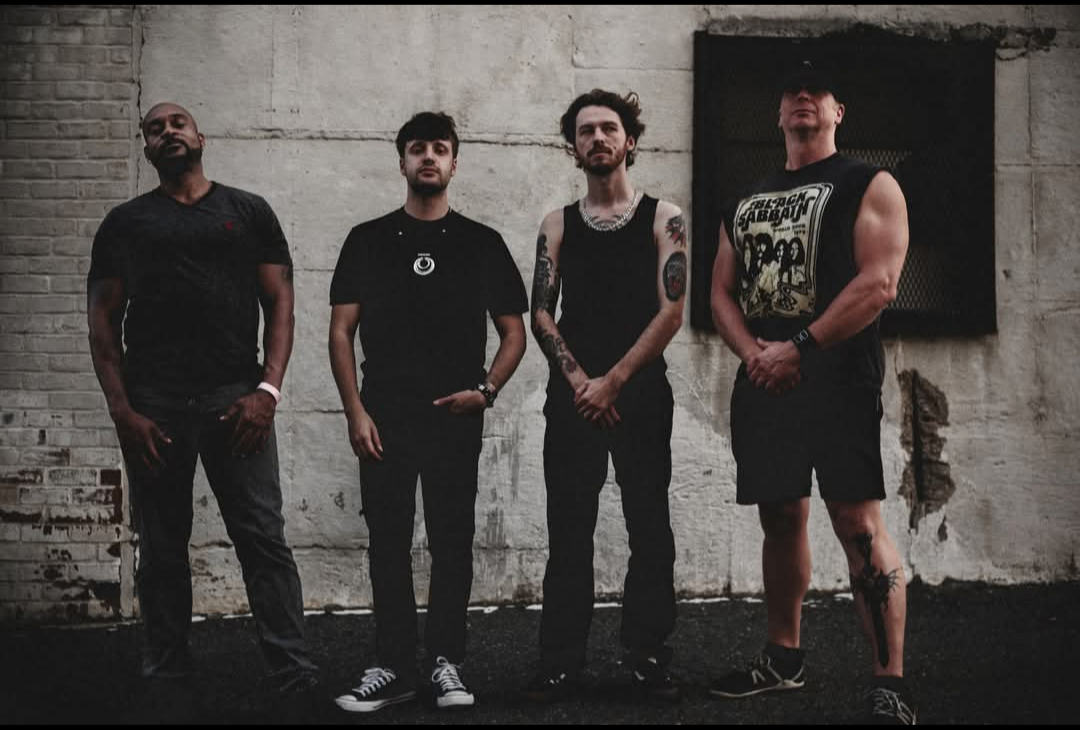
When I first pitched starting a metalcore band to my friend Connor, we were coming out of the wreckage of another project that fell apart over logistics. It felt like our last real shot at making something like this work, so I knew the pitch had to be strong.
I went home and wrote an entire album in three weeks.
I called it How It Could Be — a reflection of what we were chasing at the time: a life on stage, doing this for real. Although the album is no longer being released as How It Could Be, six of those twelve songs became our first live set! Three are already out, and the other three are coming very soon.
Matt Rosenthal (guitarist)
RRX:What can you say about your influences, and what you feel you’ve done with their influence as a musician or band? Have you extended their work?
Our main influences are August Burns Red, Bleed From Within, and Killswitch Engage. We try to preserve the core of what makes those bands hit — drop C and drop B tunings, fast-paced riffs, and those groovy, head-nodding sections — but still make it our own.
We’re not trying to reinvent metalcore — we’re trying to carry that sound forward and put our own stamp on it.
Matt Rosenthal (guitarist)
RRX:What do you think is the mostly poorly understood thing about music, or the music you play?
I think metalcore gets a bad rep because it lives in this weird middle ground. It’s not quite “hard enough” for the hardcore crowd, and not quite “intimidating enough” for the metal purists. Because of that, it gets written off from both sides like it doesn’t fully belong anywhere.
But that’s kind of the point.
Metalcore has always been about contrast. It’s aggressive, but it’s also melodic. It can be technical and tight one second, then open up into something atmospheric or emotional the next. That push and pull is what makes it interesting — but it’s also what makes people misunderstand it.
A lot of people hear the surface-level stuff — breakdowns, screaming, big choruses—and assume that’s all it is. But what actually makes it work is the balance. The tension between chaos and control, heaviness and melody, precision and emotion.
For us, that’s where the identity of the genre really lives. It’s not trying to out-heavy everything else or out-technical everyone else. It’s about making something that feels intense, even when it pulls back. Something that sticks with you, not just something that hits you.
So yeah, people either find it nostalgic or they don’t get it at all — but the ones who get it, really get it.
Matt Rosenthal (guitarist)
RRX: Part of learning to be a musician is to fall in love with a song, an album, and hammer away at your instrument until you can play the whole thing. What was that song for you? Was there a hardest part?
Tool’s Lateralus is the first album I remember learning from start to finish. At some point in middle school I discovered Tool, and within the first two years of high school I had memorized Lateralus. The hardest, but also most exciting, part of learning an album like this is fully internalizing the odd time signature grooves. Not only do Tool write riffs plainly in odd time, but occasionally they take it a step further with cross-rhythms using the odd time signatures (see “Schism” from 3:12-3:28 where the guitar plays a shorter 7/8 riff and the bass and drums play a longer idea in 14/8) or by fully playing in two different time signatures (see “Lateralus” 4:47-6:20 where the bass and guitar play in 6/8 and the drums begin in 5/8 before playing both the 5 and 6 simultaneously), which is referred to as “polymeter.” Tool are masters of letting different time signatures breathe in their own unique ways. While at first it required some boring analysis and strict practice counting the patterns, the work was well worth it to be able to forget all of the logical stuff and just feel the rhythms!
Connor Shann (Bassist/Victim)
RRX- stereotypes are a bitch. I mean……
From the outside looking in all the different forms of metal gets a bad rap. I often tell people in my circle who don’t know it’s not what it seems. I have played all different types off music and in all different types of bands and I will tell you that Metal music as a whole has the most humble, kind, loyal and supportive people you will ever meet! You don’t find this in other music genres. At any metal show you will find that it’s actually a massive support group. It’s filled with heavily passioned people who have extreme willpower. Many metal listeners generally have had hardships and they have prevailed over then through their perseverance. This music grabs our souls and empowers us to release all the harmful energy that we accumulate due to these hardships. It’s really quite beautiful thing!
-Dan Schleicher(Drummer)
RRX- would you rather have one song blow up or…….

