

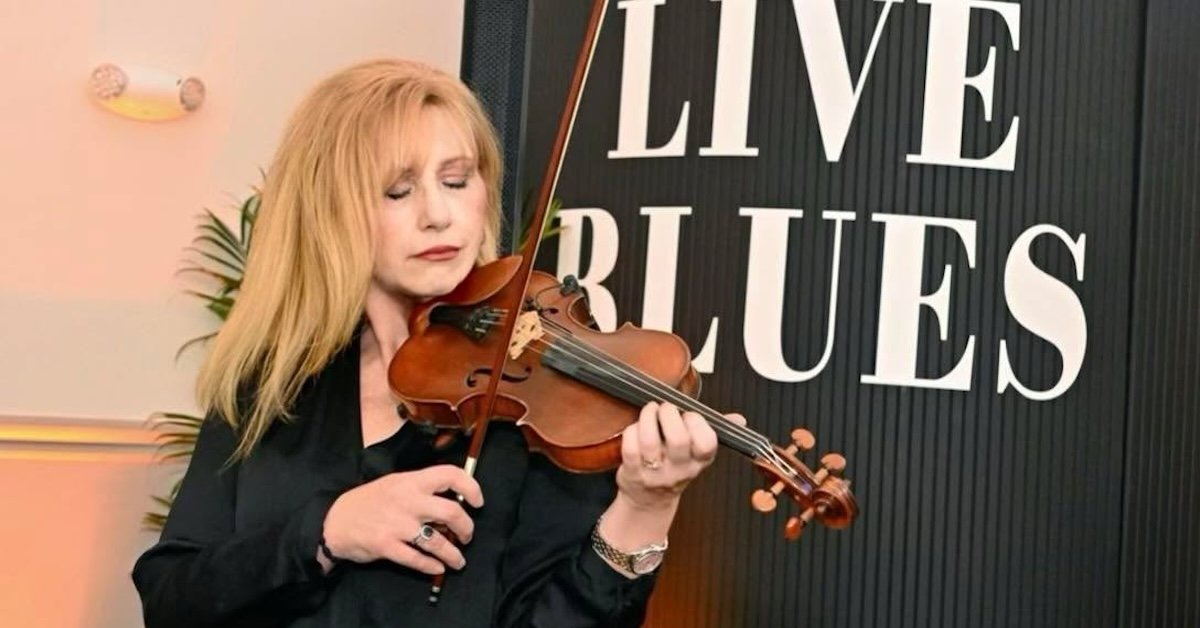
by Liam Sweeny.
RRX: You play everything from jazz to rock to Celtic, playing in hybrid-type bands where everyone tends to bring their own influences. With your broad musical knowledge, do you end up being a connective or a glue kind of person, or more of a specialist kind of person?
EM: That’s a very interesting question. I don’t know that I’ve ever thought about that. I love to challenge myself. And I am completely someone who enjoys the bonus of being around wonderful people that I ultimately grow close to and have decades-long relationships with. But it’s the music that drives me. So essentially, you’re asking me if, say, I play with a rock band, you’re wondering what my function in that scenario is given my experience with other genres.
RRX: Right. If you have a rock Celtic or a rock fusion or a rock something else, or two or three different types of musical styles that were being blended together, I call it a hybrid band.
EM: Oh, OK. One of the projects I’m in right now is totally a hybrid project. And I would say that what I bring is openness to exploring what hasn’t been done before.
RRX: You’ve worked with several symphonies, including the Berkshire, Albany, and Binghamton symphonies. With so many more performers, is it vastly different than playing in a band or a smaller ensemble? And is it harder to play with performers that you may not know as well, even though you are all playing off the same script, so to speak?
EM: That’s a really good question – everyone reading the same music and playing in an orchestra. In that world, in that kind of serious, classical music world, it’s that everybody understands the same rules. Which is, you show up, there’s an established leader, a conductor, or maybe there’s an organizer of the small ensemble, and you all read off the same music with the same markings, and the conductor has the ultimate say. Your role is to follow what is out before you as precisely as possible, and that’s the world that I started in when I went to college. I know that world very well, versus being in a band, which is more of a free-for-all, wild-west kind of situation, where the structure isn’t as defined. There are unspoken rules. There’s certain etiquette that nobody has ever really talked about, but after you’ve been in the world a while, if you’re relatively observant, you’ll get it.
I mean, this is how I stepped into it, because I came from a background where everything was very regimented. By the way, I’m extremely grateful for that. I would not change even though that’s not where I spend the majority of my musical time these days. I am so grateful that that’s my background because a lot of good things came from it. So I would say that it’s kind of challenging in the music world for me because I don’t always know what the rules are, but I think I’ve spent enough time in it that I have a pretty good idea of what the rules are. But then it can change from group to group, whereas in the classical world … I mean literally, in a symphony you have an HR department, so you know if someone’s not following it, you can call HR. If you’re in a band, no matter how successful or what level, if you will, it’s still pretty loosey-goosey.
RRX: So you’re a violinist, but you also play the viola and the cello and even the Irish tin whistle. Bands are always looking for a unique sound and/or instrument to set them apart. Does playing what you play open up playing opportunities more readily, or is it the opposite?
EM: I think that I’ve been fortunate because, for a long time – it’s not so much the case now – but for a long time, the people who do what I do have been few in number, so you know it’s kind of like, who are you gonna call? Well, there’s her, and then that’s pretty much it. But the younger musicians that are coming up, younger violinists and fiddle players, are a lot more broadly experienced, much sooner. So I wouldn’t say that’s so much the case now. But yes, I think that I’ve had more opportunity because what I do is relatively unique, and it used to be much more unique.
RRX: So young people are starting to delve out now, are starting to get into instruments that maybe weren’t considered much before.
EM: I think it’s more stylistic. I think there are fewer violinists than there were when I was coming up, but the ones that are coming up now aren’t afraid to play the fiddle. It’s not as … I guess it was kind of looked down upon by a certain segment of society who got their children violin lessons, and I don’t think that’s so much the case anymore. I think people have relaxed a little bit.
RRX: You’re currently based in the Berkshires, is that correct?
EM: Yes.
RRX: It’s an area that is neighboring the Capital Region, but it has its own voice and its own culture. What makes the area an attractive place for music, in particular the kinds you play?
EM: The Berkshires – I love it because it is strategically placed between Springfield and Albany. So you can get to a city if you would like to, and obviously I do. And there’s this sort of rural artistic culture that really thrives here. And it’s not like being somewhere more isolated, where you don’t have access to institutions of education or cultural events. We do in the Berkshires; in fact, we have Tanglewood and Jacob’s Pillow. So we have a lot of access, but yet there’s this slower pace, laid-back, sort of neighborly attitude. So it’s really a great place to live. It’s strategically placed, and it has this kind of warm rural feel.
RRX: Nice. I didn’t know Springfield was a bigger city. I didn’t know that. I mean, comparatively.
EM: It’s probably a little smaller than Albany. I’m trying to remember the last time I looked at the population of Springfield. But, you know, they have a symphony, and there are colleges here, like full four-year colleges. There’s some stuff happening in Springfield. I would say it’s the city of Western Massachusetts, even though North Adams is technically a city, but that’s questionable. There’s Worcester, and then after that it’s Springfield, and there’s not really much after that,
RRX: When you move between styles, do you find combinations that you particularly enjoy? Is Celtic rock more fun to play than, like, a blues-jazz kind of hybrid, or does it depend on the particular music or the particular players?
EM: I wish I had a canned answer for that. I love harmony. I love the changes from chord to chord, and that’s probably the reason I wake up in the morning. It’s so fun to play gigs and to have all these adventures with different musicians and to play all this different music. All of that is always fun. What makes me wake up in the morning is my absolute love and appreciation and devotion to music harmony, the chord structure, the chord changes. So the way I can answer that question is: what lights me up is when the chord progression strikes something emotional in me, and then I get to go on the ride with it. I hope that makes sense.

