

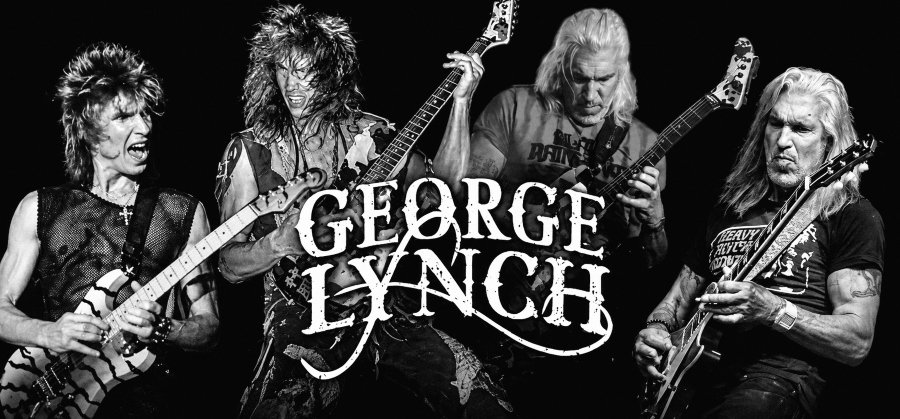
On the Phone: Dokken and Lynch Mob’s George Lynch
By Jason Irwin
“Hi Jason, this is George Lynch.”
When George Lynch called me the other day, the conversation was so casual that I had to remind myself that this was the same guy ripping the solos on my ‘80s cassette copies of “Under Lock and Key” and “Back for the Attack” (which I still have). I could tell right away, though, that he was a no-nonsense guy. He has a firm tone, and when I told him it was great to speak with him, he shot back, “Well, you don’t know that yet, do you?” I think he was joking.
New challenges and BFFs
George Lynch recently turned 72, but retirement plans involving a porch, rocking chair, lemonade, and a dog at his feet will have to wait. As to why he can’t quit yet: “I still have this crazy music in my head that I’m chasing,” Lynch told me. “I’ve never really attained what I think are my best abilities to create some amazing song or solo or riff.” He was kidding (I think—again) about the porch. The guitarist, known for Dokken and Lynch Mob, still loves making music and finding new challenges. “My best friends have always been my band members,” he said. “Guys I worked with when I was 14 years old or 72. It’s really the same dynamic.” A band that keeps him moving is Lynch Mob’s current lineup featuring drummer Brian Tichy, bassist Jaron Gulino, and vocalist Andrew Freeman. Lynch says they’re talented, funny, and make touring enjoyable. “We don’t take ourselves too seriously, but we take our craft seriously,” he said. “It’s always covered with a patina of just fun and joking.” Freeman, who has worked with Lynch on and off for more than 20 years, continues to impress him. Lynch referred to him as “the Jeff Beck of singers,” explaining that Freeman has become increasingly consistent and seems to be getting better all the time. “He’s just on fire,” Lynch said. The band was even tackling 10 shows in a row. Lynch said Freeman was eager to keep playing rather than spend a day off sitting in a hotel room. That enthusiasm is part of what makes the group click. They recently “clicked” at the Strand Theater in Hudson Falls (10/3/26).
Keeping the mistakes
Lynch Mob’s live album, “The Final Ride – Live,” was recorded over two nights at the Kress Theater in San Francisco. The goal was to capture the energy and improvisation that can happen onstage but often gets lost in the controlled environment of a studio. The band decided to leave in some imperfections rather than polish every moment until it sounded flawless. “There are mistakes on the record,” Lynch admitted. “Normally we would be like, ‘We can’t include that.’ We just forced ourselves to grit our teeth and say, ‘Listen, this is real. This is what happened.’” “We’re not perfect. We’re human, but it’s beautiful,” he said. Lynch doesn’t spend much time revisiting his old recordings unless he needs to relearn material for a gig. Sometimes, listening back gives him a new appreciation for music he made decades ago. One exception is the three albums he recorded with KXM, the trio featuring King’s X bassist and vocalist Doug Pinnick and drummer Ray Luzier. For those records, the musicians would meet in a studio, write and record original material together, and finish a song each day. The process was exciting, but it didn’t leave much time for fine-tuning. “Sometimes we’d get it right, and it was magical,” Lynch said. “And sometimes it was maybe a little weirder, which is okay.” There are still moments he hears and thinks he might have taken a different direction. But that, too, is part of the experience.
Old riffs, new directions
Lynch doesn’t always play his classic parts the same way anymore. At a recent guitar lesson and meet-and-greet, a fan wound up reminding him how to play some older songs. “The whole lesson he turned into the teacher, and I turned into the student,” he said. “But I didn’t give him a refund.” As a longtime fan, I told Lynch I still couldn’t quite nail Dokken’s “It’s Not Love.” He offered a few tips, including a reminder to pluck the two-string part rather than use a pick. I knew that much, but didn’t let on. I was just lost in the realization that I was getting a free guitar lesson from George Lynch. Then the conversation took a turn toward the zombie apocalypse. As for his “fame,” Lynch joked that, when the world falls apart, people won’t be looking for a guitarist. They’ll need people who can build things, fight, and grow food. “While we’re getting eaten by the zombies, it’d be nice if George could strum a little of those old Dokken songs on his acoustic guitar by the campfire,” he joked. Still, he appreciates that people have found something meaningful in the music he helped create. And he doesn’t see Dokken and Lynch Mob as separate, competing chapters. “We play together often, and I also play with Don and do guest appearances with them,” he said. “We get along fine. I think it’s just a story of an evolution.”
The sound keeps changing
Lynch has spent years exploring guitar tone and equipment, and he still loves a good tube amp. In fact, he says he’s more of an amp guy than a guitar guy, drawn to amplifiers for the way form and function come together, much like a classic car. He’s no longer obsessed with tone in quite the same way. He realized he was using too much distortion to get the sounds he admired in his heroes. “The magic and the personality come through your heart and your hands, head and your fingers and the wood on the instrument,” he said. “Excessive distortion was masking that.” He has gradually dialed back the gain and found that he enjoys playing more this way. His style is changing, too. He’s interested in playing more personal music, slowing down in some ways and avoiding the temptation to repeat himself. “I’ve done a lot of albums in recent decades,” he said. “I pretty much said what I’m going to say. I don’t want to start repeating myself ad nauseam.” Lynch now lives near Taos, New Mexico, where he’s surrounded by musicians playing styles far removed from hard rock. He’s been drawn toward acoustic music, blues and even country-leaning sounds, enjoying the learning process. “I’m not amazing at it, but I love it,” he said. “It keeps me moving forward.” His hero, Jeff Beck, he noted, was always evolving, and Lynch wants to keep doing the same.
Before everyone wanted to be Van Halen
One of the most interesting parts of our conversation was Lynch’s recollection of the Los Angeles rock scene in the 1970s, before the familiar ’80s hair-metal era took shape. He remembers a time when bands were simply making things up as they went along, rather than copying a successful formula.
“There weren’t any rules, and there weren’t any precedents,” he said. “It was just sort of experimentation, and it was hit and miss.” Lynch recalled unusual acts such as Sound Barrier, an all-Black hard-rock band that combined heavy music with glam looks, and A La Carte, a three-piece he loved for its guitar tone and theatrical performances, even if the songwriting wasn’t always as strong. He remembered bands still developing their identities, too. The appeal was variety: you never knew what kind of performance you were about to see. He felt that changed after Van Halen broke through and other bands began trying to recreate that sound. “Previous to that, it was fascinating,” he said. “A lot of variety and a lot of experimentation.”
What comes next?
Lynch has collaborated on studio projects including Sweet & Lynch with Michael Sweet, KXM, and The End Machine. For projects that don’t tour, his rule of thumb is three albums: one to establish the sound, one to build on it, and a third to wrap things up. He’s considering a different kind of project next: an instrumental album that would give him time to experiment and take chances. “I’ve never really done that magnum opus guitar instrumental record where I’ve taken a lot of time and experimented,” he said. “Maybe I’ll take a year off and do something like that.” There’s no fixed plan yet. Lynch says much of what he records comes together spontaneously, and sometimes the equipment itself points him in a direction. A particular amp, a baritone slide or an old effects unit can spark an idea that becomes a song. “Anything I’ve ever recorded has always been off the top of my head,” he said. He’s still drawn to live performance because every night can be different. A full room, good sound, and an engaged audience create a feedback loop between crowd and band. Lynch Mob improvises and lets a show develop naturally. After decades in the business, he hasn’t run out of things to explore. He’s still chasing the sound in his head, still learning and still having fun with the people beside him onstage.
I couldn’t resist
Near the end of our conversation, Lynch admitted he can’t stand the “usual” interview questions, especially “Where do you get your ideas?” and “Who are your biggest influences?” Naturally, I waited until the end to ask him, “What are your influences?” He said he would have fallen into dead silence in disbelief if I were serious. At least I got the joke in before we said goodbye. I hope he “got” it. And referring back to how our call started, I should add that it was great to speak with him.

