

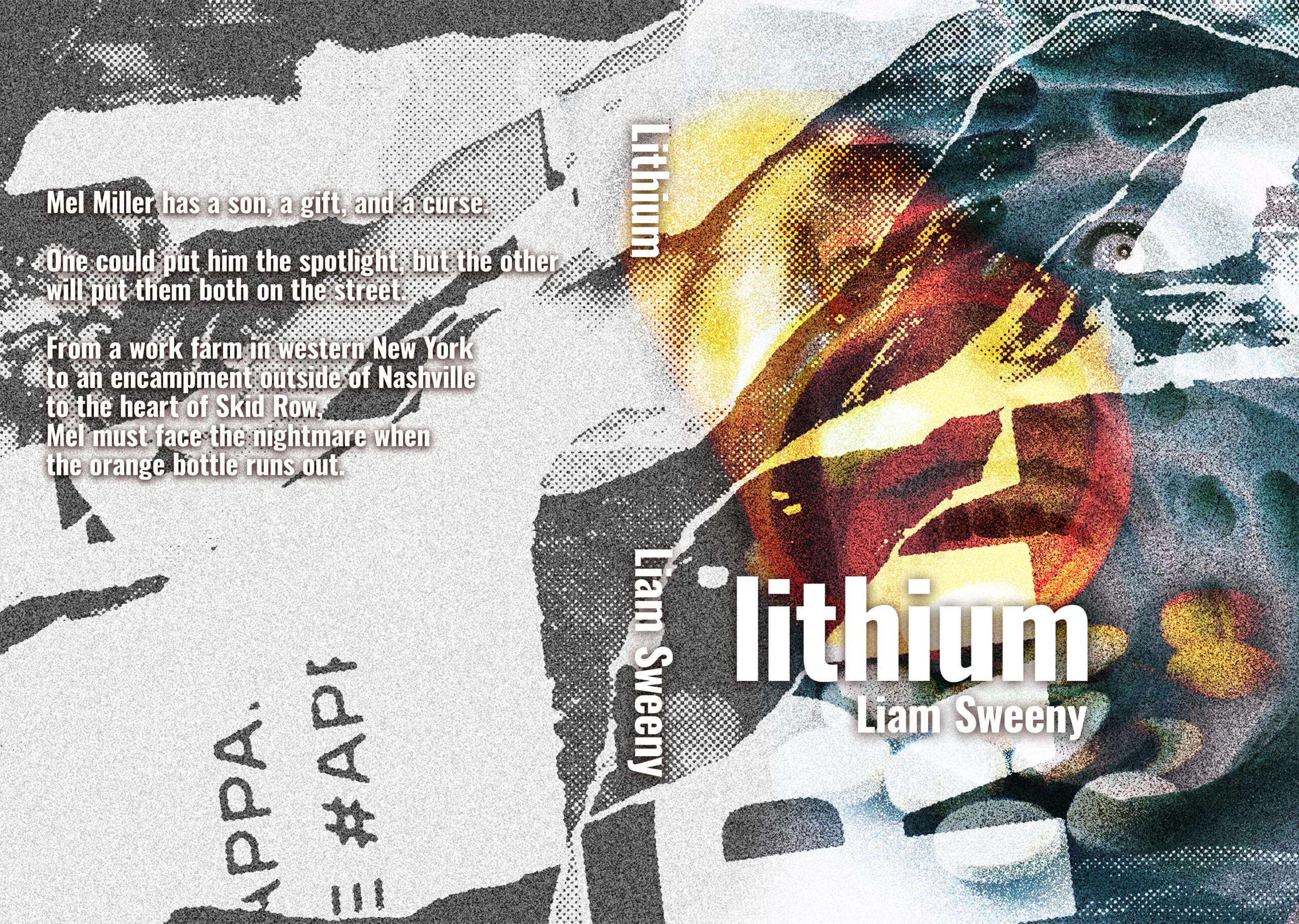
Lithium, Chptr. 17 – Xperience Fiction – by Liam Sweeny.
Mel leaned back in the lawn chair, on which he had put pillows he had gotten in trade. Andy was tending their new fire. Among the things he and Hope had done while Mel was working was a stone-lined firepit. Mel was surprised that wasn’t one of the first things he had done when they set up the site. Then again, he was rationing meds, and he had far more on his mind.
It was full-on dusk, nearing night, but it was only six-thirty. Mel used to like the nights coming earlier in the colder months. He had more energy at night, more creative energy anyway. Had he not been the parent of a school-aged kid, he would’ve risen at dusk and bed at dawn. But now, being out in the cold, he prayed for more daylight.
The sound of shoes scuffing against the path announced Andy’s return to the camp.
“Where were you?”
“School,” Andy said. “Or whatever it is.”
“Mrs. Wilson’s class, right?” Mrs. Wilson had a master’s degree in elementary education. Sadly, she wasn’t being bussed in to teach the kids of the camp – she lived there and traded her time for food.
“Yeah,” Andy said. “Do I have to keep going? It’s boring.”
“Is she teaching at your grade level?”
“Sometimes,” Andy said. “She hops around. Sometimes she’s doing, like, basic math, and other times she’s doing stuff that I don’t know yet.”
“I’m either bored or I can’t keep up,” he added.
Andy plopped down beside the fire and absentmindedly fist-bumped Hope. Mel was glad to see it, even though he felt bad for his kid. He tossed twigs into the fire from a pile they’d collected while Mel was working. The wood that was in there, which amounted to thicker branches they’d scrounged, popped, sending a shower of sparks skyward in a wavy flight path.
“I miss my school,” Andy said. “My real school. Back home. I miss my friends.”
“I know, I know,” Mel said. “I miss my friends back home too. But we make new friends. Haven’t you made friends here?”
“Yeah, but it’s not the same.” Andy shifted his legs out from under him to get comfortable. “My friends here act like they’re not going to be here tomorrow.”
“Half of them won’t” Hope said. Mel shot her a glance. “It’s true,” she said. “He knows.”
“She’s right,” Andy said. “They’re all delinquents because they don’t care. Cause they won’t be here, so they don’t bother. And they make fun of me because I don’t want to prank camp people and smash their stuff.”
“You’re sounding very adult right now,” Mel said.
“But I’m eleven,” Andy said. “I don’t wanna’ be an adult.”
The three of them sat around the fire, hisses and crackling passing for words and sentences. Mel’s heart ached for Andy and he felt out of touch, proud of his boy for acting like a man when Andy was so desperately clinging to being just a boy. Mel wanted to take him away from it all, no matter what that meant. If he could’ve gone back to Albany, to Social Services, to the motels and to Helping Hands, would they have an apartment right then? Had he let Debra scare him into an even worse horror?
“Hey guys.” They looked over to see Clifford walking up with a backpack slung over his shoulder. Mel pulled out the folding chair. “Have a seat.”
“Okay,” he said as he sat down. He glanced around the firepit. “Nice construction,” he said. “Do you have-,” Hope held up a five-gallon water cooler jug. “Oh, okay, cool.”
“I got it from the pond, walked it over.”
“Well, you’re always on point with this stuff.” Clifford reached into his backpack and pulled out a bottle.
“This is pretty good,” he said. “Bourbon, aged – I don’t know how old, but it goes for, like, fifty bucks in a liquor store. Anyone in the mood?”
Mel thought against it, because of the meds. But he remembered he wasn’t on the meds anymore. He could get completely tanked if he fancied it.
“I’ll have some,” he said. Hope abstained, and Andy, of course, was too young. Clifford and Mel had a drink, then two, then two more before Hope and Andy decided to find something else to do.
“I’m glad you came in, Mel,” Clifford said. “The painting stuff really cheered people up. I didn’t know how it was going to work at first. We’ve had artists, and they end up selling their wares on the side of the path.
“You didn’t do that. You went to where people were. That was good of you.”
“Yeah, I didn’t really need to showcase my own work like that.”
“But your own work is really good,” Clifford said. “I saw the one you did of Hope. And the one you have in the car. You could really make it.”
He thought of telling Clifford that he had, sort of, made it, but he held back. Clifford was catching a buzz. So was he. Clifford leaned forward and spoke.
“They want to shut us down,” he said.
“Who does?”
“The city,” he said. “The county, the state, the U.N.; you name it.”
“It’s private property, though,” Mel said. “Right?”
“Right it is.” Clifford pivoted the bottle in his hands and swirled it around. “But there’s a lot at stake. I’m not a million-billionaire, I work too. I own a construction company. And we’re good. But they-,” Clifford waved his finger around. “They talk to our jobs. They try to get in the way of us getting work. The drag out red tape on projects, delay permits, all kinds of dirty tricks.”
“They want to ruin me so’s I’ll have to sell. They want to turn this into another luxury housing complex, complete with a pond.”
“They won’t get away with it though, will they?”
Clifford screwed the cap back on the bottom. “They won’t,” he said. “But eventually, they will.”
***
The sounds of Mockingbirds echoed out over the pond, soloing over a background ensemble of crickets, accompanied on occasion by the sound of dogs barking and eighteen-wheelers passing on the highway that led into the camp. It was the most peace Mel had felt in a while. He stroked Hope’s hair, felt her warmth as she turned to continue in her comfort. Her body enshrouded by his like they were two layers of silk, the femininity of which didn’t cause Mel the slightest pause.
He thought of all the things he had to be when he thought he had to be something to find a girl like Hope. The lack of definition of his muscles in his long mirror back home, as he thought that was a sentence of perpetual isolation. The heaviness of his fat contrasted by the lightness in his wallet. The room full of paintings showcased for an audience of mice and moths. He needed looks, money, fame, yet even then he wouldn’t be adequate.
And in his darkest, most exposed moment, when he couldn’t be anything except a mouth to feed and an illness to cope with, Hope appeared divine, took his hand and tasted his soul, and there, beside the pond, amid the mockingbirds and the crickets and the dogs, she was still dining.
Hope curled up to face him, the heat from her naked body sliding in the sweat of his own nakedness.
“Tell me about her.”
“Who?”
“Debra,” Hope said. “Your ex. Tell me about her.”
“Oh, you don’t even want to know.” Mel said.
“Or maybe you don’t want to tell.” Hope smiled, the moonlight reflecting off her teeth.
“Okay,” Mel said. “What do you want to know?”
“How did you two meet?”
Mel shifted to sit up against the trunk of the tree under which they were laying.
“When I first had an episode, manic episode, they sent me to rehab,” her said. “It happens, happens a lot. I met her in there. But they eventually got me to the nut ward, and when I got out, I was all ‘fuck that’ about the meds. And I ran into her, and she was working the program, you know, sober, and she convinced me to go back to the hospital, do the meds, the whole bit.”
“So what happened between you two?”
“A biker, drug-addict shitheel named Sam,” Mel said. “She cheated on me. I’m not saying everything was rosy between us. It wasn’t, not at all. Turned out she was a dry drunk, you know what that is?”
“No, not so much,” Hope said.
“It’s where you quit drinking or drugs, but you never really work the steps, you know, try to get better as a person. She was clean six months and she stayed clean but got bitter.”
“Did you already have Andy?”
“Not at first, and yeah, I should’ve seen the signs. But I felt like she saved me in the wards, so I figured I was duty bound to stick around.”
“Rhymes.” Hope said. Mel laughed.
“She was really bad to Andy,” Mel said. “And it got ten times worse for the six months she had custody of him when we split. I mean, abuse – physical, emotional. Kid went through hell. Don’t tell him I said any of this to you.”
Hope put her finger to Mel’s lips, then brought it to her own lips.
They got dressed and started down the path to the camp. They could see lights, and flashers.
“Someone else must have died,” Hope said.
“That’s awfully close to our camp,” Mel said. “We better hurry up, in case Andy’s in trouble.”
He and Hope triple-timed it to the camp, and sure enough, the flashing lights were there for them. A wave of panic washed over Mel at the thought of Andy in trouble, which was lessened only a hair when he saw that the second vehicle had the orange flashing lights of a tow truck. A tow truck that was making an eleven-point turn to get connected to the minivan.
Mel ran over to the tow-truck and signaled the driver to roll down the window. When he did, almost all Mel could see was a massive forearm.
“That’s my minivan,” he said.
The man leaned over in his seat. Mel could hear shuffling papers.
“Paper I got here says this is the bank’s minivan.”
“I just paid my car payment,” Mel said.
“Look, fella, I’m not a lawyer or a judge,” he said. “I can give you five minutes to get your stuff out, assuming the sheriff has no problem with it.” His thumb aimed to the back of the truck, where, as Mel’s eyes followed the point, a sheriff’s deputy stood.
“You runnin’ cross country with this car, boy?”
“No sir, I paid the payment. I could’ve sworn I did.” Mel didn’t want to tell an absolute lie to the sheriff.
“Let me get your license and registration, and your proof of insurance, and I’ll let you get your stuff out.”
Mell hopped in the minivan, grabbing his wallet, which had everything asked for. He handed it to the deputy, who held a flashlight to everything.
“Your insurance is lapsed,” the deputy said. “Swore you paid that too, huh?”
“Sure, I’m just trying to get on my feet. I’m trying to work; I’ve been working day-labor for a few days now, but I can’t do it without the minivan.”
“Should’ve thought about that before the payments run out. You don’t get a car for free.” Huh?
“Look, I can bring you in for driving on lapsed insurance. Or really, for grand theft auto. But really, there wouldn’t be a point. You’d just clog the courts and the jails. So how about you get on a bus, soon as you can afford to, and wave goodbye to Tennessee in the rearview.”
They wasted no time in pulling his minivan out, leaving everything it contained in a pile on the side of the road. He and Andy stood over their belongings. Hope put her arm behind his waist, which could only be cold comfort.
***
Mel used to hate mornings before he married Debra, He was the quintessential night owl, with all the accoutrements, blackout shades, a busted alarm clock and enough caffeine throughout the night to keep pace with a tweaker. His creativity rose with the moon, and there wasn’t anything happening during business hours that he wanted to be a part of. He even took third shift at ArTechnic and got third shift pay, rewarding his vampiric tendencies.
When he got fired from ArTechnic, or, as Mel put it, committed passive quitting, he had to wake up early to look for a new job. It didn’t last long, the looking, but the waking up at dawn seemed to fit him. And as things went downhill between he and Debra, he grew to love the four hours from four a.m. that he had the house entirely to himself.
He came to look forward to the next morning throughout the day, going through it only so he could stream seventies TV shows in the bedroom until he could go to bed and find his time. Because each morning was a reinvention. He had all the time in the world to set himself up for a new day, with new possibilities. With a new him.
He could see his breath outside. He was staring at his tent from across the path as he sat on a pile of scrap that was in one of the many free areas. Later that day, when people were up, he’d have to sort through a few of the free areas to reinforce their tent. It was fate laughing at him that the first cold snap he’d seen in Nashville came on the first night they didn’t have the minivan to sleep in.
He felt homeless for the first time. They had motels they could drive out of, a farm they could’ve driven away from at any time and a camp they could come and go as they pleased. But that was gone now. They were at the whim of the winds, and at the mercy of others in a way they weren’t before. As he sat there, he realized that he thought he and Andy were better than the people they encountered, even the ones they liked. Mel thought it was because he was an artist, or his manic ego, but it dawned on him, sitting there, that he thought he was superior because they were all on the street and he was just visiting.
Last night when they repossessed his escape hatch, he wasn’t visiting anymore. And he was freezing.
He ran when he woke up. Hope wasn’t with him. In a way, he was glad she wasn’t. He couldn’t run away from his manic worrying, about everything that he could and couldn’t control, and eventually the worries and the fears and even angers slid into ridiculous proportions and he felt a warmth spread from his upper diaphragm to his chest, which tightened up on him and sent him into full blown panic. He kept running lest he sit down and pass out and no one find him, and he die.
Of course, he didn’t die. He never did. But he could never just tell that to himself during an attack, like the psych practitioners who never had panic attacks told him was the way out.
He hoped the attacks wouldn’t be a regular companion.
Clifford walked into the camp looking like a surgeon coming to a family in a waiting room after throwing a loss on the board.
“Guys,” he said. “The council just met. They… weren’t happy with what happened last night. With the minivan.”
“That makes three more of us,” Mel said. “But they’re blaming me for this?”
“It’s your car. I don’t think there’s anyone else to blame, is there?”
“Look, I was going to make an arrangement once I had a job, but it hasn’t exactly been easy. We can’t use the address here for applications, and no address, you’re stuck with day labor, which pays for shit.”
“It doesn’t matter to the council that you had good intentions,” Clifford said. “Most of them like you and none of them want to kick a kid out-,”
“So you’re talking about kicking us out?”
“It was a vote…”
“You own the property, you own that council,” Mel said. “Don’t tell me you couldn’t sway them if you really wanted to.”
“Maybe I could,” Clifford said. “But I have a lot of pressure on me to shut this whole thing down. I told you this when I was over at the camp. Stolen cars in here; if I don’t get rid of you, the county will think I’m letting people bring stolen cars in here. I can’t have that.”
“So kicking us out is what, good optics?”
“Good what?”
“P.R.,” Mel said. “Good P.R.”
“Look, I get that you’re mad-,”
“Damn right,”
“But I own the property. I can be liable if the deputies come on here for legal actions. Look, I like you. I don’t want you or your kid to go. But I have a couple hundred people here depending on us.
“You’re in good enough shape, you have a great talent; you can make it,” Clifford said. “But you’re going to have to.”
“So where are we going?” Mel didn’t have to look behind him to know it was Hope.
“I can’t put you out, Hope.”
“I’m ready to blow the joint anyway,” she said. “Besides, I’ve been homeless a long time, and that look in your eyes right now? That’s you finally realizing you’re homeless too. You and Andy are going to need help. So, like I said, where are we going?”
Mel looked over at Andy, who shrugged. He took a deep breath to put all the chess pieces on the table.
“I found out the painting that was at the Guggenheim got sold to a museum in Los Angeles, the Getty Center.”
“I went there once,” Hope said. “One of the few times I was in an actual school.”
“So I’m thinking I can probably get a start there. Being able to point to a museum should help me sell paintings to the smaller galleries. What do you guys think?”
“I like it,” Andy said. “Maybe we’ll see some movie stars.”
“I’m in,” Hope said.
They left the camp in the back of Clifford’s truck, who, in an act of either good faith or contrition, decided to give them a ride to the bus station in Nashville. He went one step further and paid for their bus tickets.

