

Richard Wang – An Xperience Interview – by Liam Sweeny.
Chinese calligraphy is a beautiful art, and Master Calligrapher Richard Wang has a dedicated mastery and treats us to an inside look at an ancient art form. We welcome Richard as he shares his world with us.
RRX: When did you start doing calligraphy? Were you young, or did you pick it up as an adult? Does it serve any other purpose in your life, like relieving stress?
Richard Wang: I started learning Chinese calligraphy since 9-years-old, when I was third grade. I was fascinated by the booth on the street, with the local master calligrapher writing couplets, which is a tradition during Chinese New Year. Almost every family buys a set to put on their door. It happened that I had a neighbor who wrote Chinese calligraphy, and he taught me the first few years. Later, I found an artist to continue teaching me.
RRX: Are there any legendary calligraphers? Is the art scene like that? Are there different schools?
RW: Chinese Calligraphy has a very long history, over 2000 years. There are many legendary; Wang Xizhi is the most famous one.
RRX: Where do you present your work? Has it been anywhere big (say, in New York), or are you aiming to get your work there?
RW: I have displayed my artwork at the library, the Chinese Community Center, the Arts Center of the Capital Region, and the Albany Center Gallery. I haven’t tried places like New York City yet. However, I am planning to contact galleries and museums in other cities.
RRX: A lot of younger people these days don’t know cursive because it isn’t used commonly. And they really miss out on the beauty of the hand rendering of the letters. You are even further along that path, emphasizing the beauty of text. What experience have you had with younger people as they see your work?
RW: I think the youth use phones and computers too much; they don’t use hand to write anymore. Once you give them a chance, they enjoy it. I had a workshop named Ink for Healing for youth last year. All the kids who joined the program liked it. Many young people buy a bookmark with their name in Chinese calligraphy as a gift for themselves or friends. Each year at multicultural festivals, there is a long line in front of my table. I am sure they love calligraphy.
RRX: Every artist has their toolkit, and I imagine you do too. Is there a history behind the tools you use?
RW: Yes, all tools – brush, rice paper, ink holder, and ink – have stories. The Chinese brush is from the Qin dynasty, over 2000 years old. Paper is from the Han dynasty, which is nearly 2000 years old. Ink and ink holders, too.
There are many different kinds of brushes, rice paper, inks, and ink holders, but for beginners, keep it simple: a middle-sized mixed brush, fully cooked rice paper, a bottle of prepared ink, and a cheap ink holder or a small dish would do the job.
RRX: I imagine there are aspects of the Chinese alphabet that would baffle a Western mind. To an American, there may not be a perceptible difference between Chinese standard lettering and Chinese calligraphy. How might an American tell the difference?
RW: There is no alphabet in Chinese; you have to memorize all the words. Students learn the simple ones; just a few strokes first, then go harder and harder. There are 3,000 basic words, 7,500 for advanced levels. Experts need to remember around 10,000 words
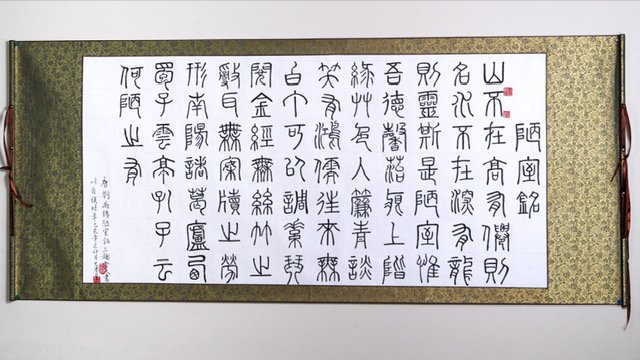
Calligraphy is a more artistic way to write a word. There are five different scripts: seal script, which is from oracle, the oldest standard script from the Qin dynasty. The clerical script started in Han Dynasty, which is more flat and simple. The regular script (standing style) is in modern-day use and taught in Chinese schools today. It is clear, balanced, and readable — this is the foundation of all calligraphy training.
Running script is semi-cursive. The brush begins to move freely, connecting strokes naturally. It feels like handwriting — elegant but still readable. Cursive script is the most expressive form. The characters are no longer drawn. They are performed. The brush records movement, rhythm, and emotion, almost like music. This is purely for artwork now. Not many people can recognize it.
Check my website for more samples and information

