


An Xperience Interview
Even beneath the blaze of the summer sun, he dwells within the chill of grog, locked within the ruins of rumination, feeling as though a fraught string has been threaded through his temples, looped around his skull, and constricted with the hunger of a feral serpent.
His disdain for humanity’s inanity warps the glass through which he views. The sounds of commonality rake his ears with discordance, while the beauty of nature regards him with silent contempt. In the absence of sense, what value does life possess? Meaning can only be found beneath perception and within what we dare not ask.
If everywhere one goes, problems arise, is it wrong to believe that within them is where the answers lie?
Within this existential climate, I found myself revisiting the creative terrain of local artist Alex Waters, whose work makes me feel as though I can move through reality before interpretation fully takes hold. And I feel like that’s precisely the unspoken beauty of his work: it operates through the understanding that imagination possesses a freedom reality rarely permits.
The paintings behave almost like psychological thermal scans, exposing emotional temperatures that strain against inherited structures of order and identity. In that sense, the work carries a quiet anarchy, resisting normality while searching for balance between chaos and order.
In one of his paintings, identity appears lodged amid dissolution. Combustions of black, charcoal, violet, and deep crimson merge into the suggestion of a fractured, near-human face. Nearly conjuring itself in full, the image teases the senses before dissolving back into the elusiveness of abstraction, slipping away before perception can fully contain it.
Legibility doesn’t interest Alex, whose abstract expressionism exists comfortably within liminality, where spill, gesture, and erosion bleed into one another.
Through further conversation, I was brought into the inner workings of his mental architecture, illuminating what makes his approach to his craft so unique.
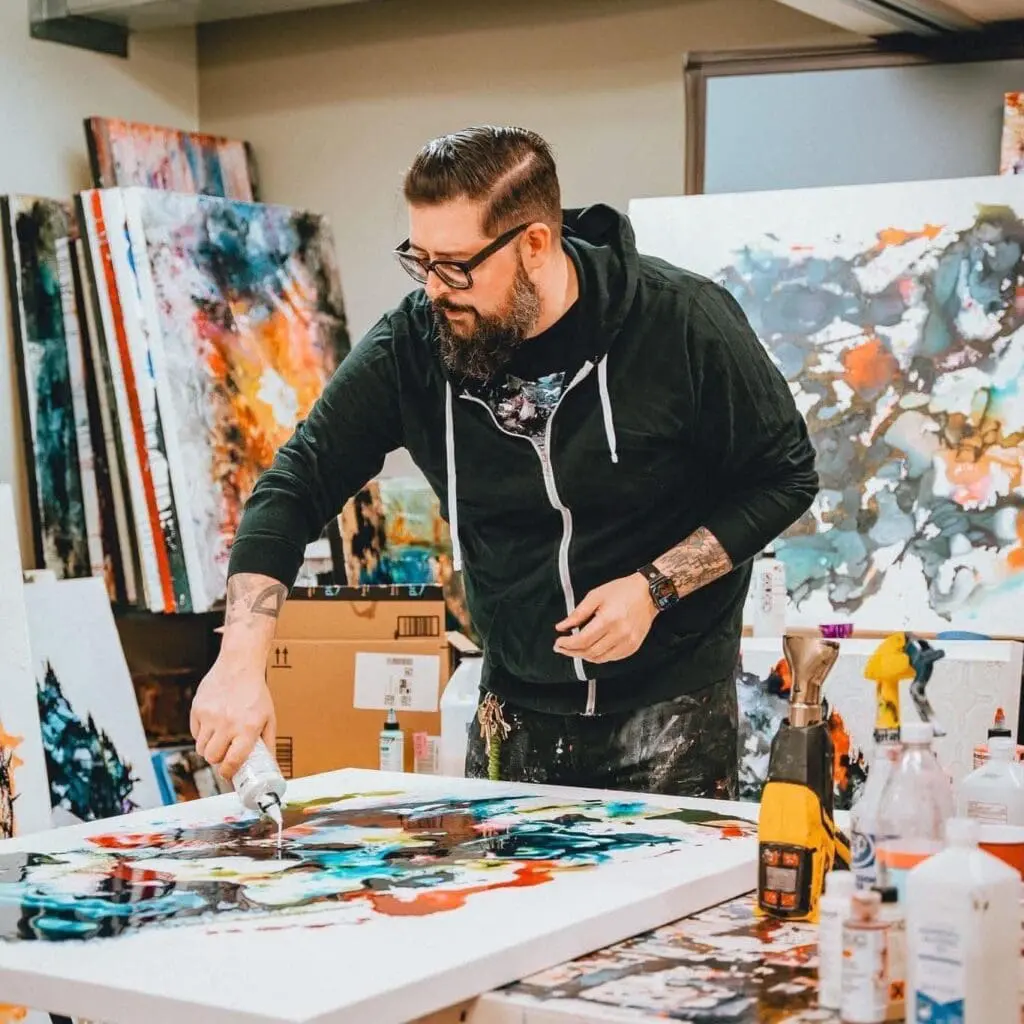
Interview with Alex Waters
RRX: When you begin a piece without an image in mind, what part of you is making the first decision—the mind, the body, or something quieter that resists naming?
Alex Waters: “It’s, I would think it’s the mind, because a lot of my stuff is more just about the feeling, rather than the physical nature of things. Because I’m not- yeah, I’m not the most skilled painter in the world, and I know I’m not the greatest artist as far as capturing real life- but like, I try to capture the emotion I’m feeling at that time on the canvas, and that’s usually what I try to express.
And like, right now, I’m trying to, like, get into this whole process that happened where I’m, like, I had this weird, crazy medical thing, and I’m trying to deal with that, you know what I mean? So that it’s crazy. I’m not dead.”
RRX: What emotional state do you generally operate from when you create?
AW: “I would probably say anxiety. Like, I try to not be anxious in my outward persona, like, have that kind of bartender vibe. But really, I’m an anxious mess. Like, I’m trying to always think around things, yeah? Like you have that feeling in your chest, and it just kind of flutters, and it sucks. It just doesn’t f***ing turn off. It’s like an endless flicker.”
RRX: What emotional state do you trust the least while creating, and why does that state still insist on entering the work?
AW: “The feeling of a deadline. The feeling of, like, I have to get this done sucks. I’m not a fan. I don’t work well under it as far as, like, oh, I need to get this done now. It’s not as good as the natural process of creating. The natural process of creating is a happy accident. And like, I think the happy accident is much better than like, oh, I have a show I have to do this for. I’ve been creating on my own schedule, my own time. I have a job. You know what I mean? Like, I don’t depend on this for income.”
RRX: What do you believe actually happens in the moment a piece becomes finished?
AW: “When I look at it, and I’m like, ‘Oh, I feel that.’ Because when I paint, whatever period of time that may be, that’s the pain, that’s the story, because that’s the emotion that I’m going through right there. And it’s hard to get back to that emotion. I think every emotion that you might have about a certain thing is documented on a painting. I try to make that thing there, and that’s its world. That little canvas is the emotion’s world.”
RRX: What truth about yourself first became undeniable through your work, even if you weren’t ready to accept it at the time?
AW: “I went to college, like an art school, and I went for graphic design at first, and I can’t work for clients like that. I kind of do that in my job, like doing graphic-design-type things, but it doesn’t fulfill me. So I knew that I needed to do something that was like painting or making something and having my own rules and not abiding by somebody else’s rules.”
RRX: How do you understand control in your process, not as a technique, but as a psychological negotiation between intention and surrender?
AW: “So sometimes, as far as the paint itself, I use Golden High Flow, which is an airbrush paint, but I use that flat. Sometimes, like in this painting, this mixed with the black, and I couldn’t control that. So that’s the surrendering part of what happened, and then it looked great, so then I tried to do that. How I discovered how to paint the way I do is I was drinking a sh** ton of Scotch one night, and I spilled my Scotch on a painting. Alcohol f***s with paint something fierce. Then I was like, ‘Oh, that’s interesting.’ So using that little alcoholism that I had, that was kind of a surrounding point, like, ‘Oh sh**. That’s something really cool.’ And I still continue that to this day. I just don’t use Scotch. I use rubbing alcohol.”
RRX: When viewers project their own narratives onto your abstractions, what does that teach you about the distance between who you are and how you are perceived?
AW: “I paint a lot of things black for a reason because I put bar epoxy on top of that, and when you put bar epoxy on black, it acts as a mirror, so the viewer acts as a part of the piece when they look at it. So every interaction you have with the painting is yours and yours alone. I kind of encourage finding your own way through what I painted. It’s your own path.”
RRX: Is there a recurring internal conflict that your paintings return to, even when you believe you’ve moved beyond it?
AW: “Oh yeah, absolutely. My lovely mother named me Alexander Aaron Waters. Alexander Hamilton, Aaron Burr. Aaron Burr shot Alexander Hamilton. That’s literally what I was named after. She always knew there would be an internal conflict with me. I knew that growing up.”
RRX: What does beauty mean to you when stripped of harmony, and why does disorder feel necessary for it to exist?
AW: “I think there is order in a lot of things that I paint because I create these weird rules and such. But I think that disorder is the natural state of being, so therefore the human condition is what I’m trying to get to. I think disorder is important to make beauty happen. Because without disorder, there is no order. It’s just like that thing of suffering. I want to get to the opposite of this. How do I get there? Disorder, order, and finding a balance in between.”
RRX: In moments when the world feels physically or emotionally exhausting, what compels you to continue rather than step away?
AW: “I feel like this is the way to process. It’s the healthiest way, I think. When the world is exhausting, create something, and then the world feels a little bit brighter, right?”
One might say that’s what makes Alex’s work resonate with such psychological intensity. Buried within the abstraction, spill, and erosion exists a man attempting to negotiate with disorder in real time. Not to overcome it, nor even fully comprehend it, but to shape it long enough to coexist beside it.
And perhaps that’s the uncomfortable truth pulsing at the core of his work: that meaning isn’t discovered through the absence of chaos, but through our willingness to compose within it.

