

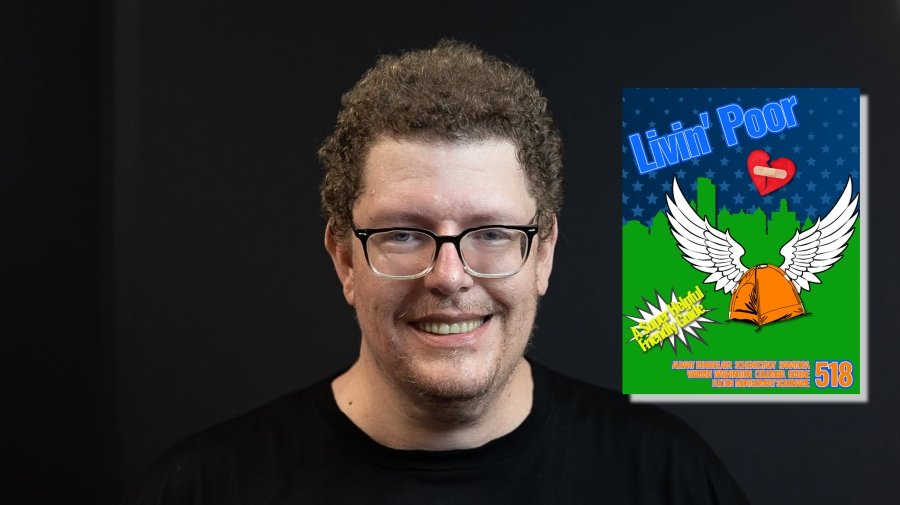
Interview: Liam Sweeny (Livin’ Poor)
By: Rob Smittix
RRX: We’ve got Liam Sweeny on the line. He’s known for a lot of different things. He’s an author. He’s a certified genius. He has also done many years of work with us here at RadioRadioX and The Xperience. But now he’s got a brand new thing, a brand new project, something that I know is near and dear to his heart, and that is “Livin’ Poor.” Tell us about that.
LS: I guess, to start, by saying that I’ve done guides before in the past. Livin’ Poor is a survival guide for being homeless; that’s what it is. But the first guide I had done was in 2005 in Baton Rouge for Katrina relief. I did a caseworker’s guide, and I love doing them. Just about a year and a half ago, I had this idea that I should figure out, if I was gonna become homeless, what kind of a guide would I want? I just wanted to create a guide for homelessness; I think mostly it’s because I know that inflation is gonna continue to rise and rents are gonna continue to outpace wages, and more people are gonna become homeless. So it got into my head: people will need a guide. They need some kind of guidance because there’s plenty of guidance for not becoming homeless. But once you actually become homeless, there’s no guidance. And so it kind of cooked itself out of that, and just the experience I had with working with the paper, you know?
RRX: I know a lot of the language has changed over the years, and that homeless is now unhoused. I think both are still acceptable, but as someone who’s been homeless before, I am still okay with that term.
LS: Yeah, I kind of play it by ear because sometimes I feel like unhoused is the right word to use and sometimes I feel like homeless is the right word to use. Honestly, that’s the writer in me that’s trying to find the right word pattern. But yeah, the language is definitely changing. I hope that with the change in language comes a change in understanding.
RRX: We should talk about some of the different types of homelessness because I don’t think everyone realizes that there are different levels to this.
LS: I think this is an understanding that people don’t always have. When they see homelessness, and they think about homelessness, they think of the person on the street asking for your change. They think about the person who’s creating a problem, or who’s intoxicated, or who’s mentally ill. But the largest majority of people who are homeless are not public. They may be living in their car, or they may be sleeping on a friend’s couch or at a family member’s house. And to the point where, if a family member is taking care of you and they’re not trying to get rent, they’re not trying to make money, then you are homeless. That’s the type of homelessness that we don’t talk about. But that’s the thing … we see the worst cases, the most untreated cases of homelessness we see publicly. But then it’s all the people just getting by; you would have no idea that they were homeless, and yet they’re homeless.
RRX: Well, that was kinda my situation. I mentioned that for a short period of time, I was homeless. It wasn’t like I wasn’t working full time; it wasn’t like I didn’t have a job. It’s a situation; it’s an incident that happened: my ex-wife and I broke up. She got to keep the place and all the furniture and everything in it, and now I’m out on my own. I’m all for child support, but I’m just saying, the amount that I was paying was ridiculous, so I didn’t have enough money to get my own place. Yes, I did have friends and family that would let me couch surf, but you never wanna overstay your welcome, so I would rotate that. I did have a car, and on the nicer days, I would sleep in the car, you know? That’s a different type of homelessness. I felt more blessed in a sense, because I did have people that cared enough for me and I had a support unit around me, where some people don’t have that.
LS: I’ll tell you honestly, the thing that I noticed when I was putting this guide together, when I was talking to people and going down every rabbit hole online that I could, was … when you get past the homelessness, and you get to know who they are and what they’ve done in their lives, you find out that it’s everybody. It’s us, it’s your next-door neighbor, it’s your best friend, it could be anybody. There’s not a “homeless type of person.” There isn’t anything like that when you actually get to know people.
RRX: And everybody’s got their own story. What was it that got them to that point? Like I mentioned what happened to me – some people had way more tragedy involved. Especially the people on the streets that you do see. We can’t really ignore that drug and alcohol abuse can be a factor for many of them as well.
LS: It was an epiphany-type moment for me when I was putting the guide together. I’ve been with the Red Cross for 17 years as a volunteer on and off, and I realized just from being there for so long that the Red Cross is the largest homeless organization in the world, if you think about it. Because people lose their homes to fires, they lose their homes to floods and tornadoes, and the way people are treated who lose their homes in such a way is miles different than the way a person loses their home to soaring rent or loss of wages; they couldn’t keep up. And in both cases, you’re talking about forces beyond the person’s control. But the public reaction to both of them is night and day. So a part of the guide is like a draft type of legislation just for people to think about to declare homelessness an economic disaster, either in New York or in some other jurisdiction.
RRX: So, if I was someone who was down on their luck and I needed a guide like this, where would these be found?
LS: We’re gonna put them in some interesting places. We’re gonna try to get them into some libraries. We have a first batch we’re gonna get out to some elected officials, but then half of that batch is gonna go out to libraries. We’re gonna try to get them out to barber shops, soup kitchens, food pantries, and hopefully get them into a couple of shelters. We would like to get them into the places where people who are at risk for homelessness might show up rather than people who’ve been homeless for a while, because this guide isn’t gonna be 100% effective for somebody who’s been on the street for five years, because they know more than anything this guide could tell them. But for people who are just looking at the uncertainty of it, this is what the guide is for.
RRX: If I picked up one of these guides and I’m fresh to this whole new lifestyle that I’m trying to get myself out of, what would the guide provide for me? What kind of tips and tricks are in there?
LS: When you open up the guide, one of the first things you’ll see is a 72-hour plan for rapid rehousing, and I would say that this plan could be used at any point. It doesn’t have to be your first day being homeless to use this. If you’ve been homeless for a little while and you just want a little bit of direction. There’s a section on how to live, health and wellness, mental health, and social connections … these specific little tips and tricks can help. It talks about how important it is to get a library card and how important it is to get a gym membership, and how you can actually have a parcel sent to a post office that you want, specifically, instead of a mailing address. A lot of little interesting stuff like that.
RRX: That’s what it’s about, man. You get an idea, you go for it, but this seems like it’s gonna be something that’s great for the community.
LS: It is, and there’s a message as well. It’s not just a simple guide; there’s an overall message when you read it. I hope it will change people’s hearts and minds a little bit.
For more information visit: livinpoor.org

