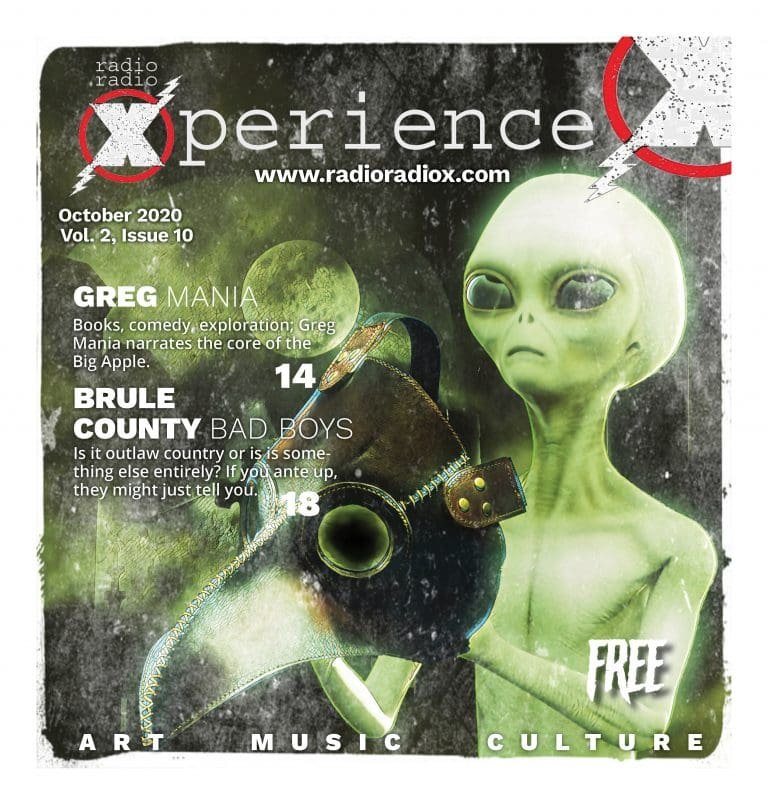
Halloween is coming, and a full moon will shine upon the October Issue of Xperience. But you don’t have to wait to read it!
Featured are dancer and choreographer Jillian Davis, punk-Russion folk band Caribbean Crisis, writer and comedian Greg Mania, Brule County Bad Boys, and writer and photographer Vincent Zandri.
Paul was always one for “bad” jokes and puns, so he started telling at least one joke a week. It was an immensely popular segment of the show. Most of them were real groaners. After a year of hearing these jokes week after week, folks started getting tired of it and came asking me to do something about it. It was around the same time that Aron Kay and other yippies were pieing political figures such as William Buckley, Phyliss Schlafly, G. Gordon Liddy and many others. He even pied Andy Warhol because he had dinner with the Shah of Iran. https://www.huckmag.com/perspectives/activism-2/the-yippie-pie-man-americas-unlikely-hero-of-the-radical-left/ Every pie’s flavor was chosen on purpose. Paul really admired the yippies for doing that, so I decided to give the “bad joke of the week” segment a big ending. I had already pleaded with him and knew that Paul would never willingly give it up. One week, I came up with a plan to pie him in the face after his joke. I chose whipped cream because it reminded me of the old comic routines with cream pies. Later on, a friend, Clinton, suggested that shaving cream is a kinder way to do it, but at the time all I knew was whipped cream. As he told his joke, I filled up a pie pan with whipped cream and waited … and waited … and waited, while he told more and more jokes. He usually only told one, maybe two, but this night, he went on and on. The crowd was getting antsy, and the whipped cream was melting. Because I was holding the “pie” in the back of the room, I couldn’t go up and give him the hook. When he finally finished, I hit him with this pie pan full of half liquid cream. Sploosh! The crowd loved it. Paul was shocked but had always been a good sport and, that was the end of “bad joke of the week.” It was fun while it lasted but everything must end sometime, and even Paul had to admit that this was a great ending.
We met a lot of interesting characters at these Open Mics. One man we met there was a songwriter named Mitt. He was not a hippie. He was a local and was very conservative. He had a connection with a local radio station in Tillamook and hired us to record one of his songs in multiple harmonies. There were six of us on that recording. It was my first experience in a recording studio and my first time hearing myself on the radio. I was hooked. One day, he came to the house to jam and met our kids for the first time. At that time, Jessie loved to dress her brother up in her old dresses. She even had a name for him in drag. She called him “Rubessa.” He enjoyed it too, probably because of all the attention he was getting from his sister, and we saw no harm in it. That day, he was wearing a frouffy, lacy dress, toddling around without anything on underneath because he was potty training. I always found it easier to teach my kids to use a potty when it was easily accessible, so they had a potty where they could see it, not hidden away in the bathroom, and didn’t wear training pants. It worked very well for all of my kids. This was well before they started making disposable training pants, which in my opinion are too much like diapers to be highly effective. The kids were playing around us as we jammed, dancing and listening to the music when Justin fell, and his dress flew up around his face. The look on Mitt’s face, as he realized that we didn’t have two daughters, was priceless.
We also met a woman flutist, Marla, who lived on a farm with her boyfriend Tom. One Easter, we were invited to an egg hunt at their farm. Most of the eggs were in the barn, so off we went with a whole troupe of friends to find them. Jessie decided that she needed to use the bathroom, so we left the group and started walking back to the house when we were suddenly attacked by their flock of geese. They surrounded us and started trying to bite our legs. Justin was still small, so I scooped him up while holding on to Jessie and kicking at the geese. Finally, another adult came out to help us, and we made it to the house. Jessie’s memory is that I picked her brother up and left her to the strong beaks of those geese. She still reminds me of that. In reality, I was trying to protect both children and could only lift one of them, but we all remember things in our own ways. Another incident at that farm happened when we arrived one time for a visit. They had horses, so there was a metal gate that had to be opened to drive through. Jessie loved being a “big girl” and opening the gate for me. This one day however, there was a curious horse that strolled over as she opened the gate. It startled her, and she screamed, scaring the horse and sending it galloping down the road. Tom came running out and chased the horse almost all the way to the highway before he finally caught him.
Of course, our friends, Patty and Jim were living there as well. They were the reason we ended up moving there in the first place. Although they didn’t have a farm, they also raised animals and gardened. They bought a lamb, who they named “Buck Burger” as a way of letting the kids know that this would someday be food. They were all cautioned not to play with the lamb for that reason. Predictably, they didn’t listen and played, not only with the lamb, but with the baby rabbits, too. We would chase them away, and as soon as our backs were turned, they’d go right back. Nothing could keep them away from these cute little babies. One day there was an unusual heat wave, and all the baby rabbits died. We were invited to a delicious dinner that night. Jessie raved about how good the food was and wanted to know what we were having. When Jim told her that we were eating Buck Burger and rabbit, she cried and never ate meat again. It was a hard lesson but one that farm kids have to learn. She was obviously not destined to live on a farm.
Another man we met was a stand-up bass player named David. He had one of the longest beards I’d seen and braided it in creative ways. He was a gentle giant, and Jessie was fascinated by him. He often joined us in our sets at the café. He was one of the few friends who didn’t have children of his own. David introduced us to an older man who had landscaped his yard as a fantastical playland for kids and adults. There was a rope swing that went out over a deep pond, gardens with fun decorations, play structures for all ages and unusual trails. Looking back on it now, I realize how much of an inspiration that was for my own landscaping.
There were lots of couples with kids including one couple who worked on a dairy farm and a pot farmer and his partner who had recently had a child. This man grew square plots of marijuana scattered throughout the National Forest which bordered his home. Every square was kept separate and pollinated by hand with every one of them being a different strain. He often hired his friends to help out in the fields and paid us with any branch we would like to cut. I often babysat for his child and was also paid in weed. He had studied the genetics, creating his own strains very scientifically. He eventually made enough money to pay all of his tuition for medical school, much like our friend in San Francisco who raised her tuition for art school by being an upscale call girl. That year, one day right around harvest time, he heard a knock on his door. When he answered it, he saw a man from the Forest Service in his uniform. He admitted later that he was a little worried. The Forest Service official told him that he had received an order to fly the planes over that part of the forest the following day. He wanted to warn him so that he could get his friends together to do the harvesting immediately. A bunch of people worked all afternoon and almost until the morning getting all of the plants in before the fly by. I always thought that was such a nice service.
We had finally landed in a community with like-minded people, many of whom had kids that befriended our own kids. I soon found out about an alternative school that was there. This was the second time I’d heard about alternative education, the first being in San Francisco in the artist community we were in briefly. As you’ll find out later when I make the move to Albany, New York, the third time was the charm. There was so much that I could relate to, that inspired me and influenced my life for many years to come. However, like many things, it wouldn’t last for us. We soon got word that our landlord had found himself earlier than expected and was coming back home. We had a month to move out. In all fairness, he had offered to let us stay there with him as long as it took to get a place. He soon found himself fending off well intentioned travelers who had gotten the word about our hippie bed and breakfast. I guess that went on for years, much to his chagrin. Although, I’ve heard that he had a good laugh about it.
Music has had an amazing ability to adapt to the most stringent adversity, and the pandemic has been case in point, seeing bands once reliant on their live sets eaking out an existence with livestreams and social media. But on October 1st, Facebook is putting down an iron fist.
One of the many visitors we had while living in Hebo was our old friend Clinton. Clinton is the juggler who had lived in our backyard in Portland and who became a good friend. After his year off traveling by thumb around the country, he went back to Yale to finish his degree in Geology. We had kept in touch and knew we would see him again eventually, probably that summer. However, with nomads, you could never really count on anything. He showed up on one of the most terrible days, a day full of surprises.
That day, I had taken the kids to the little school playground less than a block away from our house. We went there often, having no play structures in our own yard. There were even woods behind the school where we would often gather wild foods for our meals. The playground was usually empty but not that day. This time, we were sharing it with an older man and his granddaughter. As I’ve said before, Justin was a daredevil. There was no holding him back, and he loved slides. This playground had a rather tall metal slide, so I would always go up the ladder behind him, making sure he was safely seated at the top then go around to the front and catch him as he slid down. We’d been doing this successfully for weeks, and he always waited for me to say “Go!”
This time, he waited for me then started down the slide putting his sneakered feet out to the sides to slow himself down when suddenly, he flipped over the side, still near the top, landing on his head on the blacktop below. I lunged for him and managed to grab the tip of his sneaker as he hit with a loud crack. I was horrified and wanted to scoop him up immediately, however my mother was an RN, and I knew that I shouldn’t move him. I knelt down next to him checking to see if he was conscious and trying to assess how hurt he was. He wasn’t crying, which scared me. Meanwhile, the only other adult at the playground, the grandfather, came running over and started screaming at me. “What kind of a mother are you? Why don’t you pick your child up?” I managed to block out everything except my son and kept whispering to him as he started focusing on me. Eventually, he moved of his own accord and started sitting up, still dazed. Once he sat up, I did scoop him up, grabbed Jessie’s hand and started running for home. As we entered the driveway, Justin threw up all over me. I knew we had to take him to the hospital.
Paul came running out and, when he saw Justin bleeding and vomiting, also started yelling at me. He wanted to know what I had done to our son. Once again, I bit my tongue and ignored him, walking into the house to clean up and grab the car keys. I was greeted by Clinton and an old friend of his from their home state of New Jersey. My first thought was, “what a bad time for a visit.” Then I realized that they could stay home with Jessie while Paul and I made the trip to Tillamook to the closest hospital. Luckily, when Clinton saw what was happening, he took Paul aside and talked him down then sat with Justin while I changed into clean clothes. Within minutes we were on the road, headed to the Emergency Room.
The hospital was a rinky-dink little facility that didn’t really instill much confidence in me, but we had no other choice. They checked us in fairly quickly and led us to the X-ray room. Once there, they had me lay Justin down on the table and handed me a lead vest to wear so I could stay in the room with him. When I asked where Justin’s protection was, they answered that they didn’t have any child-sized vests and actually only had that one. After freaking out at them for their incompetence, I promptly took it off and draped it over my small child. They didn’t like it, but I guess they knew enough not to argue with a mama bear. It was all starting to hit me now and, with everything that had happened so far, including being screamed at by two different men earlier, I was not to be trifled with. Miraculously, there was no fracture, but he did have a concussion. They wanted to keep him overnight, but I refused. I didn’t trust this place to keep him safe, and it was at least a half hour away. They gave me directions to wake him every hour and ask him simple questions to be sure he was okay. He was already very drowsy and would probably sleep in between.
We finally got home well after dark to find dinner waiting for us. Thank-you, Clinton. Jessie was all ready for bed but had insisted on waiting up for us. I settled Justin, set an alarm for an hour, put Jessie to bed and ate some dinner. An hour had gone by already, and it was time to wake Justin. He barely woke up but did answer everything falling back into a deep sleep immediately. I set another alarm and exhausted, sunk into our recliner hoping to nap, when I suddenly heard a distressed meowing from behind my chair. Our cat was struggling with having her kittens and needed assistance. Everyone else had gone to bed already, so I stayed up all night long delivering kittens and waking Justin hourly. Justin recovered quickly and was back to his old self of climbing high things, trying to escape whenever he could and taking ridiculous risks. The ironic thing about this accident was that it wasn’t really a risky thing or shouldn’t have been. I realized later that the rubber on the side of his sneaker had stuck to the side of that metal slide and had flipped him over. Ever since then, I have cautioned parents at various playgrounds about that danger. I even saw it almost happen again with another kid years later. Luckily, that child pulled his foot back in before actually going over the edge.
The next day, I got a formal introduction to Vernon, the friend that Clinton had brought with him. Vernon was even more shy than me, which was saying a lot. As a child, I was so shy that I would be doubled over with stomach cramps if I ran into a schoolmate at the grocery store. I battled waves of nausea when called on by teachers in school. I never looked anyone in the eye, not even family members, so I understood what he was going through. However, Clinton was outgoing and had been on the road the previous year. Vernon’s shyness was too much for Clinton. He felt like he was carrying a lead weight. He asked if he could leave him with us for the summer. Paul was not excited about having him stay. He had been with us for three days and hadn’t said a word except a whispered hello with downcast eyes. On the other hand, I was always glad to have more people around, and the kids had taken a shine to him. I also liked this quiet man. Poor Vernon wasn’t thrilled at being dumped by his friend either, but he also wasn’t happy about the idea of constantly meeting new people on the road. We all finally agreed to the arrangement. Vernon ended up being one of our best friends. Once he adjusted to this new situation, he opened up and became a member of the family. We were all incredibly sad to see him go when Clinton returned to get him to hitchhike back to New Jersey together.
Clinton had gone north to Washington State and hung out with the Flying Karamazov Brothers, a world-renowned hippie collective of jugglers. He came back with all kinds of new tricks. He learned how to eat fire, which he told me was not really a trick. You actually burn the inside of your mouth. It wasn’t something he wanted to continue with, and I didn’t blame him. He also started juggling any three things that were handed to him. So, of course, Jessie handed him a dollhouse, a super ball and a cup. If he dropped anything, you got to pie him in the face with shaving cream. He’d started out doing whipped cream, but it got rancid pretty fast all stuck in his beard, so he switched to a non-food item. He always managed to drop something because being pied in the face was an important part of the show. He stood out on our front lawn, right on Highway 101, juggling everything including flaming torches. We were acquiring quite a reputation in town by this time, but luckily, we weren’t the only hippies in this very rural area. The locals were adjusting quickly to this new community.
Next up: excerpts from Hippie Mom Living on the Coast & Patch Adams – Chautauqua
In January of 2002, Budweiser aired a 9/11 Tribute commercial only once, so as not to profit from it. Today is the 19th anniversary of the catastrophic attacks on the World Trade Center and the Pentagon. It hits us especially hard this year, because, like that day, Americand are called upon to rise to a higher purpose. We love this country, and the music and the art and the writing that shapes and molds it.
Here is that commercial. May you have a reflective day.
We settled into our new coastal life easily. The Friday night Open Mic at The Riverhouse was a huge success. We kept meeting more and more like-minded people and were surrounded by music. We had a reliable babysitter who came from a large family and was not flustered by Justin’s adventurous nature. After a couple of incidents where he broke away from her and went running down the highway chasing after our car, he soon grew to love and trust her. It wasn’t until we were able to have a night out every week that we realized how much our relationship was suffering. I had been totally immersed in being a stay-at-home mom, which was a twenty-four-hour seven day a week job that exhausted me and kept me from being the partner that Paul wanted and needed. Now, that could change. I hoped we would fight less and remember how much we loved each other.
Our two children were as different as night and day. Jessie was very talkative and independent but respectful of limits. Justin was an adventurer and had no sense of practical limits. He was always pushing the boundaries. Even as a toddler, Jessie would never venture far and always came back if I said I was leaving without her. Justin, however, would turn and run in the other direction as fast as he could go. This was confusing to me since he usually wanted to be attached at the hip. It was a crazy dichotomy. He was fine if it was his idea to explore but, if I wanted to go somewhere without him, even into another room, it was a different story entirely. Both kids were exhausting in their own ways, and both of them were smart as a whip.
When I was pregnant with Jessie, I had read somewhere that you should read aloud to children from the day they were born. I read everything aloud from that point on including novels or newspapers that I was reading while she played by herself. When she was three years old, she suddenly read a cereal box to me. I thought I must have read it to her at some point, and she was reciting it from memory, but I was wrong. I brought other things to her, and she read them, too. Unbeknownst to me, she had taught herself to read. Now, in kindergarten, she was a voracious reader and far beyond her classmates. When we lived in Portland, the school refused to let her into an advanced reading program, so I was surprised when her new teacher in this tiny rural school suggested that she do reading class with the first grade. She excelled and was happy there.
Although Justin also learned to read early and loved it as much as his sister, his skills were of a different nature. He was a planner and a schemer. I was never sure what was going on his head, unlike Jessie who was an open book and eager to share every thought … endlessly. Justin didn’t say much and would think nothing of suddenly taking off to go wading into the rushing river or jump right into the big waves of the Pacific Ocean. We often visited the beach in Pacific City climbing up the big sand dune at Haystack Rock enjoying the majestic view. But no sooner were we settled at the top, than Justin would go plummeting down the steep hill, tumbling most of the way to the bottom with me running after him. Paul always looked at the child-rearing as my job. He brought in most of the income, though I did what I could while managing both kids and the household, so in his mind, he was off the hook as a parent. Although, he was always ready to yell if they disturbed him.
Meanwhile, my back issue was getting worse. Hauling around a feisty two-year old didn’t help it any either. While in Portland, I had tried many different remedies for the pain including chiropractors, massage therapy, even Nemo Therapy which was electro-shock to the muscles. It tightened the muscle until it released itself. It was a painful procedure but was actually the only thing that helped. The relief usually lasted for a day or two before the pain came back again. Now, we were in the middle of nowhere, and those things were no longer available. I started stretching everyday and doing floor exercises, with Justin climbing all over me. However, mostly, I just got used to the constant discomfort and soldiered through. Some of my new friends noticed and offered to do the heavy lifting when they were around which helped. But the never-ending pain affected my mood more often than not.
I was also starting to be noticed by some of the other musicians. Before I met Paul, I had been working with wedding bands and getting solo gigs with churches for various services. When we first got together, he became jealous and insisted that I give all of that up. I had spent my childhood alone and my high school years bullied and wanted him more than I wanted the gigs, so I agreed. Now, I was getting invited to sing back-up on recordings and offered radio work in a neighboring town. That caused us to start fighting again, so I turned down anything that didn’t include him. I wasn’t ready to go back to the endless yelling and certainly wasn’t ready to be a single mom. I had grown up with parents who, although they loved each other passionately, fought constantly. I thought that was probably normal, but I was willing to do whatever it took to avoid that in my own relationship. Unfortunately, Paul had also come from a highly dysfunctional and violent family and was probably addicted to adrenaline. He was not violent towards us but threw things at the walls and stormed around too often for my comfort. I soon started playing the role of protector towards the kids, mostly towards Justin. As I said, he was a rambunctious troublemaker. He would go racing through a room where his dad was sitting on the floor reading the newspaper with a cup of coffee, a cigarette and a bong. In no time, the coffee and bong would be spilled, and Paul would be standing over our terrified boy, waving his arms, throwing the coffee cup and screaming at him. I would swoop in and scoop him up, facing Paul’s rage myself and propelling Justin towards his sister who would take him to refuge in their room. Once the dust settled, Paul would take up his guitar and we would heal ourselves and our relationship in our music. I’ve often said that being in a band is like being in a marriage because the bond of music is so strong. For us, we had both our love and our music. For a long time, the music was the strongest bond of all and eventually became the only bond. And then there was also pot.
Pot was one of the glues that held us and the music together. We smoked together remembering our love for each other and became inspired to write or share music. For me, music was everything. It was the air I breathed. I had been singing for as long as I could remember. It was the one thing that had always healed my soul. It was what made me feel connected to the world. But it was also a business. I always wanted to be a professional musician and had started on that path early on. I even went to college to study music but soon dropped out, having never been a good student. For Paul, it was a hobby. It was definitely something he loved, but he had no aspirations to make his living with it. It was always my push to get gigs. I always did the promotion and all of the behind the scenes work. I organized practice in addition to jamming. Paul was very social and was able to talk to people easily and book gigs at clubs and private parties. He just needed the push to go do it. In that way, we were a good team. He would make the initial contact, and I would follow up. Everyone loved Paul. In public, he was funny, gregarious and generous to a fault. That was the man I had fallen in love with, and I wanted him back. I was convinced that I could help him heal from his earlier trauma. I wasn’t ready to give up on him yet.
Celeste Plowden has such a way about her writing style that you are often left wondering if she herself actually had experienced what she writes about; even if it defies what we assume to be impossible.
RRX: Many may know you as an artist and I know you can sing too but today we are talking to Celeste the author. For those that do not know can you give us just a little background on yourself?
CP: I started out in New York, where I studied textile design at Parsons, and lived there for many years, until I moved upstate with my husband in the 1990s. Prior to that, I received a BFA in Art History with a minor in English literature, which studies have greatly influenced my writing style. In my lifetime I have been a fabric designer, real estate title examiner, fine artist, showroom model, singer, and fiction writer. Currently, I sell my paintings on a home decor site, search a few titles for local clients, write fiction, and sing a few blues tunes at local jams.
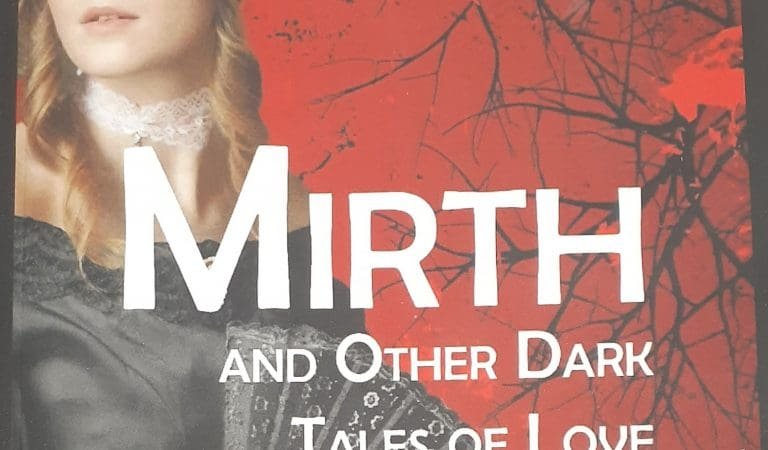
RRX: Your most recent release is Mirth and Other Dark Tales of Love. This is a collection of short stories, a couple of previews of upcoming works and of course the title story “Mirth”. “Mirth” takes place in our local area which I think is so cool. What was it about Hudson, NY that compelled you to write?
Celeste Plowden. Photo provided.
CP: I think Warren Street in Hudson is one of the great gems in our area. Just peeking into all of the shops of fantastic furniture and art objects takes me back in time, and I see many of the items as tidbits of history that add color to my story settings. I like the way that street goes on for such a long stretch of blocks, so many shops to explore within the older brick buildings. I thought of the story “Mirth”, as I was rambling around there early one evening last summer as the sun was just beginning to set.
RRX: “Mirth” takes place in modern times but I know that you are very inspired by the seventeenth and eighteenth centuries and I also know many of your stories take place in the past. I imagine there is a great deal of research that comes with writing alongside history. How do you pull all of your research together and maintain accuracy when you write about the past?
CP: The historical settings I use in my stories are periods of history that I have read about over the years, and am already very familiar with, especially in terms of period costumes, furniture, art, music, and many customs. But of course, I have reference books at home, to refresh my knowledge, and I also use the internet to look up old drawings or photos. I only write about places I have been to, for instance, Coney Island, but of course since I wasn’t there in the 1920s, seeing old photographs from then, really helps me to get a better sense of place, making the story more interesting. Being an artist, I like a very visual setting for my stories.
RRX: So I have viewed a lot of your artwork, paintings etc. and I haven’t found these works to be on the darker side of things. What is it about when you write that brings the darkness out?
CP: I search titles and create decorative paintings for a living, and while I have always enjoyed doing both of those jobs, I am doing what the client has commissioned me to do. But when I write, it is strictly because of my love of classic fiction. I write about things that I’m interested in, and some of it is pretty dark, like ghosts and vampires. I like using those supernatural beings to describe deep, emotional longings, and mysteries within ourselves that some of us feel a need to figure out. Many parts of my stories come from things I have experienced, or people that I have known, but I like to ratchet up some of the romance by using characters who fall in love with a creature who is dangerous, or unattainable, or lives on forever. Never let the passion end!
RRX: So the word is, you have a novel coming out in the very near future, without revealing too much; what are we to expect?
CP:The Harpsichordist should be out sometime in July on Amazon (Kindle and paperback). It’s a vampire novel that takes the reader on a trip through nearly three centuries in London, New York, and Paris, with a man who was once a noteworthy builder of harpsichords. This vampire’s quest for a mate, and his love of music are the main themes of the story. Vampires don’t have to be that gory to be interesting, and Miles Beaumont flourishes in each age of history that he has existed in, including, the French Revolution, the Belle Epoch, the Roaring Twenties, contemporary times, and more.
RRX: Please let our audience know where we can find you online to keep up with what you are doing.
CP: Thanks, Rob. You can find my book, Mirth, (an Amazon best seller) available on Amazon, and The Harpsichordist, there as well, in a few weeks. I have an author’s page on Facebook, and also on Goodreads. You can check out my artwork on Chairish.com, under the shop name of Cleo Plowden.
So if you haven’t familiarized yourself with Matt Pless yet, you can thank me later. We the music lovers are always looking to find new music and musicians to add to our personal playlists. I say look no further, Matt has been described as today’s Bob Dylan but I find Matt’s lyrics to be a step beyond. So thank you Matt Pless for speaking with me today I really appreciate your time.
RRX: Matt, what’s good man? So you’ve been a favorite singer/song writer of mine for years but for those just catching on: if you can give us a little introduction of who Matt Pless is and what you’re all about it would be beneficial for our audience and prospective fans.
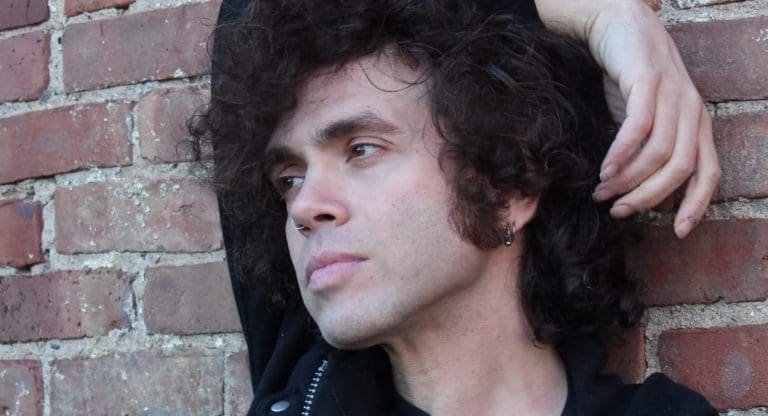
Matt Pless. Photo provided.
MP: Who is Matt Pless? Depends on what day of the week really. Who is anyone? Who are you while you are being who you are? I’ve been all kinds of people. I guess you could say I’m a little bit of everyone, just like everyone else.
In the context of this interview, which I assume is being conducted due to you having an awareness of my music, I would say Matt Pless is an artist, the last of the streetlight beat poets, the lost boy in the land of chalk drawings, and the minstrel troubadour trapped in the wrong time. Matt Pless is about expression, freedom, truth seeking and invoking the spirit of a wild whimsical libertine.
RRX: We’ve all heard the cliché saying that actions speak louder than words but I’m a firm believer that sometimes words can be actions. With that being said, your lyrics are actions to me. As a songwriter myself sometimes all I feel I can do is write and if people heard the message then my actions helped. With the state of world affairs and our country, I can only imagine the inspiration you have had to write.
MP: Lately, I haven’t written much at all about the state of the world. I’ve been writing about all of this for the last ten years. I suppose if there is more to write about the current state of the world, I assume you’re referring to politics and the social landscape and all that, I will receive inspiration to write about it, but if you wanna know my perspective on today, I suggest looking in to things I wrote yesterday, maybe that will help you figure out tomorrow.
RRX: I’ve told you this in the past when we’ve spoken and I stand my ground that “When the Frayed Wind Blows” is one of the greatest songs ever written. I remember some of the background story on this but can you tell the audience a little more about how this song came together?
MP: When the “Frayed Wind Blows”, oh man, well, I was living in New York City juggling train wrecks and listening to painted piano players. There was this guy on the subway who winked at me, I found myself in a rather high strung state and couldn’t sleep, something grabbed my hand and I started writing. Before I knew it, I had scribbled down dozens of lines on about fourteen pieces of paper. I couldn’t stop writing the damn thing, it just wouldn’t finish itself. I had a feeling it was gonna shape up to be something important, so I stayed up for three days and didn’t eat anything until it was finished. The whole thing was done by day three, except for the last line of the hook. I wandered around focusing on what would fit in that section for hours and hours, every combination of words I could think of. Finally, I came up with “when the fury of the frayed wind blows” it felt perfect, like the moment you know you’re in love. It’s got something to do with Dante’s Inferno, A Peoples History of the United States (Howard Zinn), and Peter, Paul, and Mary.
RRX: “What a time to be alive,” obviously quoting one of your songs, but man, 2020 has been like a game of Jumanji. Roll the dice and take cover. What have you been doing to get through this? How are you holding up and what do you make of all of this uncertainty?
MP: What do I make of 2020? The real question is, what does 2020 make of me? Hopefully not a corpse. I’m holding up OK, as well as anyone who isn’t wearing a ventilator I suppose. I’m aware, cautious, but not paranoid or living in fear. I think having a balance with all that is important. I haven’t been doing much differently except being bored more often and wishing I could be out on tour playing shows. As far as what’s going on socially and politically, I think there is a whole lot of stuff this country has to reckon with. There’s blood on its hands and shadows down its highways. Don’t get me wrong, I love America, but it will have its day in court.
RRX: Lastly, I know you have a new EP on the way. Let us know what’s on the horizon and what to expect in the near future.
MP: I have a new full length album in the future. It’s all finished, I’m just putting its release on hold until we stop needing so many ventilators. I’m releasing 3 vinyl records of previous albums. A vinyl version of my Nero EP can be pre-ordered off my Bandcamp, and I’m gonna say my new full length will be out in early spring, right before touring picks back up. After that, I’ll be out on the road for a while playing shows, romancing chewing gum diner waitresses and swallowing sunshine out in California.
Reality can be bleached by the news tickers and the 9-to-5s and the endless pile of pills that cry out to be juggled. And then you see it: that flash of color. The shapes, stroke and gloriously blended gradients that soak into that bleached timeline to remind us that there’s more to live than the ticking hands of a clock.
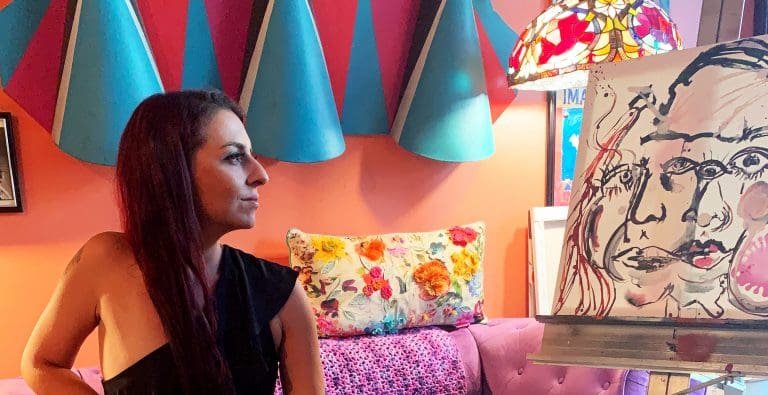
Sarah Petrucci is an artist and graphic designer from right here in our own little kingdom. Her work is, in this writer’s opinion, transcendent and inviting to that transcendentalism. She works in multiple media, and she’s here to brighten your doorstep.
I sit with Sarah and we talk about practical sorcery.
“Bloom” 14”x17” Ink on Bristol “Passion creates, addiction consumes.”
RRX: I love covering art and music because of the similarities in the craft of each, and how they have so correlated an effect on the person taking them in. So let me ask a big question. A lot of artists and musicians have “that vision” or “that sound” that they chase but never quite catch, and they create along the way. What is your big vision?
SP: I have been creating for as long as I can remember and had the compulsion before I knew what it was. Maybe it’s a bit cliché, but I remember the first time I saw Van Gogh’s “Starry Night” and Edvard Munch’s “The Scream.” I was in the 4th grade and couldn’t get over it…I wanted to memorize every brush stroke. It was the first time I “felt” art and realized that it wasn’t just about looking and seeing. That same year I attempted to execute that concept with a rather fearsome papier-mâché mask that my art teacher took a special interest in. She entered it in a statewide juried exhibition called the Imagination Celebration in 1992. I called the piece “Long Nose, Wooden Tooth.” My parents and I attended the reception at the NYS Museum and I vividly remember the stark white walls exploding with art. I knew in that moment that I was an artist and that’s what I wanted to do forever.
I kept my creativity close and used it as a coping skill during my tumultuous teenage years, graduating from high school early to attend art school at the Sage Junior College of Albany. I wanted to find the “real artists,” and back then it felt as elusive as finding a unicorn. I studied with Willie Marlowe, Garry Shankman and John Hampshire all of which influenced me exponentially; Marlowe in particular. I had never met a woman painter. Her work was all about color, intense close valued color, neon color, deep color-textural color all the time; sometimes straight from the tube. She encouraged every wacky notion I came up with and even allowed me to implement my own “independent study.” I created glow in the dark paintings, paintings on wood, metal and glass, and a series of paintings on car doors I ripped off of a 1978 Volvo, called “Vehicle of the Mind.” She challenged the notion of what “fine art” or high art was made of and I was obsessed. I’ve been chasing that vision ever since. In the words of Andy Warhol, I believe “Art is what you can get away with.”
RRX: Some say it’s all about the tools. Most in the know would argue that the tools in uninspired hands don’t amount to much. But in inspired, trained hands, the tools take on their own life. You work in visual, so what do you like, in terms of different media, and different brushes, pens, charcoal, etc.?
SP: There are many tools in my toolbox and my approach is playful! As a graphic designer, my biggest tool is the Adobe Creative Suite, Photoshop and Illustrator mostly. In terms of painting or drawing, few things are off limits. Some of my favorite mediums include Liquitex acrylic and spray paint, ink, and Sharpies. I’m obsessed with Sharpies…the precision and permanence, and the colors they are coming out with are awesome. There are always at least a dozen of them in my purse.
RRX: Art and music both have two natures, or aspects. Both can exist live, or “in the wild,” and they can be preserved in some way. In both, there’s live and recording. What do you think is different about a live, physical sketch or painting and the digitized version? Is it even better to present a work as digital only?
SP: The distinction between a physical sketch and the digitized version is similar to live music versus the recorded version in that digital work is usually much more refined. Mistakes can be corrected and polished. For me, the beginning is always the same; everything starts in my sketchbook. Whether that sketch evolves into something digital or not is another story. I don’t think it is better to present work as digital only. With my design clients I always share my preliminary sketches; they are a part of the process. In the same way live music is raw, honest and full of soul, so too is “art in the wild.” I can’t imagine Pollock creating his splatter paintings digitally. I believe there is tremendous value in the process of creating art, and that process possesses equal importance to the final product.
RRX: You are a graphic designer. I wish I was. I know from work I do in this publication that graphic design is sometimes a delicious torture. How did you get into graphic design? And for someone like me, who probably wouldn’t score a scholarship anywhere, how can I get to a working understanding of graphic design?
SP: Delicious torture indeed. I never imagined I would get into graphic design! When I was a fine art student there was a rivalry with the design majors…a real us versus them attitude. The fine art folks were accused of being lazy and messy, while the design people were mocked as “sellouts” for being commercial and considered up-tight, compulsive and deadline oriented. I wanted no part of that! I was a perpetual student and was working as a police dispatcher for the city of Rensselaer. That job was not for me to say the least! It took a decade of repeatedly dropping out of school, trying again and again, until I found an online graphic design program at the Art Institute of Pittsburgh. I was desperate to finish…something. I couldn’t see myself making a living with art alone, had little interest in teaching and couldn’t swallow being condemned to a life of emergency services, so I decided I would try. I enrolled in 2013 and FINALLY earned my bachelor’s degree in graphic design in 2018 while working full time. My goal was to happily compromise…not all graphic designers are “artists” and not all artists are graphic designers but the aspiration was to incorporate and overlap the two into the creative career of my dreams.
My advice on gaining a working understanding of graphic design would be not to bury yourself in student loan debt like I did! My degree program was very challenging and had an 11% graduation rate. It involved a lot of independent learning. I knew I wouldn’t have the discipline to teach myself without the pressure of getting a grade. If you have the patience and tenacity, you can definitely teach yourself! YouTube has changed everything. Many resources and tutorials are available through Adobe and Lynda.com as well.
RRX: Following up on the last question, graphic design. This world is governed by design. Advertising, architecture, the placement of junk food in end-caps at the supermarket – it’s all design. As an artist, do you ever feel you need to break a design/function barrier in your work, or is it better in the long-run to follow the rules, but maybe bend them?
SP: I’m a firm believer in learning the rules before bending them and that is where art and design differ. Art can be just for art’s sake. Art can be a banana duct taped to a wall.
Design has function and rules are important because the human brain is wired to see structure, logic and patterns. Both are attempts to understand and describe the world around us. The subjects and methods may have different traditions, the intended audiences can be different, but I think the motivations are fundamentally the same. I don’t like to regard design vs function as a barrier but as an opportunity to embrace both and solve the problem as eloquently as possible.
America is a treasure chest to the ear. Along the highways and byways beats are carried over vibrating strings and crooners sing for that girl they knew one summer at the county fair. Americana is more than just a music; it’s music. It’s the telling of a story in a language everyone can get.
Marcus Ruggiero and Sideshow Gypsies bring notes and grooves from the land of plenty to share with everyone that finds them, because you search for Americana until you become Americana.
I sit with Marcus and we talk the glory days.
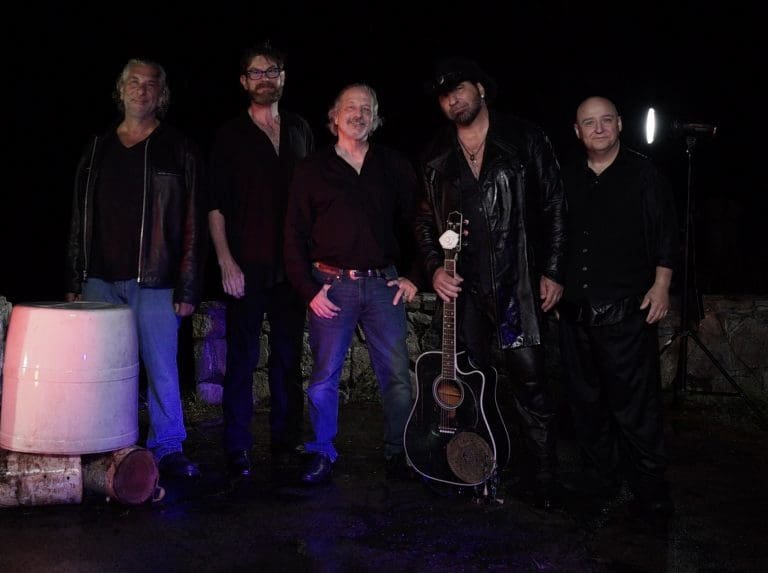
Marcus Ruggeiro. Photo provided.
RRX: Sideshow Gypsy is Americana, which is really a universe in and of itself. I’ve interviewed people that play and write Americana, and I’m always curious to understand what makes it their genre. Could anything developed in America be considered Americana? Or does it take a special something?
MR: Americana? Well, it does have a distinctive sound yes and actually Wikipedia can explain it in more detail if anyone’s interested in what it is. I don’t think just anything written in America makes it Americana. Although it is kind of a mixed cocktail, rock, country, rhythm and blues and I think sometimes a bit of pop sneaks in there to give it its sound….
And then there’s jazz…lol.
RRX: On the origin of Sideshow Gypsy. Did it originate from something you were doing, so as to wrap around a project of yours and grow, or was it a project that you joined up with. And regardless of which, can you take us through those initial steps of getting your lineup to the point at which you tapped the mic on the stage at that first gig?
MR: SSGB, unbeknownst to me, manifested itself. What I mean is when I wrote the songs such as “Long Ways Down”, “Quiero Tus Besos” “The Clown and the Snake Lady” and “Life’s Crazy Road” between 2009 and 2015 to name a few, at that point I had no idea what I was going to do with these songs. I placed them in my archives waiting for a home; waiting to be brought to life.
When I wrote the songs I didn’t know what their purpose was or how to present them. They were rogues, every now and again I would write another and I also placed them in my archives, these songs came out of nowhere. Basically they were like gypsies just showing up out of nowhere with no home and no destination, lol.
Also I might add that in the time since I wrote those songs I was writing others and was recording and releasing several EPs and LPs. And what finally became SDGB songs were just never included.
But Then I wrote “Little Tornado” and all of a sudden I thought wait? I have some others like this? And I went through my archives to locate the previous “gypsy” songs and it all made sense to me that collection of songs had a destination, a home.
Following that I wrote “Sweet” “There’s a Girl I Know”, “Drunken Sea” and all the others on the SSGB self-titled LP became the record. And lastly but not least I wrote “Side Show Gypsy” and “Song for Wendy” and it all made sense.
RRX: Listening to what I have of your work, it’s very earthy, very gravelly, like thumbs along the highway. When you’re writing a song, do you have any visual references? Memories that your writing about, obviously, but more so a “happy place,” a place you go in your head that just pumps you up. If you have a place, what does it look like?
MR: A traveling circus, on a winding dirt road complete with fire eaters, horse whisperers, magicians, and contortionists and I feel like I’m the ringleader, having only one goal in mind to entertain, to bring people along on magical journey .
“Unless a man enters upon the vocation intended for him by nature, and best suited to his peculiar genius, he cannot succeed.” (P.T Barnum)
RRX: You recorded Sideshow Gypsy live after around eight shows. And I think this is a big choice with bands: to record track by track, or to record live. It seems like there would be pros and cons to each method. Do you think that some kinds of music most benefit from a live recording? Do you think that Sideshow Gypsy naturally did?
MR: Although there are variables, I think the writer/producer has to have some sort of a vision and reason why to do so. For me recording live gives the songs more life and more emotion, rather than tracking. Also, my vision was I wanted the album to sound like what the band sounds like live in concert. On a side note however we did over dub the violin and backing vocals.
RRX: Times are tough. Without going into innumerous detail, fates are decided in this kind of crucible, and bands, musicians – even more so. A strong sound is so critical now, because people are going to be exposed to you through their sound system instead of the stage. How do local musicians get their sound in local hands right now?
MR: Creatively. Lol. Also I have always been a believer in that if the music is worthy people will find you. So we will see.
RRX: Back on Americana. Or roots music. Roots rock. I feel it powerfully when I hear it. But I’m a forty-four year-old. Americana really calls to a time before me as well as, well, during me. But generations change. Would you be willing to wager a guess at what kind of sounds might make up Americana 50 years from now?
MR: Well it’ll be fun to take a crack at it. Although as we all know things change and music is always growing and changing in its subtle sometimes explosive and romantic fashion.
I’m looking forward to whatever that sound will be tomorrow rather than in 50 years lol. Although if I may? I recommend you check out a listen to “gangstagrass”, my latest favorite band, Americana is already changing its face my friend no need to wait.
RRX: This is where you answer the question I didn’t ask. Where are the best flea markets? What kitch can be fashioned into instruments? Educate, enlighten, emote – the floor is yours.
MR: Open floor? Well I’m always thinking of my daughters, Jesus, Time and Gratitude. Do for others and be thankful, gratitude is one ingredient to the fountain of youth. Matter of fact, “In this life we fight for what we need, in this life if we end up with just a little of what we want we shall find each other down on our knees in thanks, a whole bunch of Lord thank you’s” (Lyric excerpt: Song of Gratitude/ Marcus Ruggiero Music)
I wish to thank the incredible SSGB, I call my family. Sonny Speed, Brian Melick, James Cappello and Doug Moody, also our sensational backing vocalist Areli Mendoza-Pannone.


 We met a lot of interesting characters at these Open Mics. One man we met there was a songwriter named Mitt. He was not a hippie. He was a local and was very conservative. He had a connection with a local radio station in Tillamook and hired us to record one of his songs in multiple harmonies. There were six of us on that recording. It was my first experience in a recording studio and my first time hearing myself on the radio. I was hooked. One day, he came to the house to jam and met our kids for the first time. At that time, Jessie loved to dress her brother up in her old dresses. She even had a name for him in drag. She called him “Rubessa.” He enjoyed it too, probably because of all the attention he was getting from his sister, and we saw no harm in it. That day, he was wearing a frouffy, lacy dress, toddling around without anything on underneath because he was potty training. I always found it easier to teach my kids to use a potty when it was easily accessible, so they had a potty where they could see it, not hidden away in the bathroom, and didn’t wear training pants. It worked very well for all of my kids. This was well before they started making disposable training pants, which in my opinion are too much like diapers to be highly effective. The kids were playing around us as we jammed, dancing and listening to the music when Justin fell, and his dress flew up around his face. The look on Mitt’s face, as he realized that we didn’t have two daughters, was priceless.

 Paul came running out and, when he saw Justin bleeding and vomiting, also started yelling at me. He wanted to know what I had done to our son. Once again, I bit my tongue and ignored him, walking into the house to clean up and grab the car keys. I was greeted by Clinton and an old friend of his from their home state of New Jersey. My first thought was, “what a bad time for a visit.” Then I realized that they could stay home with Jessie while Paul and I made the trip to Tillamook to the closest hospital. Luckily, when Clinton saw what was happening, he took Paul aside and talked him down then sat with Justin while I changed into clean clothes. Within minutes we were on the road, headed to the Emergency Room.

 Although Justin also learned to read early and loved it as much as his sister, his skills were of a different nature. He was a planner and a schemer. I was never sure what was going on his head, unlike Jessie who was an open book and eager to share every thought … endlessly. Justin didn’t say much and would think nothing of suddenly taking off to go wading into the rushing river or jump right into the big waves of the Pacific Ocean. We often visited the beach in Pacific City climbing up the big sand dune at Haystack Rock enjoying the majestic view. But no sooner were we settled at the top, than Justin would go plummeting down the steep hill, tumbling most of the way to the bottom with me running after him. Paul always looked at the child-rearing as my job. He brought in most of the income, though I did what I could while managing both kids and the household, so in his mind, he was off the hook as a parent. Although, he was always ready to yell if they disturbed him.




 MR: Although there are variables, I think the writer/producer has to have some sort of a vision and reason why to do so. For me recording live gives the songs more life and more emotion, rather than tracking. Also, my vision was I wanted the album to sound like what the band sounds like live in concert. On a side note however we did over dub the violin and backing vocals.