Home Blog Page 648

Mark Emanatian – Driven

0

Driven. That’s Mark Emanatian. He works in Citizen Action and Labor, and he plays in a few bands, among them Soul Sky and The Lawn Sausages. He does a lot, some of which we know, and much of which we’ll likely never know (unless he spills during this interview.)

He’s a gracious guy, and did I mention he was driven? It’s in the music too, encapsulating the upstate New York “crank-it-up” attitude. Both well liked and well regarded among musicians, and first among equals.

I sit down with Mark and talk about a little wet marble, third from the heater.

RRX: The thing that is universally said about you is that you have a lot heart that you bring to the stage, and to your work in the Capital Region community. And there’s a parallel that you could draw between the giving nature of music and other forms of giving. Are your music and your community work branches off the same trunk, do you think?

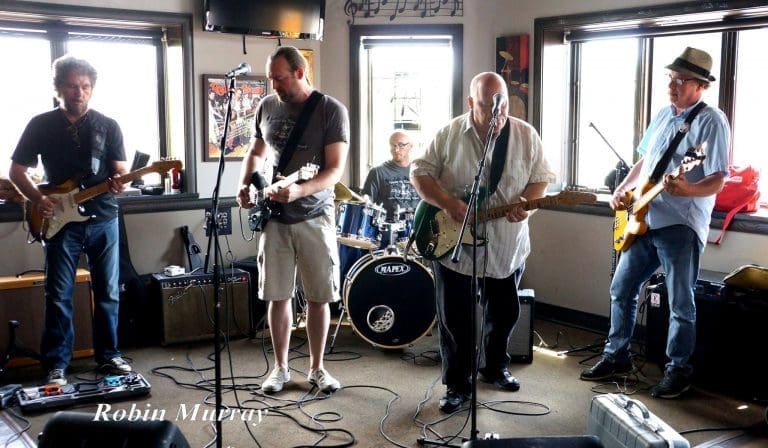
Mark Emanatian (r)

ME: Music has always made life better. It sustains people. It builds community. It has been a part of my life forever and it helps me do all the things I do. I often say at the end of the night’s last song “Take care of your family, your friends and your community…it’s all you got in this world.” I define my community in a big way…in a real sense my community is the world.

RRX: I know that you work for the Capital District Area Labor Federation. I saw you at Foodstock in the Rustic Barn, and I know you were very involved in that. But it’s not easy to just find a list of all that you do. That’s usually a sign you’re actually doing something. But can you tell me some things you’re involved in, so we can raise awareness?

ME: I work on issues of poverty all the time. The United States of America is the richest country in the history of the world. The three richest Americans have more wealth than the poorest 150 million Americans. Think of all the poor…the elderly, homeless veterans, children without enough food, hard working people who work jobs that don’t pay a living wage. I try to do something about it. I am a member of The Poor People’s Campaign. Some of what I do helps groups like the Food Pantries of the Capital District and the Regional Food Bank. That’s why I am involved with FoodStock at the Rustic Barn. The next one is on February 17, 2019. I help out at the Oakwood Community Center in Troy, which is a volunteer run center that’s a beacon of hope. Some of what I do is to try to build a movement that would fundamentally change the system that allows this to happen. That’s why I am member of Citizen Action.

I also work on anti-war and anti-violence campaigns. I don’t think peace is too much to ask for. I work on social justice issues and human rights campaigns. I am against racism, I am for the rights of women, I support the rights of our LGBTQ community. I try to build and support unions.

And something very important to me is supporting the efforts of my friend Joe Mele and his family. He lost his son to suicide six years ago and he took his tragedy and sorrow and has raised thousands of dollars to help people struggling with depression. The  Sixth Annual Dustin Mele Memorial Concert is taking place on March 9, 2019 at Revolution Hall in Troy. I am honored to be playing at it.

RRX: I come from an activist family. We’ve gone on demonstrations and I’ve had causes ever since I was eight. As a musician, or as a creative person in general, do you feel that having a cause puts a particular fire in your belly? Does your willingness to fight for people push you internally to push the envelope with your own creative development?

ME: I have been going to rallies since I was 14…I went to a rally to try to stop the Vietnam War. I grew up in a time period when young people thought they could change the world and musicians thought they had a role in that. I can remember the first time I heard Ohio by CSNY, or Why I Sing the Blues by BB King or Deportees by Woody Guthrie or The Rising of the Moon by the Dubliners. I got to see Pete Seeger playing a concert to help farm workers and singing to end apartheid. I admired all of the musicians who used their talents to help the world or change the world. I am not able to separate my activism from my music. It’s all part of who I am. I think it is wonderful to go out and play some guitar with my friends, sing a few songs and help everyone have a good time and build some community along the way.

RRX: I’ve heard you play, and you go from having a real stomp acoustic road-trip vibe to some slick hotwire blues riffs. I heard a tribute to Ernie Williams, departed local blues great, and I’m always curious, when I hear blues players, what it means to them to play the blues, or to sing the blues. Can you describe that meaning, and how it motivates you?

ME: For whatever reason I fell in love with Blues music the first time I heard it. I grew up in a household where music was always played. My mother and father loved music and we heard everything from Sinatra, to classical, to big bands, to Peter Paul and Mary, the Beatles, Dylan, Joni Mitchell, Laura Nyro, Coltrane, the Allman Brothers. The record player was always on at our house. It was a time before the 24 hour a day television world we live in now. And I love most kinds of music, but when I heard Blues music and the sound of the guitar in that music, I was hooked. I wanted to listen to it, read about it and try to learn to play it.

When I was fourteen, I joined my first band…the Third Avenue Blues Band. Tom Dolan, my dear friend, played in that band and I am still playing in bands with him almost five decades later. I got to see many of the legends…BB King, Albert King, Freddy King, Muddy Waters, Paul Butterfield, Luther Allison, Sonny Terry and Brownie McGhee, John Lee Hooker, Buddy Guy and many more. I fell in love with the British greats…I love Eric Clapton and Peter Green and Mick Taylor…and then the great Stevie Ray Vaughan.

In my 20’s and 30’s I moved around the country a bit and then in the early 1990s I moved back here and I started playing in bands again and I played in Ernie Williams and the Wildcats for a decade. With Ernie I got to play all over the country in blues clubs and at blues festivals. Meeting Ernie and playing in his band was a wonderful experience. It also gave me a chance to play with and learn from some great guitarists that live and play around here. Joe Mele, Hank Soto, Scotty Mac, Jeremy Walz and many others. You don’t get better guitarists than that list.

Mark Emanatian (l)

RRX: Jimmy Barrett was one of my recent interviewees, and he was in high praise of you being someone who could straddle the fence of having a career and a music career. I’m sure you read it, as Jimmy is a friend to all, so I figured I’d give you a chance to comment on it. I’m sure there are quite a few aspiring string-slingers who’d like to catch some wisdom here.

ME: Jimmy Barrett is a dear friend and he has done so much for me and the rest of the musical community. He is also a person who is always there to help anyone in need. He is also one of the funniest people I have ever met. Music is a weird business. It’s tough. People pay $150 to see someone lip sync at SPAC but don’t want to pay $5 to see a great local band. It’s very tough to make a living playing music…especially if you want to play original songs. And everything in the world tells you to give it up. But I think you have to resist that. I think you have to fight to play music. And most of that fight is in your own head. But it is the fight for your soul.

I have a family that I love. I know we all do. I have bills and responsibilities. We all do. But after a long week at work, on Saturday night, you put on your guitar and you start to play and all the weariness fades away and you close your eyes and you are you again. I will fight to keep doing that.

RRX: Can you separate what goes on in the world from what makes its way into your music? I’m not trying to spark any specific political argument here, but it seems like there are a lot of people who want to say “just stick to…” Can we make music that will be classic three decades from now that isn’t drawing on what goes on now?

ME: Other than songs that we are just writing, most of the music I play in Soul Sky, The 317, the Dolan Brothers or even the Lawn Sausages is decades old. I play at least one song that’s over 100 years old. And even with all the changes in technology and in the world, the human condition and what we feel is pretty much the same. There is a longing that I see in people for real things…real emotions, real music, real instruments. Music should be fun, happy, sad, angry, tough, kind and anything else the human condition and spirit can muster up. With me, music makes me feel better and it is best when it is shared.

RRX: This is where you can answer any good questions I didn’t ask. Who’s on the edge, who deserves a ‘like’ or a ‘share’? What projects do you have coming up? I yield the floor.

ME: There are plenty of really good people trying to promote local music. The work Art Fredette is doing with RadioRadioX playing local music all the time is one example. He is another person who is always there when someone needs a helping hand. There are plenty of good people booking bands and keeping music alive. I count them as dear friends…Dottie from the Stony Creek, Tess from McGeary’s, Brian from the Ale House, Jody and Jason from the Rustic Barn, Jesse from the Cooperstown Blues Express, Garrick from Delta Blue just to name a few. Tommy and Matt up at Parkway. Sonny on Stormy Monday Blues on WRPI. Great bands all over the place. Solo acts. Songwriters. Singers. Just around the corner from everywhere, there is music and art and culture and humanity and people trying to make a better world. Find them and join in!

As for me, I want to keep playing and keep building. I would love to make another record. I made six with Ernie and four with Folding Sky and one with Amy Collins and Shadowland. But I have a bunch of new songs not yet recorded and I would love to get them out and about.

Skeeter Creek – A Change in Perspective

0

This article was written by Paula Marks.

One of the biggest country music fans I had ever met friended me on Facebook soon after I opened the mic for the first time on WGNA seven years ago. Sue Bogucki was the biggest cheerleader for all local country bands and supported new artists coming out of Nashville.

She invited me to join her at a local venue to see Skeeter Creek, and I instantly became a SK Creek Freak. During a break in sets, I was introduced to Joe Kulewicz, the lead guitarist, who was extremely down to earth and the next day accepted my Facebook friend request.

In discussing our life experiences over time, we discovered a few significant things in common, the biggest of which was our shared desires to find our birth parents. Joe, who was born and raised in Hagaman, was gracious enough to take some time and talk about some of those experiences.

RadioradioX: When did you get bitten by the guitar bug?

Joe Kulewicz, left.

Joe: I started playing casually when I was about 12. I played through high school. I took some lessons, but that didn’t go so well. I played until I was around 20, then I kind of gave it up when I got married and had kids. Then around ’97, ’98, I found my guitar again and just started messing around with it.

Then in 2001, I met another gentleman and that’s when we started Skeeter Creek. I had split with my ex wife, and that’s when I started spending more time with my guitar. My ex and I still had a good relationship and had a daughter together. The man who my ex started seeing after we broke up, and who she eventually married, (Tim Seboldt) actually became my best friend. He played instruments, and I played instruments, and that’s how we started Skeeter Creek. Skeeter Creek is actually named after a creek in West Virginia where (Tim) was from and where he used to fish in growing up.

Initially, Skeeter Creek was a bluegrass band. One of the members lived in North Carolina and once the band took off in popularity, he would fly up every weekend to play with the band. Once he left the band, Skeeter Creek moved into country music.

We were approached by a local radio station to participate in a contest at the Saratoga County Fair. The first year, we did it as a 4-piece bluegrass band, and we did OK, but didn’t place or anything. A singer from another band, who was quite arrogant, approached us and put us down and said we never had a chance of winning or anything. So it kind of lit a fire under me, and I decided the next year we were going to do it in a surprise way as a country band because nobody knew us that way. They knew us as a four-piece bluegrass band.

So we added a drummer, another guitar player, and we formed a country band just for that competition. We practiced religiously for three or four months just to beat this band, who was very well established. We went to the fair, and we won the competition that year. It shut everyone up. We did it under a totally different name. We went back the following year and won it and then went for a third year and won it yet again. At that point, we decided to switch from bluegrass to country, and the phone started ringing. People wanted to book us. It worked out better so we just rolled with it.

RRX: Skeeter Creek has been voted by many different sources as the area’s best cover band. Have you ever written your own material?

As a bluegrass band, we did perform some original material. Tim, who started with me, was a very good songwriter. We took some of that and transposed it into the country realm, and it was good. It sounded good, but we learned very quickly that when you play country at 99% of these venues, the country crowd does not want to hear originals. When we would play something original, that’s when they would go to the bathroom or to get another drink, so we ditched the original material for the most part. You have to be either an original band or a cover band. There’s no in-between here.

RRX: It’s ironic that you and I have a few things in common. One special thing is that we were both adopted and we both went on quests to find our birth parents. Your search became quite public when a local TV station picked up on your search for your birth mom. How long did it take to get leads from that publicity?

Joe: Almost immediately. Nichole Hart from News Channel 10 did a whole interview with me, and then it went nationwide. It’s amazing how far it went. People from all over the country were calling me – from California, Florida, all over- hundreds of calls in the first week. I tried to follow up on as many as I could, but many turned out to be nothing

I followed the leads for a long time. I went on what my adopted mom told me – she passed before this. Some of what she told me was true, and some wasn’t. That made it difficult. Sometimes I almost gave up because I was spending a lot of time following leads that were nothing.

Then my wife got me a membership to Family Tree. It told me the origins, but it didn’t tell me any family members names. I got nothing from that, so I let it go for about a year. Then a good friend of mine got me Ancestry.com for Christmas the following year. I sent the DNA in, not expecting anything back, but when it came back, it told me who my father was.

There it was. Prior to this, I had done more looking and followed more leads. I kind of knew who some of my relatives were, but then Ancestry told me who my aunt was, who my uncle was, and told me who my father was. That was a huge relief. We have had communication, but we haven’t met yet. He is in a rehab hospital in Florida, and I am planning to go to Florida to meet soon.

RRX: Having found my birth mother and brother, I can tell you it’s really a weird experience to finally see people who look like you and have some of the same likes and dislikes and mannerisms. We get to experience something that most people do not. We get to see the whole nature versus nurture process.

Joe: Exactly. We look a lot alike. His main interests are also playing the guitar and riding motorcycles and it’s kind of crazy how that works you know?

Me: The other journey that you have taken is the commitment to get healthy and lose weight. You are so busy with work, your family, your band. How do you fit it into your schedule?

Joe: It’s kind of a weird story why it started. Obviously I was tired of being unhealthy. My main hobby at that point was eating. I was diagnosed with diabetes. I had gone to the doctor and he said I needed to be on all these medications: insulin, glucophage and all these other things. I told him I’m not going to do it.The doctor said if I didn’t, I was on a path that could lead to my death. I told him to give me three months. If I’m not showing any improvement, then I would do it.

Well, in three months, there was considerable change. Then, at six months, there was a tremendous difference. I was then showing few signs of diabetes. A year later, I was showing no signs at all.

I had been up to almost 400 pounds and didn’t care. Eating was my hobby. A year and a half later, I was 142 pounds lighter and no signs of diabetes whatsoever.

RRX: Wasn’t one of your hobbies a motivation to lose that weight as well?

Joe: There were actually two motivating factors; one is kind of funny. Riding motorcycles again wasn’t really a thought at that moment. One of the events we play at every year is at a clothing-optional resort in the Berkshires, so we go to this nudist resort, and the first year, we played there, there were 400 people and everyone was naked except for the band. I’m watching all of these people and I’m thinking if it ever came down to it, would I have the self-confidence to do this – not that I would. I said to myself I wouldn’t. I would be a million times over embarrassed to do this because of the shape I’m in.

So I turned to the guys in the band and I said that next year, I’m going to have the confidence to do what they do – but not that I actually would. My bandmates said there was no way I could do that, but that’s when it started. That was my initial motivation.

I’m getting older now, and if I want to ride a motorcycle again, I’m going to do this. That’s what got me into the gym at 5:30 every morning. That’s what got me to go to the gym every day, twice a day, for a year and a half. As you know, time goes quick and you only get one chance to do what you want to do. And I did it. That inspired some of the other band members to also lose weight.

RRX: So are you telling me that you all actually will be naked next time you go to that resort?

Joe: Ha, no. We are booked there again, but we’re probably not going to be naked.

RRX: Speaking of the band, if you had a chance to play with any band or musician, alive or dead, who would it be?

Joe: Believe it or not, the one person I would have loved to play music with would have been John Denver. I saw him in concert maybe five or six times from the time I was 8 until I was 20. My godfather was a patron member of SPAC, and he used to take me to concerts all the time, and he had front row seats.

[Denver] just really impressed me. My mom had every John Denver album and used to listen to him all the time. Some of his stuff was some of the first songs I learned how to play, like “Country Roads,” “Sunshine On My Shoulders” and a whole bunch of other songs of his.

RRX: I know you open for some big names. Who has been your favorite band or musician to open for?

Joe: Darius Rucker and Mark Wills were two of the best to open up with. They were the best to interact with and the both have really good stage shows. But Darius Rucker spent the whole morning with us. His wife is a sweetheart and our kids all played together. It was just like we knew one another for 20 years…just a real down to earth nice guy. He may be higher up the corporate ladder than us, but he is just a really decent person.

RRX: I always like to ask musicians who they are listening to right now.

Joe: I listen to artists you don’t hear on the radio now. I like listening to some of the new stuff, but I like listening to some of the older stuff: Gary Allan, Marshall Tucker, some of the southern rock and country from the ’90s and early 2000s.

RRX: Don’t you think some of the country today is just cookie cutter?

Joe: It is. A lot of the acts I see pushed out of Nashville, a lot of these kids are very talented, but they have companies backing them and telling them “You play this, you sing this, you do this and we will make you a lot of money.” It’s all promotional. It’s definitely all for profit, trying to sell, sell, sell. They have the look, they sound decent, but that’s what you get. The whole industry has changed drastically in the last 10 to 15 years.

RRX: So what’s in store for Skeeter Creek this year? Any major shows?

Joe: We usually don’t know those until very close to the shows. There’s some talk, but nothing solid yet. We are booked out two years in advance because we do a lot of the same venues and events year after year, so we’ll be busy for sure.

Uncovered : Dos Amigos

Dos Amigos By Mike Shudt

Hey music lovers! Welcome to Uncovered – the cool new spot where, every month, we’ll profile a different cover band from the Albany area. First up in the spotlight is Dos Amigos – the littlest big band in the Capital District. 
What Dos Amigos lacks in number of members they make up for in experience and versatility. This little band features local legend Todd Hanhurst (The Refrigerators, Burners U.K.) on percussion and vocals accompanied by area veteran Drew Costa (Soul Session, Groove Syndicate) on keys and vocals. Together the two long time friends have managed to put together a musical catalog that spans all genres and, often times, has the sound of a full band. Dos Amigos has the ability to perform at the fanciest cocktail hours and also to rock the areas biggest clubs and loudest parties. We sat down with frontman Todd Hanhurst to find out more about his original vision for Dos Amigos as well as where he sees the band going in the coming years.

Todd says that he initially felt the duo would play mostly lower key events at smaller venues and perform during earlier hours but that things have quickly evolved and they now find themselves in larger venues. Todd says that he and Drew have allowed the bands music to grow organically and kind of just see where things go and adds that he has learned that the two have to listen to each other much more carefully and lock in perfectly with one another vs being in a larger band where individual mistakes might not be as readily noticeable. According to Todd the plan is continue to build Dos Amigos slowly and have fun while improving their performances from week to week.  Keep up with Dos Amigos by checking them out on Facebook or at their website at www.dosamigosmusic.com.

Mike Shudt is a veteran of the local music scene and can currently be seen performing as the bass player in WYLDER-518 and Bad Apple. 

Xperience Magazine – Where You Can Get It

0

I’ll keep this short… ish. We just got a big stash of the Xperience – February 2019 issue, the sounds and grooves of RadioRadioX in print. And so we went forth from the studio, were fruitful and played stork for the many great businesses that wanted to offer their patrons some magic with their whisky sours or short-stacks.

Xperience Magazine can be found at the following locations:

Albany
Oliver’s Beverage Center
Last Vestige Music Shop
Pauly’s Hotel
The Low Beat
Pearl Street Pub
The Hollow Bar & Kitchen
Lost & Found Albany
Il Faro Restaurant and Bar

Ciro’s Place
Old English Tavern
Albany Visitors Center
McGreary’s
French Press
Stacks Espresso Bar
Mugshots Cafe

Troy
McAddy’s Pub
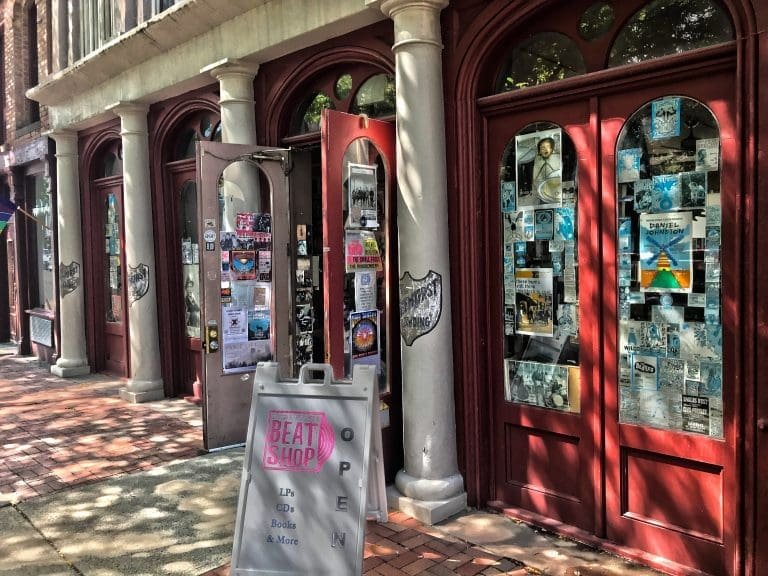
River Street Beat Shop
Spill’n the Beans Coffeehouse & Bistro
Brown’s Brewing Company
Collar City Sweet Shoppe
Troy Music Academy
Mudaddy Flats
Dinosaur Bar-B-Que

The Daily Grind (Troy)
The Ruck
Nighthawks
Prism Glassworks
The Shop
Rustic Barn Pub (Spiegeltown)
The Ale House
Troy Grooming Company
Slidin’ Dirty Troy

Kennedy’s Tavern
Troy Beverage Center
HVCC

Around Troy…
American Legion Post 1489
Carluccio’s Italian Delicatessen
Deli and Brew
Full Effect Tattoo
Alexis Diner
Rocky’s Music Studio
Villa Valenti Pub
Tipsy Moose Tavern

Junior’s Bar & Grill

Watervliet
Arsenal City Tavern
The Black Bear
Bob’s Diner
Patrick’s
Muddy’s

Waterford
Corcoran’s Towpath Tavern
Chrome Food & Spirits
Don and Paul’s

Port of Call Consignments
McGreivey’s

Cohoes
Smith’s
Spindle’s Wine Bar
Tugboat Tavern

Cohoes Bowl
Island Wine & Spirits

Latham/Colonie
Spare Time Latham
City Sports Grille
Dinertime
Ring Around the spectrum
Top Custom Jewelers, Inc.
Galleria market 7
Chops and Hops Meat Market
Professor Java’s Coffee Sanctuary

Halfmoon/Clifton Park
Halfmoon Wine & Liquor
Spare Time Clifton Park
Wicked Eatery Pub and Entertainment
Grecian Gardens Pizza & Restaurant
Halfmoon Diner
Clifton Park Pizza Shop
Parkway Music
Fred the Butcher
Savemore Beverage

Legacy Tattoo
Jade bistro
Payettes Music
Peddlers Bistro
Uncommon Grounds
Ravens Wood

Saratoga

D’Andreas Pizza
Caffe Lena
Esperanto
The Bourbon Room
Saratoga Hookah
Lyrical Ballad Bookstore

Schenectady

Wolff’s Biergarten
Isopo’s Pizza
Katie O’Byrnes
Amtrak
Boulevard Bowl
20 North Broadway
Happy Cappucino

Delmar

First Care Urgent Care
Four Corners Pharmacy
McCarroll’s Butcher
O’Slattery’s Pub
Perfect Blend


Sandy McKnight – Clef Notes

0

The modern world, in many ways, is a created thing. Not getting religious or philosophical, just saying that every graphic, every jingle, every eight-thirty a.m. pre-work cranker was created. Yes, yes, your favorite band, but more than that; the world as we know it is propped up by names that appear in the liner notes of history.

Sandy McKnight is a personality in his own right, but just like the iceberg that sunk the Titanic, most of his accomplishments are beneath the surface. His past experiences in the world that props up the cool one is best told in volumes.

Today I sit down with Sandy and discuss the state of creation and other fun things.

RRX: I love your videos. It’s funny how they shape the perception in a way, like those who watched the Kennedy-Nixon debate thought Kennedy won, but those who only heard it thought Nixon won. That said, would you rather someone come across one of your videos first, or the song for that video first?

SM: I’d rather they make the videos!  It’s very time-consuming, and not what I want to be doing.  But, having said that, I recognize that in today’s competitive music scene, one must share their vision on as many levels and platforms as possible.  And for the techies out there, I use freeware to edit, and, like any limited tool, it forces you to be creative in different ways, like George Martin and the Beatles with Sgt. Pepper.  In fact, at one point, I linked 2 computers together, cut the hard drives into tiny pieces. flung them in the air and reattached them, changed the speed on one, and…

RRX: To bounce on the music videos again (sorry, I love videos,) you’re composition, with that vintage forties-fifties footage mixed with modern film cuts, interspersed with the playing; it just complements the groove that I hear in your songs. I mean, some of that footage is just out there. Is there a story or a method to the cuts, and how they fit with the playing?

Sandy McKnight. All images provided by Sandy McKnight.

SM: Thanks for your kind words!  When creating a new video, I try to envision a narrative concept that expresses the subliminal as well as the ‘liminal’ (is that a word?) meaning of the lyric, along with the musical vibe, and then find ‘found footage’ (as opposed to losing it) online that I can steal utilize creatively.  Rhythmic synchronicity occurs mostly by accident, or maybe due to some inner mechanism I don’t fully understand.

RRX: You wear a lot of hats, and you’ve been everywhere. You can throw a sessions crew like a dispatcher can send out cabs on New Year’s Eve. I think most people know that musicians aren’t exactly Buddhist monks. Creative people in general have big personalities. So how do you wrangle all the stars into working constellations?

SM: Well, the hat thing started when I developed a bald spot in my 30s.  But, all seriousness aside, I wear hats out of necessity, not egomaniacal-ness.  When I started out recording, I was offered free studio time in a great facility in Brooklyn.  So, being broke but with a wealth of free opportunities, I learned how to make records.  I eventually learned the art of producing, though much of the craft still eludes me…I really don’t care about knobs and meters (or waveforms and virtual sliders, for your younger readers). I’m old school in the sense that it’s my vision that clients pay for, not my technical expertise.  I figure techies are a dime a dozen (although really good ones are rare), but visionaries can always find a gig. 

As far as having been ‘everywhere’, again it was only because I wasn’t making much headway in New York, so I tried London, and when that didn’t work I tried L.A., and so on.  Persistence is even more important than vision, in terms of eventual success.  In terms of stars working with/for me, I’ve been lucky to have access to some of my favorite players through the years.  The trick, once you get them, is to not keep them hanging around too long.  Have an idea before you enter the studio, and ask them to realize that vision.  It’s usually a pleasure working with great musicians, because whatever you can hear in your head is bound to be even better when you put it in the hands of skilled players. 

If I may drop a few names, I particularly loved working with Graham Maby, my favorite bassist, and John Platania, who is Van Morrison’s guitar guy.  Some time, privately, I’ll tell you which players I didn’t enjoy working with.

RRX: Sandy, you’re such a high-output person. Over five-hundred recorded songs, writing, directing, graphic design, radio, labels… This list doesn’t really do justice. I’m nowhere near where you are, but I understand the urge to branch out, both in expression and vocation. What area is the “hat you wear,” and what areas are the pins on that hat?

Sandy McKnight (on the left)

SM: If I understand your question, my real thing is songwriting.  Everything else I do comes from that. Producing, because, as I explained earlier, I had to.  Writing musicals was a way to find new outlets for my songwriting.  Directing my own TV series ideas, which usually have a music component, was also out of necessity.  I even became a radio DJ in the late 80s, thinking I might find some satisfaction curating music soundscapes.  I started ‘22 records’, my label, in order to learn the biz from the inside out.  I got into graphic design because I didn’t want to pay for visual ideas I wasn’t in love with.  The only exception to the songwriting connection was when I started writing sketch comedy.  I did that because I’m just a goofball.

RRX: This question piggybacks off of the one above. Being multi-focused doesn’t necessarily mean you have a video-recording memory. We have devices, tricks, whether they’re notebooks or computer programs, or they’re some daily schedule. Would you care to, if not reveal you’re organizational toolkit, at least explain a thing or two that might help someone else?

SM: Sorry to disappoint, but I have no organizational methodology whatsoever.  Because of this weakness in the lobe that controls those talents, I’ve had to learn new methods to realize my visions.  For example, most film directors storyboard, do a shot by shot breakdown of the script, etc.  I have no patience for such structure.  And so, I’ve learned how to use other tools, like instinct, fearlessness of failure, and collaboration.  In the studio, I often rely on engineers who aren’t afraid of trying unorthodox approaches to recording. 

Depending on the project, I gauge my approach by my sense of what would work for that particular artist.  Some artists want a lot of input, while others simply want to have me around to communicate to the engineer, or to coach vocal performances, or tell them how great they are.  Since they pay me, it’s their call.  I don’t force my vision on anyone, but it is important to have an idea at the ready, even if it isn’t used in the end.

I’ve also been around enough well-organized people in the arts to have gleaned some techniques from watching them be methodical.  Having that framework in my head, even if I don’t follow it strictly, allows me to be a little more fearless when winging it.

RRX: We live in a world that’s struggling to catch up to the rapid advancement of media. Somewhere I heard that the human brain hasn’t evolved much past the hunter-gathers, yet we have virtual reality about to go big. In your experience as a ‘one-stop-shop’ creative, do you ever see the strain in what we can do creatively versus what we can appreciate creatively?

SM: I feel lucky to have experienced the creative freedom of the 60s, as a listener/audience member.  The beauty of that time, when no rules were being obeyed, influenced my approach to a great degree.  People like Frank Zappa inspired me to take chances.  He used the latest technology, but seemed to always have his own way of using it to present his unique vision.  His mix of ambitious arrangements, non-conventional composition and instrumentation, and his willingness to be serious about not taking himself seriously, all taught me that art is not a science.  In fact, most technologically-driven projects bore me, whether it’s music, film or whatever. 

One of my favorite movies of all time is “Putney Swope”, a 1969 film by Robert Downey Sr.  It is one of the sloppiest, most chaotic, and weirdest movies ever made, but it’s got that ‘vision’ thing, and I’m a sucker for that more than anything.  Is Ringo a great drummer?  No.  Is he one of the best drummers in rock history?  Yes.  See my point?

RRX: At this point, I like to give you the chance the answer any question that I didn’t ask. Anyone you want to recognize? Any projects you have on the horizon? Smoke ‘em if you got ‘em.

SM: A few shout-outs, if I may…Andy Gregory, the patron saint of local music, who cares about it more than some of the musicians do…Liv Cummins, who makes me a better artist by making me a better person…and to all the people I’ve disappointed by my stubborn pursuit of this ‘dream’, in lieu of my ‘potential’, as they saw it.  It’s something all creative types must come to grips with…most people don’t take your work seriously, even if they love and admire you.  They just don’t get it.

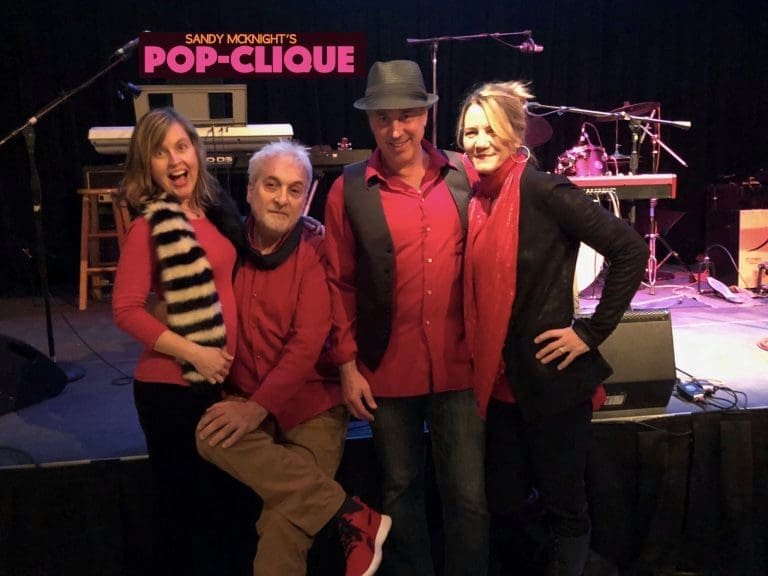
I have, as I always seem to, a half a dozen projects I’m excited about…two music projects, Pop-Clique, my acoustic pop band, and Wow and Flutter, a 70s music project that attempts to not merely imitate the am-pop sound of the time, but actually inhabit the genre.  I’m having fun producing “24 Minutes From Blandford”, a TV variety show that airs on PCTV in the Berkshires, and am keeping busy producing records for Mark and Bonnie Parsons, Dave Rhodes, and other local artists. 

My back-catalog is getting some action in movies and on TV.  I’ve started writing a memoir of my adventures as a 15-16 year old in 1969, which I think would also make a good movie script.  The songs keep pouring out, and I keep recording them, for no clear reason.

Lastly, an answer to an unasked question: the Treaty of Versailles.


Jimmy Barrett – At the Beat Shop

0

Jimmy Barrett is a man of many talents; business owner, musician and radio host, and I’m sure there’s a few things I’m unaware of. I met him in the River Street Beat Shop, a magical place, not just a stop on a musical destination, but a destination itself. It’s launched several bands that have found love in the 518.

In fair and full disclosure, Jimmy does a show on RadioRadioX called “Kaleidoscope” that airs on Mondays from 8 pm to 10 pm. But don’t worry; the questions are still right down the pipe.

I sit down with Jimmy on a blustery cold day and ask, ‘How’s tricks?’

RRX: Jimmy, I love the Beat Shop, and I find it hard to believe that anyone wouldn’t love it. But it’s more than the offerings; it’s a conversation, between you and your customers, and between the customers and each other. For you, is it purely the musical passion, or is it also the chance to connect with people generally?

Oh, it’s absolutely both. I mean music drove me; I’ve always been a music maniac since I was a kid. When I was four years old, I had a crystal radio set. So the music has always been big. But I also like people. I’m not a distant person. I don’t keep my distance, I enjoy engaging in conversation with customers and particularly musicians who spend a lot of time in here. And they’re very hip to the kids too, the younger music lovers, these guys and ladies talk to these kids and have a lot of fun, invite them to their shows, and say “pick up my record” … it’s pretty intriguing, a lot has changed for the better.

RRX: A lot of bands have gotten their starts the Beat Shop and have played in there. So the Beat Shop is really a spot on the scene. I’m all about hearing stories, and you’re all about telling them, so do you have a funny story about a band that got their start in the Beat Shop?

Photo by Kate Larson.

Well I’m not so sure “funny” but we’ve had some disasters, we’ve had some bands that weren’t quite as advertised that were like a train wreck, but were fun… Basically, for the longest time we would let anybody come in that wanted a crack at playing, anybody that put a CD out got the opportunity to play. Then we had some bands that became really popular, like Big Frank and the Bargain Bingers just got so, they are so good now. And the Mysteios, who morphed into… Johnny’s band now is called the Va Va Voodoos (Johnny changes his name quite often.) And personal pride in Off The Record, who are more of a theatrical rock band than they are a rock band – they’re a show; it’s like a theater presentation. So we’ve had so many wonderful people, Sarah Pedinotti and Sean Rowe, and so many great people have played here.

But to me just as much fun are the ones who put a cassette or CD out and didn’t do much but they got to play live with their friends and they had fun and they still have fond memories. It doesn’t matter to me who makes it or who’s doing really well, it matters to me who’s having fun and still getting the fact that playing music live is a real blast. So, a little of both.

RRX: And what interview would be complete without a question about vinyl? You carry a lot of it. And talk is there’s a resurgence. Other talk is that it’s a hipster fad and it won’t sustain a market. What do you think can sustain a resurgence in vinyl that wouldn’t be true for, say, cassette tapes? What goes beyond the fad of it?

I don’t think it’s a fad at all. I think it’s been going on for five or six years. It’s at a recent all time-, a large portion of our sales are vinyl, to be honest with you. And the kids are really hip to vinyl. But they’re not faddists; these kids are all in. This isn’t flavor of the month; I’m not getting that at all. The older fans are coming in because they’re replacing their favorite records of all time, and they’re talking to these younger music fans.

They’re really interested – I think they’re tired of America shoving this crap down their throats and convincing them they have to buy this or that, or they have to get mp3s or other sources. And by the way, there’s a resurgence in CDs also because the stores pretty much decided no one wants CDs. Well, we know better, we know people do want CDs. If you’re someone in your sixties, and you’ve been collecting CDs for years, you’re not going to stop. So if they don’t want to sell them, there’s another avenue open for sales. We take pride in having a lot of rock and roll, blues, jazz, punk, reggae – we have all that stuff available here, and very cheaply on CD. So there’s a whole new market. And they love coming in and going through. They’re surprised that we think this way, but it’s common sense. I’m not a rocket scientist. I have my ear to the ground; if you listen to your customers it’s not that hard to figure out that good things are happening in music.

That said, it’s a lot of work; it’s nor for everybody. You have to be willing to sit here on a day like today with nobody out, and hope somebody comes through the door, and other days, there’s a deluge, so… it’s not for the timid. You gotta be a believer, and I’m a believer and my son’s a believer. So we know that hard work always pays off.

Not to mention that the online service is really the way to go. We get a lot of great records here, but some of those we sell online to pay our bills. That opportunity is there.

And radio is basically no help at all, except, and I work for this place, but places like RadioRadioX push the heck out of local bands. Every hour those guys are playing local stuff, and the local bands love it. They get a chance to be heard. So major radio is dead. And a large radio station – awful, they have no imagination, and even college radio has gone to hell, Which used to be a hotbed for great news music. College stations are playing the same tripe you can get on an FM station. They’re following instead of leading – college radio are in big trouble. Stations like this are the new cornerstone of music. These are the people, like RadioRadioX, that will matter down the road if people will support them. It’s not easy to convince people that is the way to go, but it is.

RRX: You are a Lawn Sausage. You’re also in a band called “The Lawn Sausages.” What do you play, who are you fellow “fresh” Lawn Sausages, and what’s the Lawn Sausage flavor?

Photo by Ed Conway.

Well, I’m proud to be in the Lawn Sausages. It started out as a bet with one Tina Ward and her band, The Matter Babies, who said there was no place to play, and no one would support local. And Artie and I, and our friend Paul, and other, like-spirited individuals, said we could fill a club in two weeks, even write and make a CD at the same time, and the bet was a case of beer. So we made the bet, and we got a few friends in, and we bought keyboards and a couple microphones and a couple of speakers and we pretty much “make-shift” created a set of music.

Hilarious, and I thought it would be awful, but it was really crazy funny. And we played at this place called Billy’s on Broadway, and we filled the place. It was a total three-ring circus and people went nuts. We dressed in these outlandish outfits – we barely knew how to plug in let alone play – and something was going on, some zest, something we were doing was right because people were screaming and dancing and laughing, and we come out swinging. We just hit it right away, and we really haven’t changed that much through the years.

We tend not to play as often now, being a novelty band, we like to play three- or four times a year just to keep it fresh. But we do like to get together to practice a lot. We enjoy each other’s company, all of us. We’ve got great musicians, we got Rob Skane and Mark Emanation, Charlie Clifford who’s a monster drummer, Paul playing rhythm guitar, Johnny Mystery on bass, and Artie and I on “dog howling” (I’m the cat, he’s the dog.)

But it is a change, it’s fun. Our whole thing was to send up local music, because at the time, bands were taking themselves so seriously. And we’re not capable of taking ourselves that seriously. Our songs are raunchy and funny, and they’re just profane, but people laugh – we love it when we go to shows and people are singing along, they know all the words. Sophisticated people love trashy songs once in a while.

We’re having a blast. We’re playing some shows. We have a CD coming out called Appetite for Dysfunction, I think it’s gonna set people on their heels. I’ll say no more about it at this point. Artie’s handling that, but it’s quite remarkable. So yes, to answer your question, I am a Lawn Sausage. It will probably be on my tombstone.

RRX: Between the Beat Shop, the Lawn Sausages, and your long-standing radio program “Kaleidoscope,” you’re all-in on music, which is different from even some of the bands and players that you like? Do you think that musicians that are “all-in” bring something different to the art than people who are drawn to it as an escape from the nine-to-five?

I don’t agree with the question, Liam. I think if you’re in a band, you’re all-in anyway, cause you’re gonna work towards a goal of playing out and having fun. I think you’re talking about cover bands versus original bands, and in that particular scenario, I would always prefer the original band even if they fell flat on their face. I personally have more respect for a band that will go out and play all their own songs rather than the same Top 40 songs that everybody’s playing out there.

I prefer original bands, I think it takes a lot of guts, and sometimes they’re astounding. Sometimes these original bands are great. I don’t have a problem with an original band playing a few covers, that’s just common sense, as long as a big portion of their set is original. I’m happy, as a patron, to go support that. So, “all-in;” I think everybody’s all-in about playing. When you’re buying your gear and rehearsing and throwing it in a car, dragging it up a flight of stairs, play for twenty-five people in a Thursday night God-knows-where, then you’re all-in, and if you’re playing original, all the more power to you. So, I dig both, but I have a slight preference for original bands.

RRX: Art and music have so many applications in other areas of life, but it’s not always seen as a worthy pursuit. What do you, not only as an audiophile and musician, but also as a business owner, have to say to the parents of a talented bass player that says to him, in your shop, “there’s no money in it?”

Well, there is no money in it. That’s a fact. You gotta be so lucky to make a living – if you’re going to support yourself with music, you’re going to have to be available 24/7. You’re going to have to take on some whacky gigs. You’re going to have to be more than willing to swallow your pride sometimes and play a Legion dance and a Christmas party at one o’clock on a Sunday morning at the Elks, and if you’re going to do that, God bless ya’. But if you’re going to go out and have fun playing music, then you’re talking – that’s something.

So I would never discourage a person from being in a band, or doing it, but I would caution them that it’s not a great way to make a living. It’s clearly, for most, not. I can think of some exceptions, one being Mark Emanation. Mark Emanation has a terrific attitude. He has a great job in social justice, I have a lot of respect for Mark. I have a complete respect for his candor and his honesty about what he does, and that said, he raises a lot of money for fabulous causes. And he plays in three or four bands, he’s one of the area’s top musicians. He’s a first-class guitar player and a really accomplished singer-songwriter. He’s one of the exceptions that’s been able to do both. So he’s got a career and a music career. He does a lot of original stuff, so he’s kind of the top of the pyramid for me.

He’s where I think most in the area would want to end up, having a job, a nine-to-five that they like, that they’re getting something out of, and be a musician. More power to them for that. But there’s nothing wrong with playing music for a living, as long as you’re understanding and accepting that it’s going to be a rough road. If that’s what you want to do, it’s better than doing something that makes you miserable. It’s still better to be out playing and having fun.

I think it’s an age thing too. I think once you get around thirty, a little bit older maybe and you know, it’s just not gonna happen, then you gotta be sensible, maybe find a job, nine-to-five, get your truck driving license or something, and support your gang, and for your own sanity, still stick around the music scene. But bring home a salary. Be a working man or woman. Go out and earn your fair share and try to keep your career alive.

But don’t set your goals so high you can’t get there. You gotta be smart about it. Not easy – some of these kids are real dreamers. God bless them, we need that. Just don’t let yourself get too disappointed. A lot of sad things happen out there with these kids who believe. Not many make it, because not many of them are.

RRX: Last one is the family question. Not the dinner table family; the string-strumming, beat-blasting, horn blowing family. You, above many people, know who we should be looking out for locally. So, names, aliases, whatever you got; who should we BOLO?

Photo by Brian Goodman.

See I don’t play favorites when it comes to bands and artists. What I believe in, Liam, is support the venues. If you support the venues, you are supporting the bands. And some regional things have been really happening lately.

River Street Pub has been putting on some great shows. For years, they just had cover bands, but now they’re bringing in a lot of original music, which is great. The Rustic Barn in Troy is doing terrific stuff. They just had a great benefit up there, Foodstock, that Mark Emanation ran for the food bank, which was terrific. Then you have places like the Hangar, which has become my favorite place. A part and parcel to the Ale House, where they bring in incredible original music, and national bands, The Blasters and The Fleshtones and The Supersuckers – they just bring it. Billy Joe Shaver, I mean, Joe Ely; it’s crazy what Brian Gilchrist and his daughter Molly have brought to the table.

Then you have places that are always supporting, like Brown’s has bands all the time. Cohoes Music Hall has been bringing in some great shows, a little more comfortable venue, brought in some great people this year. My God, they had Tower of Power, Rickie Lee Jones last year. Then you have places that you know you’re gonna hear something interesting, you just trust the management. For example, the Low Beat is great. Pauly’s Hotel, with Jay Crack bringing in all kinds of fun stuff. Sometimes you can go into either place, you pay one admission, you can go in both places.

Another thing I like is that there are some young promoters who are really getting busy. One, for example, is Sean Secor, who has this thing called ‘Hey Greasy’, and he kind of has an affection for country-based rock and surf stuff. He’s bringing a show to the Hangar the 31st of this month, with Daddy Longlegs, pretty much the most exciting band I’ve heard in years. Just an out-of-this-world jump blues band. And we’re modestly helping with that show with a little advertising. I just think, wow, this kid’s working. And there’s a lot of them; he’s far from the only one. He’s a personal favorite on this side of the river, we like this guy. He’s working hard.

And none of it gets done without places like RadioRadioX, who are huge on local. They don’t stop. And their support of local music is huge. And it’s critical to the success of these clubs. So I don’t support individual bands. I support the clubs that take care of everybody. Then your band will find a place to play. So throw your support behind local clubs. Go once a week, they’re affordable. You won’t go broke.

Be sure to stop in to the River Street Beat Shop, 197 River Street, Toy, for all your music needs, or just to say ‘Howdy.’ Support local music, and sure to sniff the ground for the Lawn Sausages next CD, Appetite for Dysfunction.

Off The Record Trio – Rock ‘n’ Retro

0

Music is life. It encapsulates a moment, and a note or two of a familiar song can draw up our best days, sometimes our worst. It is the soundtrack to our dreams, the strength in our footsteps, and it makes me proud to be here once in a while, giving credit due to the people turning the knob up for us all.

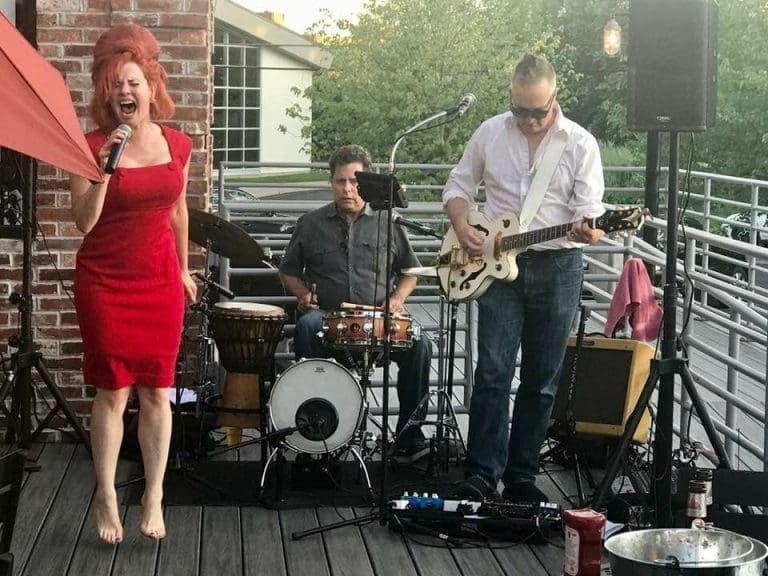
Off The Record Trio is a vivacious exploration of the words ‘classic’ and ‘retro’ that Singer and frontwoman Joanna Peterson Palladino-Resnick, Guitarist Geo Doody and percussionist Bob Resnick lead with unparalleled energy and fearlessness.

I sit down with Joanna to discuss the finer points of time travel.

RRX: I first saw the Trio play at the RadioRadioX open house. What impressed me was the energy you were able to project out into the crowd. It reminded me that, in so many ways, music is a visual performance as well. Can you comment on how the Off The Record Trio blends sight and sound when the lights go on?

JPR: OTR definitely has a point of view or “look” but our performance does go beyond the red beehive and vintage clothes. At the crux of it all is just a simple passion for the music, and that ends up propelling our entire show. I think there’s authenticity to what we do- which is ironic since we are decked out in 60’s inspired garb with our show personas. That passion and honesty resonates with the audience and we feed off of that as well. Next thing you know, I see video footage of a show and had no idea we were moving and shaking with so much ferocity!

Off the Record Trio. Photo by Stef and Rob's  Wedding Photographer
Photo by Stef and Rob’s Wedding Photographer

RRX: You all play such a range of styles, very rooted in the ‘60s. Rock and roll, soft rock, pop, jazz… and everyone in the band has such a versatile repertoire. So I must ask; will we ever see some Off The Record original vinyl (Because we all know it would be cut in vinyl)?

JPR: HA! It’s funny. I always see our band as a cover band but other bands are always telling us to write our own music and that it isn’t that hard. I don’t know. I have incredible respect for songwriters and don’t profess to be one. I do imagine that if we do, it’ll be a collaboration with some of the area’s best pop songwriters (like Jeff Sohn), and then from there we’ll see where life and skill development take us. Though Bob, our percussionist, has written an original song- so maybe we’ll cover that first. (smile) Either way, this is great food for thought and I should chat with Geo about this. In the meantime, I think we are going to release a CD of 8 or 9 of our songs we just recorded in the studio with John Chiara. (But now I am thinking that maybe it should be vinyl.)

RRX: Working good covers is a difficult task. Bearing in mind that music is the metronome of history, you have an amazing opportunity to revive cherished moments in people’s lives. On the other hand, screw up one note, everybody knows it. Can you comment on how you select what moments you want to bring to the stage – what songs, what anthems?

JPR: I feel that pressure right before a show- but I have found that audiences can be quite forgiving. Bob always says that there are hundreds of good songs out there, so why torture yourself getting one perfect, when you can select one that is more suited for your own style (voice, range, instruments, band make-up, etc.). We start off seeing if everyone in the band likes the song. We all get a veto chip- where if 2/3rds of the band loves the song, but for some reason you really dislike the song, you can use your veto power and we don’t do the song. That’s rarely, if ever, happened.

Each song should make sense for us: Does it stand the test of time or if not, is it at least humorous or fun? Does the song tell a story and is it a story we want to share? Is this song so iconic and our arrangement and orchestration will do it no justice? There have been songs that, because of the lyrics, we haven’t done. Some of those old 60’s songs really perpetuated some intimate partner violence or abusive relationships and it’s just not anything I personally want to promote.

From there, Bob actually does the set list, with input from the band. At the actual night of the gig, all bets are off- we really try and respond to what the audience wants. Are they into a show or do they want to dance? Should we skip the ballad and replace it with a song with a dance groove? Every once and a while we do have to slow things down for a moment or two so I can catch my breath, regroup, and then power through the rest of the show.

RRX: Now you have a theatrical background, which shows for anyone who has caught Off The Record Trio’s act. The theater scene and the music scene seem fairly insulated from each other, but it seems like there’s probably a lot of connective fiber they share. What do you think each scene could learn from the other?

Joanna Palladino-Resnick. Photo by  Thom Cammer.
Joanna Palladino-Resnick. Photo by Thom Cammer.

JPR: I think committed artists are always learning, and stealing, from each other – across all art forms. I know from the theater perspective, music and sound, are integral to a play or a performance and that the theater has always been deeply influenced by music (look at the Broadway musical). I have often felt that musicians, especially front men and frontwomen, understand that the theatrical, the physicality of telling a story and the connectedness with the audience, is an important aspect of their performance. I think of people like Roger Daltrey, Robert Plant, Janis Joplin, Cher, Nico/Lou Reed, etc. – they all understood this. Sometimes the theatrical may not be in the performance, but may be in the “script”- it’s amazing how an incredibly written song holds its own- regardless of who sings.

Not all songs can stand on their own though, and a performer can really bring new life to the song. The wonderful thing is, much like a script, each performer has the ability to interpret the song differently. I always say there’s a thousand and one ways to cook chicken and a thousand and one ways to read (or sing) a single line. So much opportunity and so much variation available and this keeps music, and theater, fresh.

I think we have learned a lot from each other already. Though if the theater community could continue to appreciate the simplicity of a short 2-minute 60’s rock n’ roll song- that would be great. And if the music community would appreciate a show’s actual start time, versus rock and roll time, that would also be cool. I am sure the audience would appreciate that too. I always hear, what time are you really starting- and it cracks me up. In theater world, it drives us crazy to hold the start time and wait for the house lights to go down. An 8 pm show – means an 8 pm start. That’s not always a shared value in rock and roll land. 

RRX: Woodstock. The big Five-O. Two festivals; one, Watkins Glen, Michael Lang, one of the original organizers, versus Bethel Woods, the site of Yasgur’s Farm, the original location, by LiveNation. They both call Off The Record trio and want you to play. Are you all heading west to Watkin’s Glen, or south to Bethel?

JPR: I have to go to Bethel. Not only is it closer, but historically more women played at Bethel than at Watkins Glen – so I think we’d fit better there. OTR is more Sha-Na-Na and Sly and the Family Stone and less the Allman Brothers (though I love the Allman Brothers). And Watkins Glen happened in 1973 and Woodstock was 1969- a little more our speed.

RRX: I like to ask about influences, because most of the bands we’ve had on are working solely off original songs. So, maybe a twist; in ‘60s music, a lot of unique sounds have been brought up by uncommon (in America) instruments. And you all don’t just rock a three-piece yourselves. So can you name an instrument, something off the beaten path a little, that has influenced your sound?

Off The Record Trio (l to r) Bob Resnick, Joanna Palladino-Resnick, Geo Doody.

JPR: Good question. What 1960’s rock and roll lounge band do you know that plays with a djembe and a converted tom-tom as the bass drum? I think our sound, and music selection, is heavily influenced by percussion and that makes our band sound just a little different that other 60’s bands out there. We aren’t replicating the music necessarily- we’re playing it slightly differently so we tap into nostalgia but are deeply rooted in the here and now.

RRX: Lastly, it’s shout-out time. Anyone out there, original or cover, that’s caught your collective eyes? Anyone maybe a little undervalued, unsung, under-recognized that you’d like to flick a lighter for? Also, do you have anything coming down the pipes that we need to put on the calendar?

JPR: We owe shout-outs to so many people who have supported the band over the years. Our triumvirate of support: Frank Nvoko from Big Frank and the Bargain Bingers for helping us find our first venue for our very first gig (one of the most generous guys out there), Artie Fredette (now of RadioRadioX) for booking our first gig at Bat Shea’s, and Jimmy Barrett from the River Street Beat Shop in Troy for always promoting the band or giving us a place to perform. I also have to give a shout-out to some of the awesome female led bands out there- but especially two of my favorites- The Big Takeover and Kitty Rodeo. You have to check them out.

As for upcoming gigs—yes!!! You definitely need to put the Second Chance Prom at Il Faro Restaurant on your calendar- January 26th 7 PM. Don’t put it on your calendar- go and buy tickets before they are all gone. It’ll be a riot- dress however you want (throwback, vintage, modern), eat tons of great food, and dance the night away. It’ll be a blast- dinner and a show for $60 a couple or $40 a person. You can’t go wrong. Check out our Facebook page or website for other gigs too (Indian Ladder Farms and the University Club)— but you don’t want to miss the Prom. (Especially if you hated, or missed, the last prom- it’s your chance to reframe history.)

Peggy LeGee – Moochie the Dumpster Kat

0

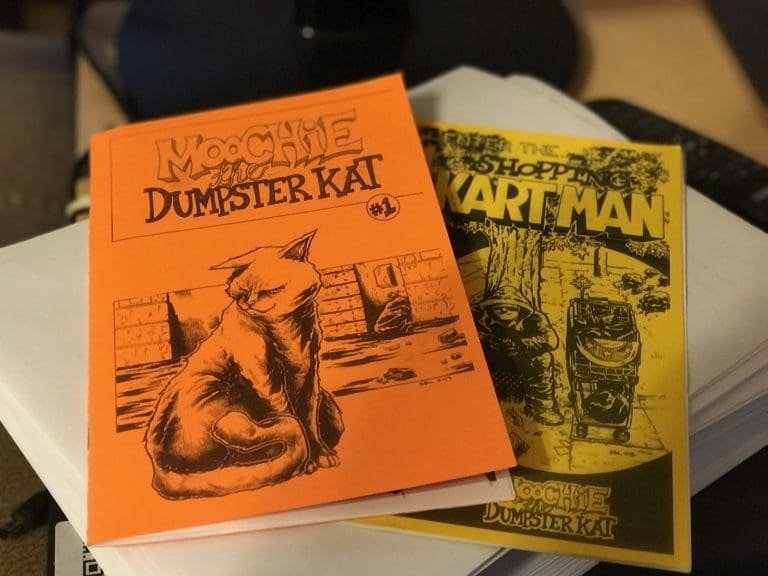
I first met Peggy LeGee at a show in Troy. We talked music, art, writing, and the local scene, which she’s been a huge supporter of. Then she went to her car and came back with two comics, Moochie the Dumpster Kat, which was issue one, and the second issue, Enter the Shopping Kart Man. They’re on my desk next to me as I type this out, a week later.

Peggy and artist Raymond Lowell have created a revolution in orange and yellow card stock and are taking it to the streets. Drawing from her own struggle as a transgendered person in a culture that offers few friends and allies, Peggy is establishing a name for herself. We sit down with her to talk shop.

Peggy LeGee
Peggy LeGee

RRX: When I had Moochie the Dumpster Kat and it’s following issue, Enter the Shopping Kart Man, I knew I had something in my hand that was uniquely “here.” And after reading them, I can’t wait to get my hands on more. So let’s start with a simple question: who is Moochie the Dumpster Kat, and why do people need this story?

Peggy: Moochie is a metaphor based on a true experience! It is about compassion and selflessness! So often we do not help situations in this world esp when we are in a position to make a difference! We need Moochie The Dumpster Kat to show us that good if not great things are possible if we help others help themselves

RRX: You were introduced to me as one of the biggest local music fans in the Capital Region. Your resume includes such things as actress, model, comedienne, singer, dancer and, of course, writer. You’re also transgendered, and Moochie the Dumpster Kat is a work that comes from your realization and transformation. Would you like to describe that?

Peggy: Yes I do singing, modeling,dancing, comedy ,writing and love music! These comics encompass all of these elements! The confidence I have from my transformation from Paul to Peggy has opened up my mind to its unlimited creative potential!

RRX: Being transgendered in the Capital Region, as in most places, means being surrounded by people with strong opinions and maybe no direct experience with anyone who’s transgendered. In fact, there may be people who stopped reading this the moment they say the word ‘transgendered.’ What is something you wish you could tell the people who would’ve walked away from this article by now?

Peggy: Yes transphobia comes from ignorance from society ! People that run from me do not concern me ! The people who have talked to me especially those who never met a trans person have not been disappointed! My message to the people who will not listen is it is your loss ! We will not be silent or erased!

RRX: You’ve used you’re writing to create this badass comic to help express what you go through with your gender identity, yet I feel that Moochie is going to be so much more that one perspective, or any one thing. What do you want people to walk away with after they read the two issues you have now, and future issues?

Peggy: These comics are expressionistic in nature! I try to create feeling and emotion by abstract techniques such as limiting dialogue and existential poetic wordplay! Raymond captures this brilliantly with his highly detailed illustrative genius!

People that have read it multiple times have seen different nuances every time they read it! I leave it up to the reader to put their own experience in their comprehension of the story! Every comic will have a slightly different vibe to it, I have to keep the readers on their toes like my artist Raymond said! The third comic will have many surprises!

RRX: One of the things I like about Moochie is that it’s not commercial. No high-gloss paper, not the standard comic book size. It’s very punk rock, both in the art and in the composition. What is your game plan for getting it out there? Is there any guerilla marketing in your future?

Peggy: No, these zines are about the content not the package! There simplicity has-been cost effective, which allows us to raise money for charities like Humane Society. The Market Block Bookstore is the main vendor for this.

A hardcover edition of the first three comics was suggested by Raymond! I’m constantly promoting it and Raymond has it on his Deviant Art Stockmanray Website along with his awesome illustrations! I’d love to travel across the country and make it a phenomenon!

RRX: I really feel like there’s an insurgency of people who are struggling in this area, either physically or mentally, emotionally or economically, and the creative world is picking up on it. Moochie the Dumpster Kat is a superhero in this kind of world. Do you think there’s something about the struggles of life that are attractive to art?

Peggy: Yes, there is a hidden world of struggle in every age! The great creative minds will display this in their works! It shows us how to survive the hostile and unforgiving world we exist in.

At the local level we are very needy and the institutional versions of remedy do not always work ! LeGee and Lowell will give them back their heroes from the most unlikely characters!

RRX: We like to give our guests a chance to give shout outs to people, usually other bands. Since you’re here as a writer and artist, would you like to bring our attention to anyone else out there?

Peggy: Like to thank my family, Raymond Lowell, Becky and family, Phil Caizzo for bringing me to his Argyle Art Gallery where Ray and I met! The support of the talented artists there, The Troy Kitchen Poetry Vibe, D, Liv and Corey, Dan and Nancy and all the great writers of 2nd Sunday! All the local musicians. The Hangar, Artie and Liam from RadioRadioX, Stanley from The Market Block, Jane Wells Dave and Annie. and Moochie and everyone else that supported Raymond and I in our instant classic!

24 Hours Of Punk 1.31.19

0
Sick Fix 5th Anniversary @ Corpse Fortress

The response has been overwhelming more requests – Sex Pistols, Bad Brains, Propagahndi, Dayglo Abortions, Talking Heads,  The Disenchanted, The Ramones, GBH, MC5, COC, Negative Approach,The Stooges, Cro-Mags, Mischief Brew, The Descendants JFA, Girth Control,The Distillers ,The Plasmatics, Operation Ivy, Left Over Crack ,Noncompliants, 

…and Iggy Pop, Agnostic Front ,NOFX, The Orphans, Rancid, The Queers, DRI, 7 seconds, Bad Religion, Misfits, Social Dstortion , UK Subs , The Queers, , Germs, Green Day, Schreaching Weasel, Minor Threat, Blondie, GG Allen, RX Bandits, MXPX, The Vandals, Murphy’s Law Dead Boys,Blase Debris…

We are doing our best to get it all. Your input can be sent to info@pzf.rsq.mybluehost.me

Thursday January 31, 12:00am- 11:59pm 24 hours of Punk


Johnny Morse – Around the Block

0

Johnny Morse is a rocker’s rocker. There isn’t a bar or roadhouse in the Capital Region he hasn’t been kicked out of (or wish he had.) A fiery left-hand and the charm of an alley cat, Johnny mixes the vibes of Stevie Ray and Tom Waits, with a little overdrive and a lot of moxie.

I met Johnny a long time ago and have been following his career through the osmosis of social media. Through the ups and downs, twists and turns, accolades and long weeks, Johnny’s kept his cool on life’s little hotplate.

I sit down with Johnny and we shoot the shit about life, liberty, and the pursuit of happiness.

RRX: Johnny, you’ve been out a lot, asses kicked, names taken. You probably have a story about yourself and every musician we’ve had on here. When you first started out learning how to play, did you ever imagine that you’d still be playing now? And what do you think you would’ve been if you’d never picked up a guitar?

Johnny Morse playing outside. Photo by George Faz.
Johnny Morse. Photo by George Faz.

JM: I grew up in the projects of Cohoes, Always had a guitar, as long as I can remember. I never took a lesson and still have no clue what I am doing. I just try to play from the heart and with some passion. I will always be playing in some way.

RRX: You’re a fierce and fast player. I remember being shit-scared to have to jam with you at an open mic night one when I first met you, Kielty’s Emerald Isle in Waterford, I think. Who were your guitar heroes, growing up? Who were they when you were picking up your chops? And who were the ones who played different instruments?

JM: I’ve always been a fan of Jimi Hendrix, of course, and actually, Jose Feleciano was an early fave and Chuck Berry, Rory Gallagher, and a few of my idols I got to do shows with, like Robin Trower, Pat Travers, Micheal Schenker, etc.

RRX: I’ve heard you live more times than I can count, but I think I’ve only sampled bands like Starstruck and the John Morse Band on digital. What are your feelings about going into the studio and laying down tracks, putting out albums?

JM: I am looking to get in the studio in the coming year to do some new original music, and I’m also looking to resurrect Starstruck with some new members.

RRX: I think there are differences in the outlook between someone who plays every couple of months in a band and someone who books out multiple nights a week. You’ve been both over the years. If you had to pick doing a big show every three months or ‘working the circuit,’ which one would you pick, and why?

JM: The so-called ‘circuit’ is nothing like what it was back in the day. I used to play 6-7 nights a week. Now, I’m lucky to do that many a month. All the cool clubs from my day are long gone and people just don’t go out like they used to.

RRX: I know that you had, and maybe you still do, an impressive guitar collection. What are some of the treasures one would find in your house? Are there any six-stringed lost loves you’ve had to part with that you’re looking to snap up should you ever find them again?

JM: I got rid of a few guitars. I had a nice Korina Flying V signed by Pat Travers that I sold cheap to Himer T Morgan. I think I am down to about 13 guitars my PRS custom is my main guitar and its beat to shit. I don’t really play guitar; I just kind of beat them into submission somehow, so my guitars are beat up. I’ve got a couple of Strats, Les Pauls and an old Ibanez semi-hollow body I’ve had forever.

Johnny Morse playing guitar. Photo by Judith Hawkins.
Playing the Blues. Photo by Judith Hawkins.

RRX: Your birthday bashes are legendary, and there’s one coming up April 13th at Chrome in Waterford. And Chrome has turned out to be a great venue for local music. What can people expect at your birthday bash this year?

JM: Yes, the Birthday Bash is always a blast, coming up again. Hopefully I will make it (hahaha.) April 13th, Chrome Food and Spirits. I am still working on the line up. So far I have the Collectors, a great acoustic duo, and also The Great Tom Atkins Band, working on a couple more. I also do my set, called Johnny’s Guitar Army, which is my band with a bunch of guitar guests. I’m still working on that line up, but it’s always a blast. We just get up and wing it an wail. It’s like a low-grade Generation Axe, only cheaper to see and none of us are Steve Vai or Yngwie (haha.)

RRX: I’ve mentioned the past a bit, but you’re still out here rocking houses. Is there anyone on the radio today, or someone you play with, that’s bringing something new to the blues/rock scene?

JM: I really don’t listen to new music much, still stuck in that past and discovering things there. There are some great upcoming bands out there. I saw the Marcus King Band a few weeks ago, very good. That Greta Van Fleet seem to have the spirit, if they can find their own voice and get a little away from the Zep’-clone stuff. There’s a twelve-year-old kid called Toby Lee who seems like he’s gonna do some great things. The young kids shredding on the internet are amazing but to me that just sounds like a bunch of mosquitos after a while. I am old, like, playing with feeling, not how many notes ya can rip, ya know, like BB King or Stevie Ray, not a big fan of the Yngwie stuff though. I do admire what he does, just not my bag. I just saw the Generation Axe show and it was amazing, but I think I went for a smoke during Ywngie’s set.

Check out Johnny’s band page: https://www.facebook.com/johnmorseband/ and his Reverbnation page: https://www.reverbnation.com/thejohnmorseband