

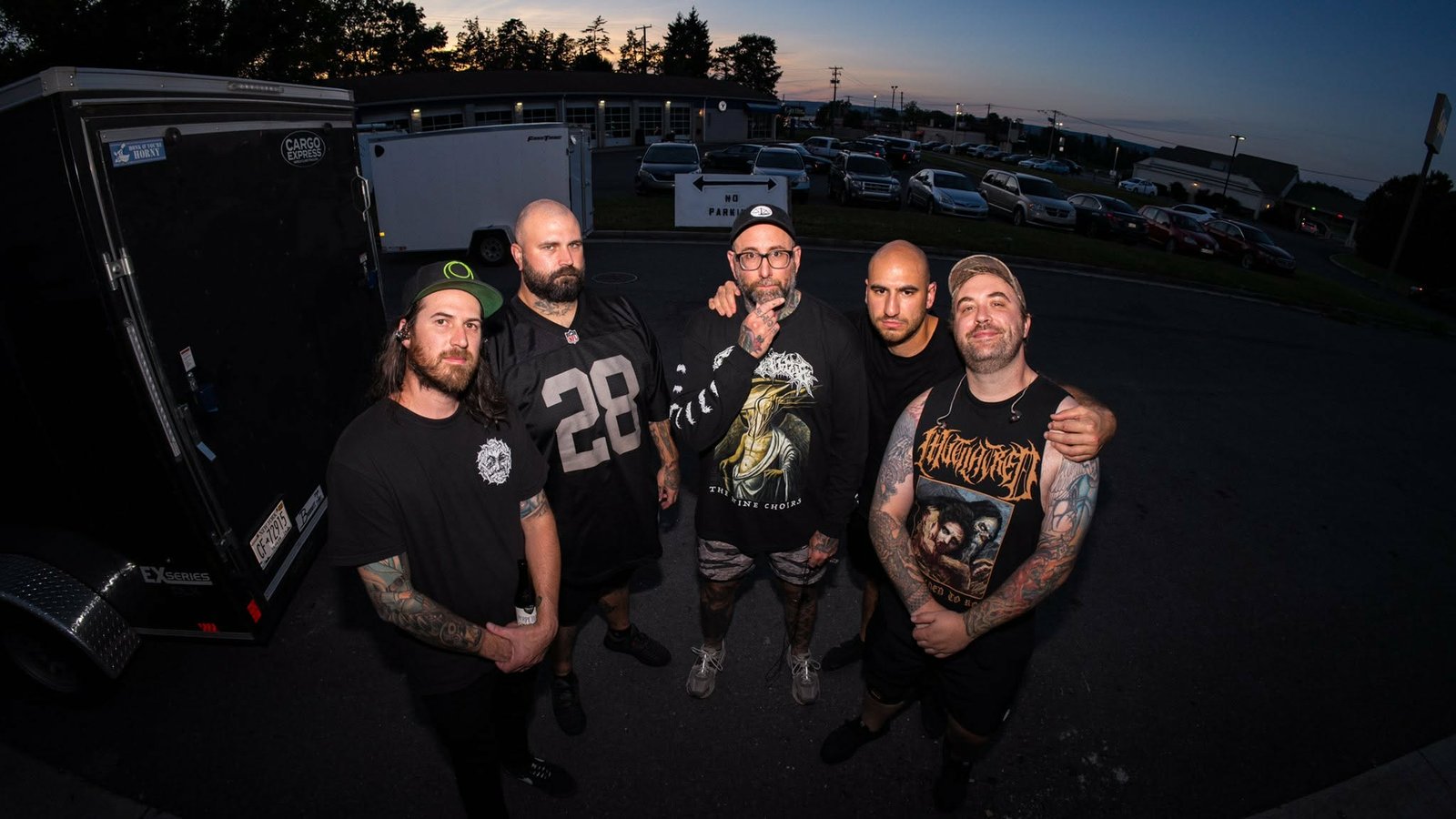
The Acacia Strain – An Xperience Interview – by BradQuan Copeland.
Scattered leaves crackle across the pavement as I sit in my car across from Kickstart Café in Schuylerville, NY. Rested beneath the sun’s gentle press, I’m greeted by the calm of the sky’s crisp breath. It’s 4:15 p.m., and cars steadily begin to fill the lot as The Acacia Strain’s lead singer, Vincent Bennett, puts the finishing touches on the listening party’s setup. You Are Safe from God Here is the heavy metal band’s upcoming album, set for release on October 24th. Though not well-versed in the genre, my openness to new sounds fixates my attention as I eagerly await the event’s start.
Exiting my car, I cross the street and slip into the slow-swelling motley line. Music brews in the background as I take in the scene: black hoodies, trucker caps, knitted hats, flannel shirts, sagging beards, dirty Vans, Garfield slippers, dyed hair, gauged earlobes flanked by piercings, and tattoos by the dozens. Light conversations simmer as 15-plus-year fanatics of the band anxiously await the session’s start. Local yokels and looky-loos pass by in laced boots and rumbling trucks, reeking of curiosity.
5:00 p.m. hits, and the line stirs to life and moves into the café’s lot. Two vintage Harleys sit on display beside a concession stand where a man in a black eye-cut mask is posted. Nearby, a small box-style TV with a VHS-DVD setup plays Casper the Friendly Ghost beside a library of tapes and a stash of merchandise: limited-cut vinyl, stickers, and glow-in-the-dark shirts. Heads knock to the pulsing tunes, and at the front of the line, a young boy, no older than six, jams out like he’s the only person in the world.
The atmosphere is electrifying! Deep, bellowing shrieks claw through the speakers, scraping at the crowd’s flesh with goth-painted nails. Faces scrunch in awe at the collision of punctuating cymbals and the blistering churn of monolithic bass lines that bludgeon the eardrums. In a live setting, a fight would surely erupt within a mosh pit of black-clad bodies, all jolting their fragile yet fervent hearts in frenzied unison.
Before I know it, an hour has passed. At the front of the line, I shake hands and snap a selfie with the personable punk himself, Vincent Bennett. We talk briefly about the band’s upcoming Albany show at Empire on December 13th, and he even agrees to an interview at a later date. Thrilled by the exchange, I head back to my car and stream the three available tracks from their upcoming album on Spotify.
With the windows sealed, I crank my Bose speakers to full blast and rip down the highway, locked into the murk of Acacia’s sodden swamp. The tracks blaze, and at the forty-ninth-second mark of Holy Moonlight, the breakdown seethes through my core. Suddenly, I’m entrenched in a heated Fight Club-esque duel: bloodied face, battered husk, salt-stung eyes, as the guitars shift into a sludge-laden guttural grind. The double pedal thunders against the crown of my skull, unleashing a primordial torrent that awakens the fury of ancestral hellions from the bowels of the netherworld. Without hesitation, I devour my opponent with cannibal callousness and stand firm, detached from divinity—hence the album’s title. This is art that scalds, like fine white lines to virgin nostrils.
Upon arriving home, I sit in my car for a long moment, letting my biorhythms settle before winding down for the night. You don’t just shake off this funk; you let it dissipate, give thanks, and recognize an experience beyond light. Needless to say, I’m beyond stoked for the upcoming interview and can’t wait for another face-to-face with Vincent Bennett.
A few days later, I met Vincent again — this time without noise, without a crowd, without shrieks. Just two chairs, coffee, and the magnitude of You Are Safe from God Here between us.
Interview with Vincent Bennett
RRX: So, I’ll be honest, I’m newer to your music, but curious all the same. What struck me right away was the sheer emotion behind it. For someone who’s never been immersed in this world, what do you want them to feel when they first hear The Acacia Strain?
Vincent Bennett: I want them to feel like they’ve found where they belong. You know, a lot of people struggle when it comes to finding a place. When you’re a teenager, you kind of listen to whatever—you listen to what your parents listen to, you listen to what’s on the radio. You don’t really have any real opinion on music yet.
When you become a teenager, you kind of find the stuff that you gravitate towards. When it comes to heavy metal and hardcore music, I feel like in punk rock, it’s a place—it’s a feeling more than music. Certain people who don’t know where they belong yet find this kind of music, and they finally feel like they belong somewhere.
There’s a lot of—well, I don’t want to use buzzwords like trendy or preppy—but there’s a lot of regular people in the world, and when you’re in school, you’re surrounded by that. You don’t have a lot of people who are just like you. So when people find metal or hardcore, they finally meet others who think like them, who like the same things, dress like them, act like them—it’s finally somewhere they can belong.
That’s exactly what The Acacia Strain is. We give people a sounding board, someplace to go, and we let them know they’re not alone in their thoughts.
RRX: Real community, yeah? Love that. There’s an intensity here that borders on spiritual almost—like it’s more than sound, it’s release. What does performing this kind of music do for you on a personal level?
Vincent Bennett: I don’t know where I’d be if I didn’t have this kind of outlet. A lot of people ask, “Why does your music sound angry? Why is it so sad? You’re such a nice person.” And I say, “I wouldn’t be a nice person if I didn’t have this.”
It’s important for everyone to have something like this. When I’m on that stage, I completely let go of everything that’s happened to me during the day, the past month—everything. It gives me a place to release. Even writing or recording or talking to people who understand helps me adjust so I’m not just an angry or sad guy all the time.
It lets me put that anger and sadness into something that makes me happy. Everyone needs something like that—music, sports, art, running—whatever brings you joy and allows you to turn negativity into something positive. That’s what this band is all about. Everybody should either start a band or find something that makes them happy.
RRX: Yeah, one philosophy I’ve always had is like, we are who we are. There are these aspects of ourselves that we don’t quite like, but we drive ourselves crazy trying to eradicate them. They’re an unfortunate, but vital part of us that needs to be channeled properly. Once you do that, you’re off and running.
Vincent Bennett: Absolutely. Everyone’s got their own self-mirror image—how you view yourself. And if you view yourself negatively, it’s important to try as hard as you can to change that or use it to make yourself feel better.
RRX: From the outside, heavy metal can look like pure aggression, but I get the feeling it runs deeper. What’s the true driving force at the wheel of your creativity?
Vincent Bennett: It’s my own personal experience with life—everything going on around me. I think, like I said before, I’d be really angry if I didn’t have this. It’s hard not to be angry right now. Being a human being on earth feels like being in a prison sometimes.
I take all that and fortify it. I don’t want to just be direct or say, “This is what this song is about.” It’s about taking my life experiences and making them accessible for everyone. Heavy metal is expression. Hardcore is emotion.
When outsiders look in, they see people beating each other up—but I see release. People hate their jobs. People hate their parents. People get run into at the grocery store, and the other guy doesn’t say sorry—it all builds up. When people have a release like hardcore or metal or punk rock, it gives them somewhere to feel good.
When you’re a kid, your parents say, “If you’re angry, punch a pillow, yell.” Hardcore and punk rock are the grown-up version of that. You have to go somewhere to express yourself, or it rots you from the inside. People who see it as aggressive are missing the point. It’s aggressive for a reason—because we need an outlet.
RRX: Are you familiar with Jackson Pollock?
Vincent Bennett: Yeah. I’m familiar with his work.
RRX: That’s the vibe I get. It’s like colors representing different aspects—every person in that painting is a different color. As they intersect, it creates that maddening beauty, that passionate unfiltered energy. That’s what your music brings me to. After doing this so long, what keeps you hungry—or even human—in a genre that demands such rawness?
Vincent Bennett: I don’t know how to do anything else, really. This has been my entire life. I’ve been doing this since I was 19, and I’m 43 now—more than half my life. Being in this band is like breathing. Losing it would feel like losing a family member.
I do it because I love it. I always tell myself, if it ever feels like a job, I’ll stop—but it’s never felt that way. There’ve been moments of doubt, sure, but then I’ll meet a fan, or listen to one of our songs, or play a set, and I’ll go, “This is me. This is who I am.”
Everyone doubts themselves, but when someone tells me that a record or a song means a lot to them, it reaffirms everything. I don’t want to do anything else. I love it.
RRX: And someone like me—someone just discovering The Acacia Strain—walks away from your new album with one lasting impression. What do you hope it is?
Vincent Bennett: Not to be ruled by your sadness or negative emotions. We all have them. For me, it’s about personifying the bad in you and finding a place away from it. I hope they understand that being sad, having negative emotions is okay, it’s part of the human experience—but you need to take a break from it sometimes. I was horribly depressed when I wrote this whole record. I needed somewhere to go, somewhere to be, somewhere to feel outside that bubble of depression.
I want listeners to find a safe place outside your own head to level yourself. Feel everything. Feel bad, but also feel good.
If you have to talk to somebody, talk to somebody. If you need to be alone, be alone. But don’t do only one thing. Mix it up.
It’s important to understand you’re not alone when you’re feeling bad—you don’t know what anyone else is going through. Everyone struggles. And it’s important to talk about it if you need to. Don’t feel embarrassed. Find someone you trust and tell them what’s going on—because they don’t know. Nobody knows.
RRX: Interestingly enough, there was some background chatter I heard while in line at your listening session. Somebody said, “This is a line of people who need therapy but won’t go.” Being that you said if you need to talk to somebody, you should—have you ever spoken to a therapist? Have you ever felt the need to?
Vincent Bennett: I’m the type of person where talking about stuff makes me feel worse. I talk to my friends, I talk to people I trust—but therapy feels cold to me. That’s just me. If it works for someone, that’s great, and I fully support that.
But for me, it feels sterile, emotionless. Like I’m just talking to someone to get things out of my head. It’s easier for me to talk to friends. All my friends are very understanding and welcoming of that kind of conversation. Not everyone has that, so therapy is great for them—it’s just not for me.
A lot of times, making stuff known, verbalizing things, makes it too real for me. It relitigates it. I can’t always talk about things. You know?
RRX: Fair enough. That’s a really interesting take from somebody who literally takes their emotions and puts it into lyrics and music.
Vincent Bennett: But that’s what I have. Every time I play a certain song, I’m letting that part of me out. It’s a sea full of strangers, but they’re still people I can trust with this stuff. It makes them feel something, too.
That’s the bonus—I’m not unloading on a crowd; I’m lifting them. I think I’m lifting people up. I hope. I don’t know what I do. I just yell. I just yell over the others.
RRX: I dig it! It’s real, man. Atmospheric.
Vincent Bennett: I agree.
Upon the conclusion of our sit-down, I thanked him for his time, and he wished me luck on my literary endeavors. The meeting reinforced a truth long known but often forgotten: the creators behind the art we deem untouchable are, in reality, human beings operating on the same wavelength of consciousness as the rest of us. The only separation lies in the platform of expression.
It was an honor to shoot the shit with a man who shares my views on helping the outcast feel understood—who’s anti-establishment and aware of the value in what lies beyond the surface. Vincent Bennett embodies unapologetic honesty. He’s living proof that soul not only survives but triumphs within the madness of metal, roaring as a psychological soundtrack of universal understanding. His music is his life’s script, rewritten in his own words—and that’s the essence that grants life to the motion picture that is The Acacia Strain.

